As the art world prepares to mark the upcoming centenary of Claude Monet’s death in 1926, two of Paris’s premier cultural institutions are mounting major exhibitions to honor the legacy of the father of Impressionism. The Musée de l’Orangerie and the Musée d’Orsay have launched concurrent celebratory presentations: “Claude Monet, Painting Time” at the Orangerie and “I Spend My Life Painting” at the Orsay. While both exhibitions offer sweeping retrospectives of the iconic artist’s career, the display at the Musée d’Orsay carries an extra layer of discovery, featuring five key works that have recently undergone intensive technical examination. These scientific interventions have yielded surprising new revelations about Monet’s working methods, fundamentally challenging the long-held myth of the Impressionist master as a purely spontaneous painter working entirely en plein air.
The most profound of these technical breakthroughs centers on The Luncheon, a monumental canvas painted in 1873. Ahead of its current public exhibition at the Orsay and a planned comprehensive restoration slated for next year, a team of conservation scientists at the Center for Research and Restoration of the Museums of France (C2RMF) subjected the painting to rigorous analysis. Their findings have completely reshaped how art historians understand the creation of this famed composition.
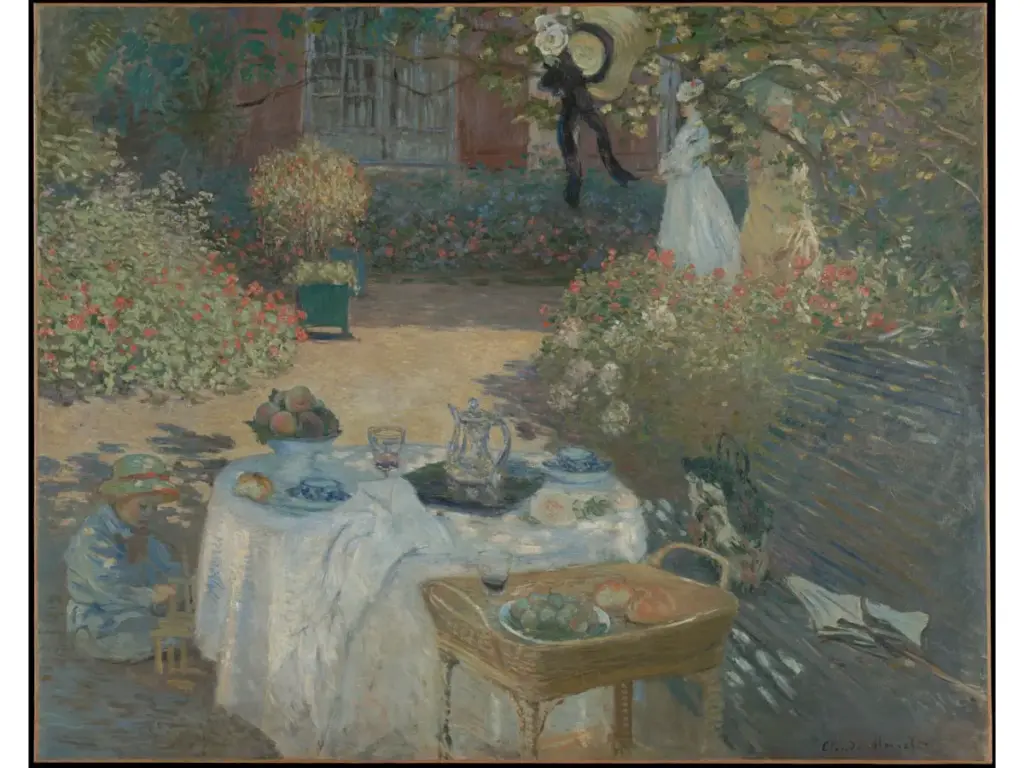
The Luncheon belongs to a celebrated series of garden scenes that Monet produced while renting a house in Argenteuil, a picturesque suburb located roughly 7.5 miles northwest of Paris. The finished canvas captures a tranquil, domestic moment immediately following a midday meal. The human guests have departed, and only quiet traces of their gathering remain behind. Measuring an expansive 5 feet 3 inches by 6 feet 7 inches, the painting places the artist’s young son, Jean, on the left side of the frame, while his first wife, Camille, walks leisurely in the background alongside a friend or neighbor. By pushing the figures to the periphery and leaving the center of the composition entirely empty, Monet created a striking psychological atmosphere defined by a profound sense of absence. A prominent garden bench cuts a strong diagonal through the space, anchoring the architectural and spatial structure of the garden—or at least, that is what generations of gallery-goers and scholars have assumed for over a century.
However, recent scientific scrutiny reveals that the painting underwent a much more convoluted and intricate process of transformation than its final, serene surface suggests. Beneath the top layer of paint, advanced imaging technology has uncovered a series of sweeping modifications that Monet made as he wrestled with the composition.

“The table itself was altered,” explained Johanna Salvant, a conservation scientist and PhD researcher at the C2RMF who was part of the specialized team that analyzed the canvas. “As for the trolley in front of it, with some bread and a wine glass, it was shifted to the right; and the fruit plate moved accordingly.”
These initial discoveries made via X-ray imaging prompted the research team to push further, utilizing transmitted infrared photography—a specialized technique that involves illuminating a canvas from behind to peer through successive layers of paint. This method confirmed the existence of additional figures that Monet had deliberately painted over. Originally, two women were seated together on the garden bench where now only a quiet arrangement consisting of a basket and a folded parasol rests.
Further details emerged under the infrared light. A floral motif that now appears as a bright rose was originally rounded in shape and may have been conceived by the artist as a piece of fruit. In an earlier iteration of the painting, young Jean stood with his back almost entirely turned away from the viewer, a stark contrast to the final composition where he is rendered in a three-quarter view, engaging the audience much more directly.
The examination went even further, revealing the ghosts of two more figures previously lost to art history: a shadowy form looming ominously in a window, and, positioned on the far left of the composition, a bearded man wearing a hat and standing in strict profile. Gilles Bastian, a heritage curator at the C2RMF, noted that Monet “subsequently expanded the flower beds, covering the figure almost entirely. The extension of the foliage seems to have been handled in a looser, somewhat more conventional manner.”
This hidden, bearded figure has inevitably sparked a thrilling debate among curators and scholars. Could this solitary profile be a rare self-portrait of the artist? A compelling comparison can be made with Pierre-Auguste Renoir’s 1873 painting Monet Painting in His Garden at Argenteuil, which is currently housed in the collection of the Wadsworth Atheneum Museum of Art in Hartford, Connecticut. Renoir’s portrait depicts Monet wearing a soft hat, though he faces the opposite direction of the figure hidden beneath the layers of The Luncheon.

“Monet scarcely ever painted himself, so if this is indeed a self-representation, it would be a major discovery,” said Anne Robbins, curator of paintings at the Musée d’Orsay.
Sylvie Patry, chief curator at the Orsay, added weight to the hypothesis. “The possible presence of Monet himself would place the work within a long tradition of artists inserting themselves into their compositions, often discreetly and at the periphery of the scene.”
Despite the excitement surrounding the finding, museum officials remain cautious. At this stage, the identification of the figure as a self-portrait remains strictly a hypothesis. Robbins emphasized that the scientific and historical research is still ongoing, noting simply, “We will need time to get to the bottom of these discoveries.”
This meticulous revision begs a fundamental question: Why did Monet painstakingly paint out these figures and alter his composition so drastically? One leading historical explanation points to the precarious circumstances surrounding the painting’s debut. Monet exhibited The Luncheon at the Second Impressionist Exhibition in 1876 under the unassuming title Decorative Panel. At the time, the artist was mired in financial difficulties and was aggressively seeking wealthy patrons and buyers who could support his career.
“Covering the figures may have contributed to making the painting more neutral and adaptable as a decorative object,” Robbins suggested.

If that calculated gamble was indeed Monet’s intention, the strategy appears to have paid off. Ernest Hoschedé—the prominent collector who acquired Impression, Sunrise (1872), the very canvas that gave the Impressionist movement its iconic name—likely encountered The Luncheon at that 1876 exhibition. That viewing may well have played a pivotal role in Hoschedé’s subsequent decision to commission Monet to create an ambitious four-panel decorative cycle for his grand château at Montgeron.
This revelation sheds vibrant new light on Monet’s artistic practice during the 1870s. While art history has long characterized this era as the dawn of pure Impressionism—where artists ventured outdoors to capture fleeting atmospheric effects directly onto canvas—The Luncheon reveals an artistic process that was far more experimental, deliberate, and layered. Rather than working with absolute spontaneity, Monet repeatedly reworked his canvases, repositioned human figures, modified everyday objects, and radically altered the spatial and emotional balance of his scenes through successive interventions.
This evidence of a deliberate, calculated construction process is not isolated to The Luncheon. Two other masterworks subjected to technical analysis by the C2RMF revealed similarly complex histories. The Magpie (1868–69), one of Monet’s most beloved snowy landscapes, originally depicted an entire row of three houses before the artist painted one of them out to make room for the solitary bird sitting prominently at the center of the composition.
Another technical triumph involved Women in the Garden (1866). Examination revealed that Monet had physically repaired the large canvas by stitching it back together with thread after a severe studio accident. According to historical accounts, in order to finish painting the towering upper reaches of that particular canvas, Monet was forced to dig a deep trench in his garden so that he could lower himself sufficiently to reach the top edge of the painting surface.
For The Luncheon, the current exhibition is merely a precursor to its next major chapter: the painting is officially scheduled to undergo a comprehensive conservation restoration beginning in late 2027. That painstaking process will undoubtedly yield further opportunities for scientists and curators to investigate its material history.

Until then, art enthusiasts eager to explore the evolutionary trajectory of the Impressionist master can visit the Musée d’Orsay’s exhibition, “I Spend My Life Painting.” The comprehensive display chronicles Monet’s career decade by decade, beginning with early landmark achievements like Women in the Garden and The Magpie, and guiding visitors forward to The Luncheon, alongside the other newly analyzed canvases such as The Thaw at Vétheuil (ca. 1880s) and the famous Cathedral series (1892–93).
“While the Musée Marmottan Monet holds the largest collection of Monet’s works in numbers,” Patry noted, “the Musée d’Orsay houses the most comprehensive ensemble, in the sense that it covers the different stages of his career and his changes in technique.”