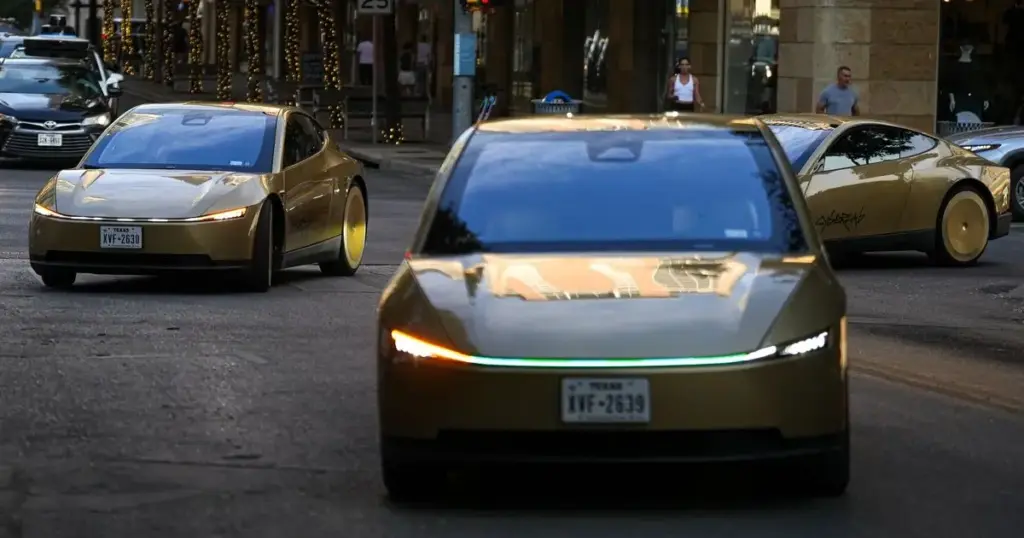
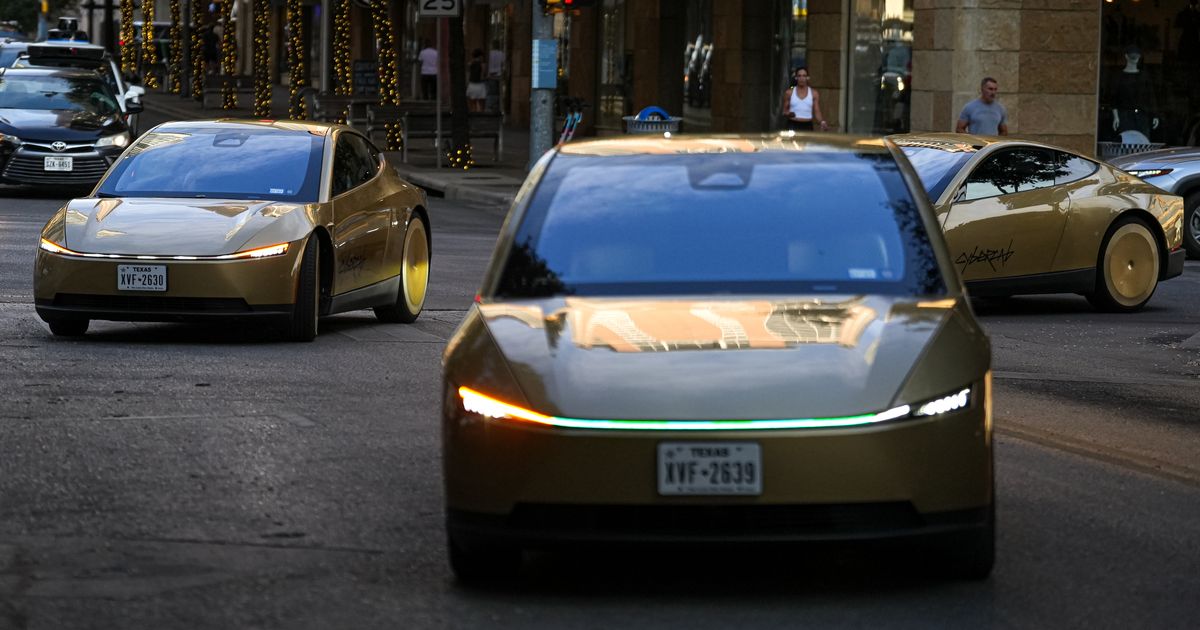
The Tesla Cybercab invasion is here, sort of. For eagle-eyed gearheads and dedicated Tesla enthusiasts navigating the hustle and bustle of New York City, a rare mechanical bird has recently begun making appearances across the five boroughs. Those stopping by Mount Sinai’s Chelsea medical center in late July may have stumbled upon one of these sights: a brassy gold Tesla Cybercab parked right across the street, capturing the attention of passersby and sparking immediate online chatter.
It remains unclear precisely when Tesla first let its futuristic-looking robotaxis loose on the city’s notoriously congested streets, nor is there a definitive count of how many are currently cruising around. However, documenting sightings of the vehicles—whether spotted along the Cross Island Expressway or gridlocked in Midtown traffic—has turned into a sport for urban spotters. These fleeting appearances serve as the latest tangible signs of the Blade Runner–esque future long promised by Elon Musk and his ventures into autonomous transportation.
Yet anyone expecting to be comfortably shepherded around the city by one of these blingy, futuristic two-seaters in the near term is bound to experience a significant letdown. While driverless Tesla Cybercabs have indeed begun zipping around cities in warmer, more accommodating southern markets like Florida and Texas—operating as part of autonomous robotaxi fleets devoid of steering wheels, brakes, and side mirrors—the reality in New York is starkly different. A spokesperson for the city’s Department of Transportation confirmed that the Cybercabs deployed locally are actually physical testers equipped with a conventional steering wheel, alongside standard gas and brake pedals. In fact, a Cybercab recently spotted by local media outlets featured a fully intact steering wheel with a human driver sitting directly behind it.
This glaring design discrepancy almost certainly stems from state law, which strictly requires a human operator to keep at least one hand on the steering wheel of any motor vehicle traveling on public roads. Beyond mere legal compliance, however, experts view this localized testing strategy with a healthy dose of skepticism. Missy Cummings, the director of George Mason University’s robotics and automation center, believes the New York tests are likely a deliberate strategy to gradually warm up local residents and lawmakers to the concept of fully driverless vehicle designs.
"Tesla first brings the safety-driven ones there to acclimate everyone, and then they hope to bring in the other ones," Cummings explains.
Introducing fully driverless vehicles to some of the most congested and chaotic streets in the country, however, could create severe logistical headaches. Cummings warns that removing human controls entirely creates a major hazard for emergency services. Without operators inside to move the vehicles out of the way, first responders would have virtually no immediate way of clearing them during an emergency situation. "This is a nightmare for first responders," she notes, questioning the wisdom of permitting such technology on crowded municipal corridors. "Why would you let that on your city streets?"
While the test models in New York do appear to feature some kind of hidden panel theoretically allowing human occupants to honk, steer, and reverse, at least one prominent automotive review test found that those alternative controls were not fully operational. Compounding these design concerns, Tesla is currently facing scrutiny at the federal level, with regulators probing whether the Cybercab’s omission of a steering wheel or traditional brake pedals in its fully autonomous tier violates established federal safety regulations.
The larger procedural question haunting these local appearances is how the Cybercabs were quietly loosed onto city streets even with their hybrid human controls intact. When Alphabet’s autonomous vehicle division wanted to test its Waymo Jaguars in Manhattan and Brooklyn, the company was required to navigate a formal bureaucratic process, securing explicit permits from both city and state transportation authorities. Those municipal permits eventually lapsed, forcing Waymo to halt its local testing operations while awaiting renewal.
Tesla, by contrast, has managed to largely avoid dealing with the traditional red tape because the company maintains that its Cybercabs are not operating anywhere close to a fully driverless state when deployed in restrictive environments. The city DOT spokesman noted that the Cybercabs spotted in recent weeks are operating under an "advanced driver assistance system," software that retains the capacity to hand off operational control to a human driver unexpectedly. This aligns with the suite of driver-assistance features Tesla already offers to the public, which theoretically permit human override at a moment’s notice.

Elsewhere in the country, however, the narrative is entirely different. Tesla is actively marketing the vehicles to consumers as a driverless chauffeur service that can be hailed directly via a mobile application. Reviewers of that service have offered colorful descriptions of the ride experience, with one comparing it to being chauffeured by a "slightly stoned teenager." Simultaneously, Tesla has begun opening up fleet sales to commercial entities interested in purchasing vehicles to run their own private robotaxi companies.
Matt Wansley, a law professor at Cardozo School of Law who specializes in artificial intelligence and automated driving regulations, suggests that maintaining a cryptic stance regarding the true autonomy of its vehicles is a textbook maneuver for Tesla. The company routinely markets itself to consumers as being right on the precipice of achieving fully automated driving capability, yet when interacting with government regulators, it adopts a much more conservative posture, describing the exact same technology merely as a driver-assistance system.
"It’s clear that the intent of Tesla is to build an automated driving system," Wansley observes. "They just don’t want to say that because it would trigger all these regulatory requirements that they don’t want to deal with."
By executing a stealth pilot program under the guise of supervised driver assistance, Tesla is managing to secure what may be its most valuable asset for future development: real-world driving data harvested directly from the complex, unpredictable laboratory of New York City’s streets.