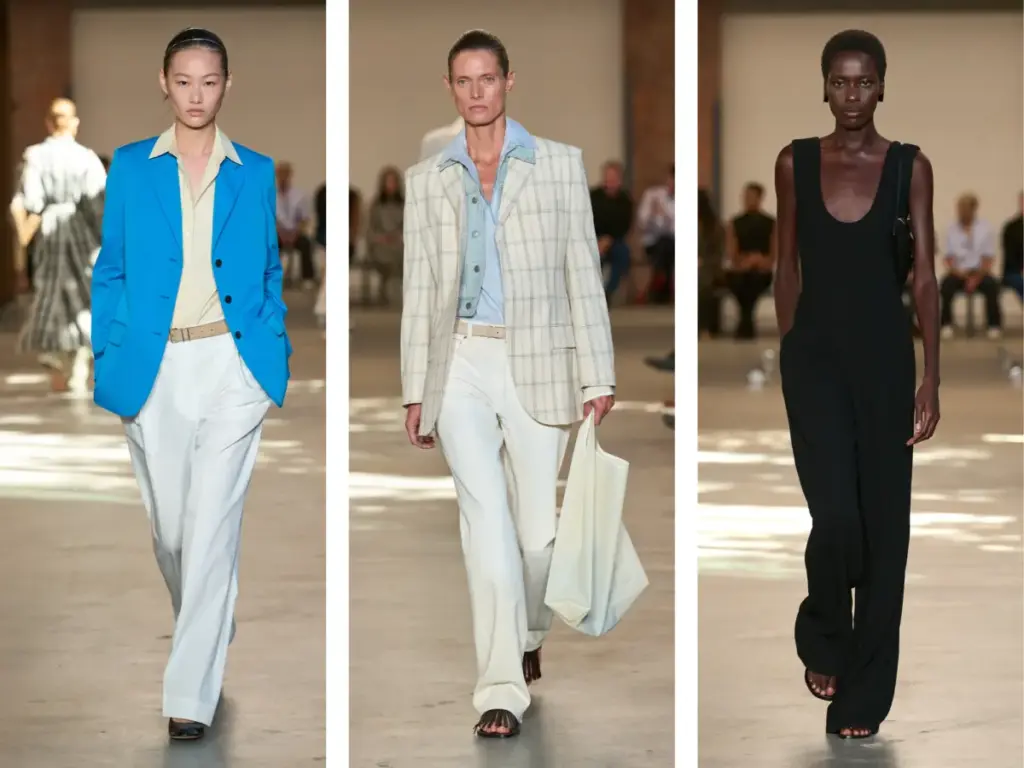
Calvin Klein’s creative director, Veronica Leoni, is firmly injecting high art back into the heritage American brand. At the house’s spring runway show held last Friday during New York Fashion Week, the cavernous, industrial spaces of the Terminal Warehouse in Manhattan’s Chelsea neighborhood were transformed into a minimalist gallery space, where monumental sculptures by Walter De Maria were thoughtfully scattered among the seating arrangements and runway pathways.
Leoni, who assumed her role at Calvin Klein in 2024, designed her fourth collection for the brand as a deep, expansive exploration of the American Minimalism movement—an artistic landscape with which De Maria is historically and profoundly associated. The presentation was more than just a backdrop; it was an intentional dialogue between three-dimensional space, industrial sculpture, and the human form.
“American Minimalism was a discipline of removal: take away everything that does not carry the work, until only what is necessary remains,” Leoni said in an official statement outlining her design philosophy for the collection. “Calvin drew from that and turned it toward the body. I turn it toward the woman inside it. My minimalism begins there, in the relation between design and a body, with nothing in between. Take everything away. What is left is desire.”
The careful curation of De Maria’s formidable sculptures was organized by Gagosian director Antwaun Sargent, whose expertise bridged the worlds of contemporary art and high fashion for the high-profile event.
“I first became involved through a meeting with Veronica, when she shared the show’s theme of American Minimalism and asked me to curate the art for the space,” Sargent explained in an interview with Wallpaper Magazine. “Given the iconic setting of Terminal Warehouse, Walter De Maria immediately felt like a natural choice. As a key figure of American Minimalism, with landmark New York installations such as The New York Earth Room (1977) and The Broken Kilometer (1979), his work offered a compelling dialogue with Calvin Klein and the architecture of the space.”
Sargent handpicked a series of striking steel works by De Maria to anchor the runway experience. Among the pieces on view were Truth / Beauty (1990–2016), 14-Sided Open Polygon (1984), 16-Sided Open Polygon (1984), and 13, 14, 15 Meter Rows (1985). According to the curator, each piece was chosen because of how it complements the surrounding environment and embodies the foundational principles of the artistic movement.
“[They all] speak to De Maria’s fascination with geometry, repetition, and mathematical order, while their polished steel surfaces interact with the architecture, light, and movement of the fashion show,” Sargent noted.
However, De Maria was not the sole artistic reference point that Leoni drew from for her latest seasonal offering. In addition to the towering steel polygons and rows, the collection’s color palette spanned a meticulous range of hues. Clean whites and deep blacks laid the groundwork, while vibrant splashes of scarlet, bright yellow, royal blue, cherry, and light citron added stark visual contrast. Perhaps most notably, the collection also featured a specialized check print that was directly drawn from the personal wardrobe of legendary modernist painter Georgia O’Keeffe, grounding the garments in yet another pillar of American artistic history.
Leoni’s strategic pivot back toward the art world recalls previous historic eras at Calvin Klein when high-end contemporary art was fused directly with the identity of the American sportswear label. Most notably, when Raf Simons—now co-creative director at Prada—served as the chief creative officer of Calvin Klein from 2016 to 2018, he famously established a direct partnership with the Andy Warhol Foundation for the Visual Arts. This collaboration gave Simons free access to the extensive Warhol archives, materials that he regularly borrowed and reinterpreted for his runway presentations. During his tenure at the helm of the brand, Simons also engaged in celebrated creative dialogues and collaborations with prominent contemporary artists and designers, including Sterling Ruby, Peter Saville, and Richard Prince.
By bringing Walter De Maria’s sculptures into the heart of the Terminal Warehouse and anchoring her design ethos in the uncompromising tenets of American Minimalism, Leoni is signaling a clear return to that elevated lineage. In doing so, she is positioning Calvin Klein not merely as a purveyor of commercial American apparel, but as an active participant in an ongoing, sophisticated conversation between contemporary fashion and the visual arts.