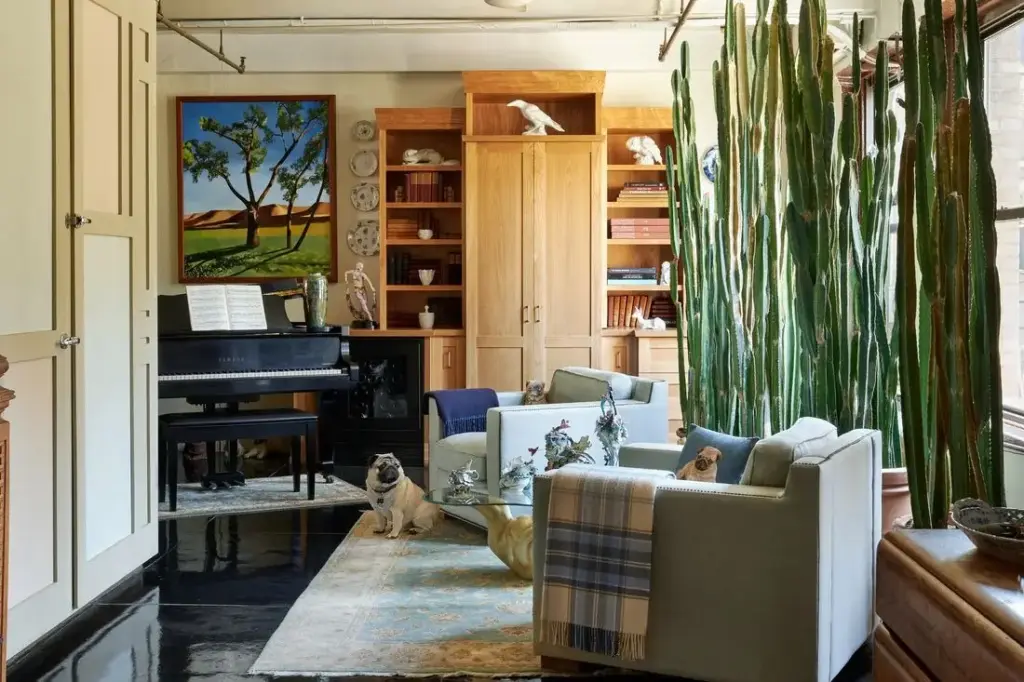
Directly across the street from the bustling energy of Madison Square Garden, tucked thirteen stories above the asphalt and yellow cabs of Midtown Manhattan, lies an unexpected urban sanctuary. Inside a former fur atelier, artist Bill Farmer and retired modeling-business executive Stewart Rahtz have spent nearly half a century cultivating a 2,000-square-foot loft that serves as both a sprawling art installation and a private botanical garden. Overlooking the iconic arena and the dense urban grid of central New York City, the loft offers a masterclass in adaptive reuse, endurance, and creative domesticity.
Upon stepping through the front door, visitors are immediately met by an unusual architectural barrier: a towering wall of giant, spindly cacti that mask the expansive south-facing windows. Rather than opting for standard window treatments, the couple deployed desert flora to solve a functional problem. "They were meant to provide shade without having to bother with curtains, which we found never worked," explains Stewart Rahtz. What began in the early 1980s as a modest, six-inch starter plant found abandoned on the side of a New York City street has steadily expanded over the decades. Today, that original specimen—alongside a growing collection—stretches all the way up to the loft’s high ceilings. "They just grow and grow and grow," Bill Farmer notes.
The couple’s long tenure in the building began in 1980, when Farmer spotted a classified listing in the Village Voice. At the time, the neighborhood bore little resemblance to its current commercial incarnation. The 1927 building, once entirely dedicated to the fur trade, had seen most of its furriers displaced by music studios. The surrounding streets were notoriously rough, marked by open drug activity, prostitution, and regular patrols by the Guardian Angels.
Securing the lease was a daunting financial gamble for Farmer, who exhausted his entire savings to make the move. He admits to feeling deeply nervous about committing to a landlord and a space with a dubious prior tenant. Seeking professional reassurance, Farmer took advantage of a television promotion by Jacoby & Meyers, a law firm famously advertising free legal consultations. "I went and the lawyer told me, ‘Do it. In 20 years, you will be the envy of every friend you have,’" Farmer recalls.
Taking possession of the loft required intensive physical labor. Farmer and Rahtz cleared out the derelict space themselves, taking sledgehammers to the interior walls. Among the remnants of the building’s past industrial life was a heavy vault that had once been refrigerated to store delicate animal pelts.
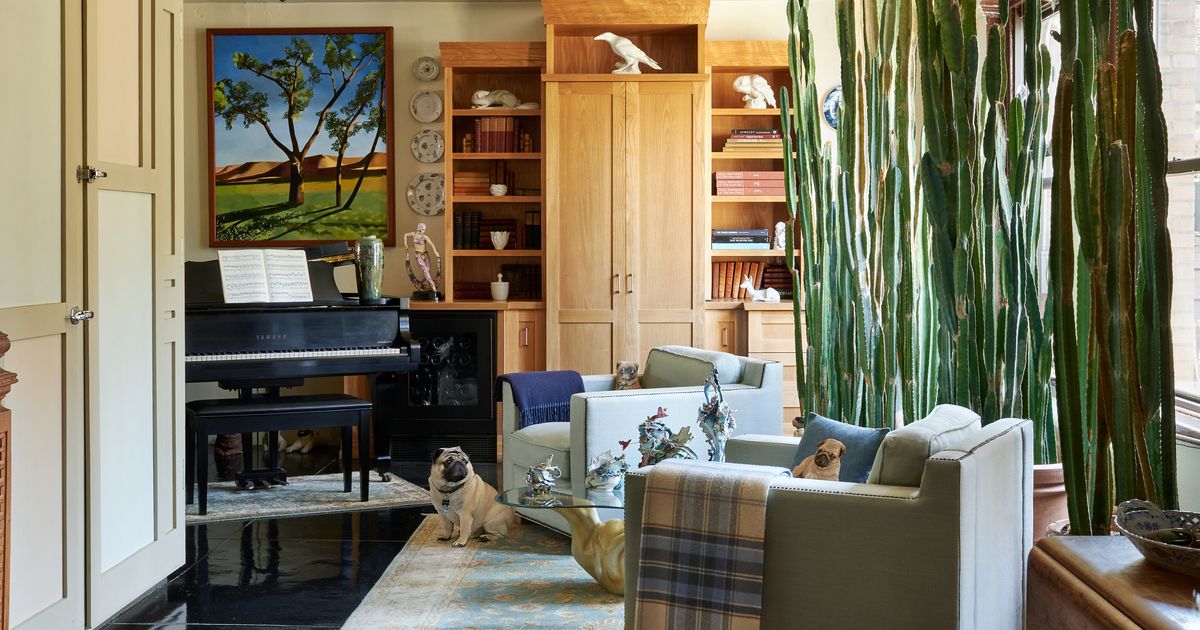
Once the structural overhaul was complete, the pair filled the cavernous interior with a mix of industrial elements, contemporary art, and deeply personal family heirlooms. Some of the furnishings trace back to Farmer’s upbringing in Kansas, where his father worked as an oil wildcatter. Other hand-me-downs arrived from Rahtz’s relatives, including pieces from his maternal grandfather—a former vaudevillian who founded his own motion picture company in Astoria during the 1910s.
During the height of Rahtz’s career in the fashion industry, the loft was famous for its vibrant summer gatherings. When the weather permitted, the party would spill out onto the building’s private terrace, hosting upwards of a hundred guests. "For a while, we were known for these parties," Rahtz says. "We’d fill the tub with vodka and Champagne and have more than 100 people over."
In the decades since, the pace of their social calendar has shifted. While they still maintain the Midtown loft to catch up on the city’s theater scene and cultural offerings, much of their entertaining has moved up to a secondary home in Woodstock, New York. When they are not in the city, the couple travels extensively, returning from trips with Venetian, Sri Lankan, and Burmese masks and artifacts that now punctuate the loft’s interior design.
As for the botanical centerpiece of the apartment, the desert plants require remarkably little intervention. Maintained through minimal human interference, the cacti are largely self-sufficient. "They get watered twice a year. That’s it," Farmer says. The infrequency of their care is punctuated by rare, dramatic moments of vitality. "They bloom for one evening, and the scent is so fragrant it lasts until the sun comes up."
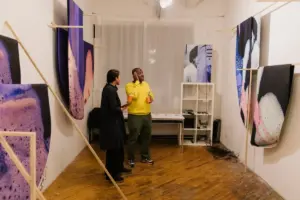
Throughout the loft, the interior reflects a collaborative history of art and hospitality. The entry sets a distinct visual tone with murals painted by David Friday, who once stayed at the apartment while the owners were away on vacation. "He just stayed here one time when we were on vacation, and we came back to this," Farmer explains, gesturing to the expansive wall art. Farmer himself contributed a nude painting positioned above a dresser, while an antique bed frame imported from Portugal is dressed with a handmade quilt crafted by Farmer’s mother.

Other spaces within the 2,000-square-foot home blend utilitarian history with whimsical design. The kitchen features an unexpected centerpiece: a vintage bathtub left over from a photography shoot by a former neighbor down the hall. Elevated slightly to accommodate proper drainage, the tub is occasionally pressed back into its original function, though it is more frequently utilized during parties to chill bottles of liquor.
In the bathroom, another Friday mural is layered with masks and cultural objects collected from the couple’s international travels, including an elephant carving from Sri Lanka and a dragon from Bali, juxtaposed against a standard sink basin from Home Depot. Nearby, a seating area displays 1960s swivel armchairs salvaged from Farmer’s family home in Kansas, originally upholstered in green vinyl. A striking doll figure named "Chloe" sits nearby—one of several created by the late Dustin Poché, who served as the visual director for the boutique Jeffrey. Farmer notes that Poché meticulously crafted everything for the figures, including miniature bags, shoes, clothing, and hand-sculpted ceramic faces.
The main bedroom continues the artistic narrative with a mermaid headboard and ambient fish-string lighting, both crafted by Friday, paired with a dresser that once belonged to Rahtz’s father.
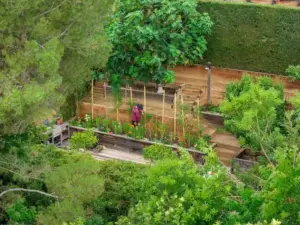
Outdoors, the expansive terrace provides a breath of fresh air above the dense Midtown grid. Recently replanted following structural code compliance work mandated by city workers, the outdoor space features a tricolored willow tree, a red maple tree, and an array of seasonal annuals, offering a quiet, green retreat alongside their dog, Doyle, where the couple looks out over the unchanging rhythm of New York City below.