Fashion shows typically begin with a straightforward, predictable diagram. Models move along a prescribed linear path, its edges strictly lined with rows of expectant spectators, and everyone in the room knows precisely where to look. In general, this basic layout has remained remarkably consistent across the history of modern couture. Yet some of the most striking and enduring runway sets in fashion history begin by intentionally disturbing that diagram, dismantling the traditional architecture of the presentation to challenge how clothes are seen and experienced.
Across four decades, visionary designers and pioneering scenographers have continually reimagined the spatial dynamics of the presentation. They have buried the traditional catwalk beneath the floorboards, broken it apart into an intricate grid, or completely removed the act of walking all together. In these groundbreaking shows, set design shapes much more than just a decorative backdrop. It actively determines when a model appears, how long they remain visible to the public, and how the garment is framed in space. It can even dictate whether two viewers sitting mere feet apart experience the exact same visual sequence. During this season of fashion weeks, as the industry reflects on its spatial evolution, it is worth returning to the pivotal moments where the runway itself became an integral part of the choreography.
Thierry Mugler Turns the Catwalk into an Arena
For Thierry Mugler’s fall 1984 show at Le Zénith in Paris, the runway unfolded through the massive concert venue like a sprawling pair of wings. It stood as one of the earliest examples of a runway presentation daring to dream far beyond the quiet, standard setup of the traditional salon. More than 6,000 people filled the expansive room, including paying members of the general public, effectively pushing the fashion show far beyond the exclusive scale and intimate confines of the usual industry presentation. Models could appear at various, unpredictable points across the extended stage, and the audience watched the spectacle from a wide, arena-style field instead of a narrow strip right beside the garments.
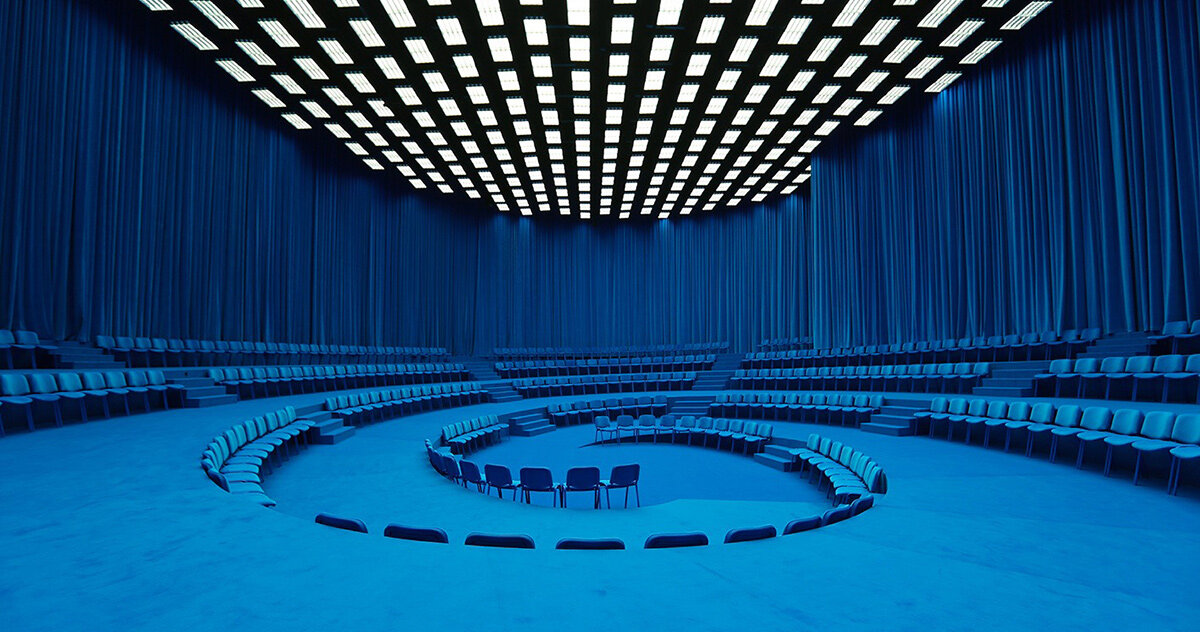
The ambitious plan suited Mugler’s inherently theatrical design language, but its primary effect was spatial. Distance suddenly became an active part of the show’s composition. A figure could first register merely as a silhouette from across the vast arena before gradually moving closer into sharp view, while the runway reached outward aggressively toward the spectators instead of holding them captive along one straight, rigid edge. The traditional catwalk had been stretched and transformed into something much closer to a structural diagram for a crowd.
Maison Martin Margiela Shares the Runway with Its Audience
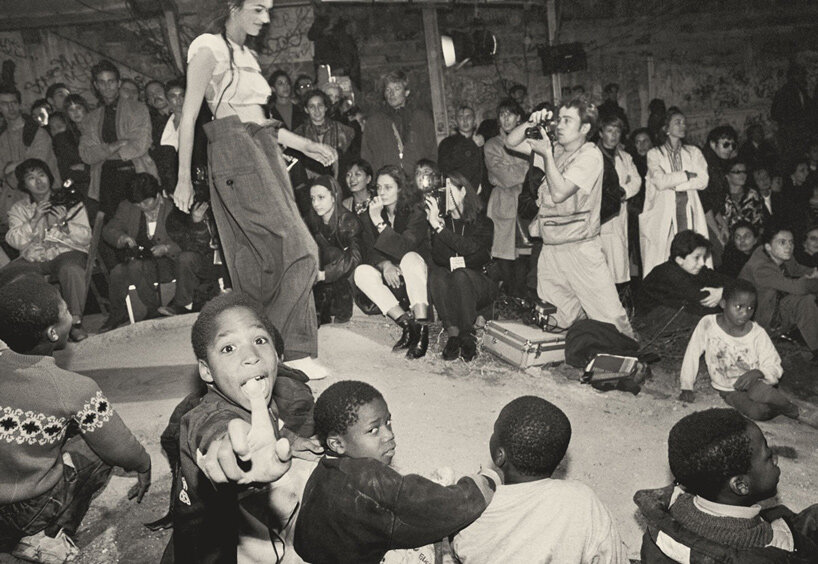
Maison Martin Margiela’s spring/summer 1990 show, presented in the fall of 1989, moved fashion directly onto a public playground located in Paris’s 20th arrondissement. Local neighborhood children sat casually along the dirt paths, then began moving freely among the models as the presentation continued. The route never hardened into a polished, elevated runway. Instead, it remained simply a part of the everyday ground that everyone in the space was already occupying.
The resulting photographs are entirely transformed because of that deliberate looseness and accessibility. Models pass remarkably close to seated guests, children naturally enter the photographic frame, and the traditional boundary between passive watcher and active participant keeps continually shifting. The runway becomes shared territory. Rather than maintaining a protected, sterile corridor cut cleanly through a seated audience, Margiela worked with a fluid path that could be crossed, crowded, and briefly taken over by the life happening around it.
Viktor & Rolf Stop the Runway Entirely
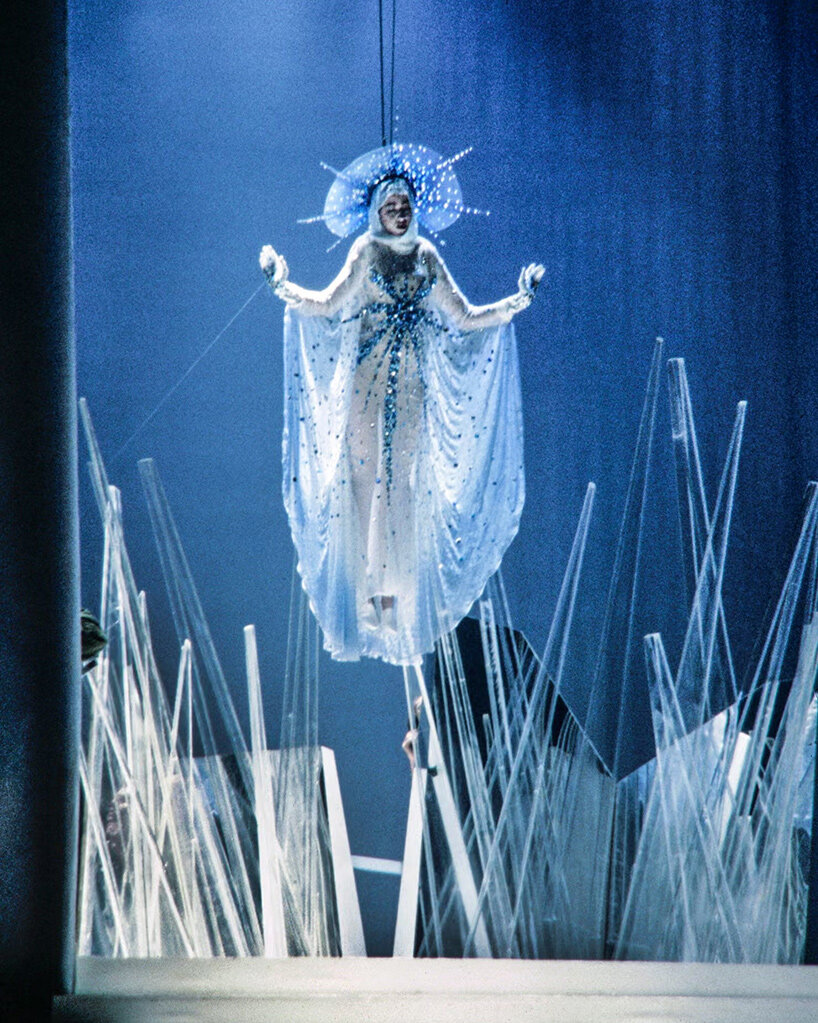
Viktor & Rolf pushed the conceptual framework of the presentation in an entirely different direction for their fall 1999 couture collection, aptly titled Russian Doll. Model Maggie Rizer stood entirely still on a rotating platform while designers Viktor Horsting and Rolf Snoeren dressed her layer by layer, meticulously building the entire collection onto a single human body. There was no traditional procession of models moving sequentially past the audience. Instead, the audience kept returning its focused gaze to the exact same fixed point.
The rotating platform turns the usual relationship between clothing and movement completely inside out. Rizer stays almost entirely stationary while the silhouette continuously expands and transforms around her, and the show advances forward through spatial accumulation rather than linear distance. The traditional catwalk has effectively collapsed into a circle just a few feet wide, proving that forward momentum in fashion does not necessarily require a journey down a long plank of wood.
Alexander McQueen Turns the Gaze Back on the Room
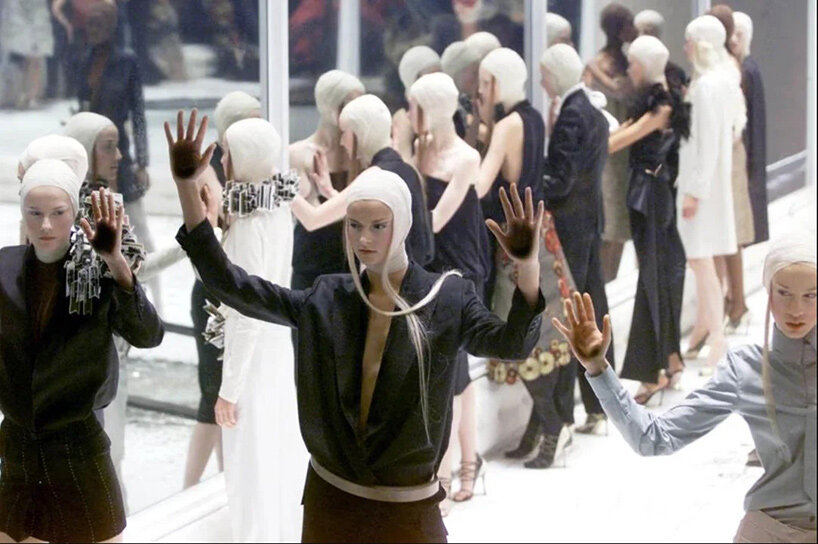
Alexander McQueen’s spring/summer 2001 show, Voss, begins long before a single model actually appears before the public. Guests sit in silence around a massive, imposing two-way mirrored box, instantly forced to see their own reflections staring directly back at them. Once the lighting shifts dramatically, the interior of the box becomes visible from the outside, while the models trapped inside remain entirely unable to see the audience watching them.
McQueen takes the inherent separation already built into the architecture of a runway and makes it painfully physical. The model route is strictly contained inside the mirrored box, the spectators stay safely outside it, and the glass itself controls precisely who gets to see whom. The audience shifts uncomfortably from watching its own image to observing vulnerable bodies that cannot return the gaze. Few runway designs in fashion history have ever made the underlying mechanics of spectatorship quite so visible.
Prada Breaks the Front Row into a Field
For Prada’s men’s spring/summer 2012 presentation, AMO treated seating and the catwalk as a completely unified plan. Six hundred guests sat on individual blue foam blocks spaced evenly across a rigorous 1.5-by-1.5-meter grid, while models followed several tightly choreographed routes through the negative spaces between them. Artificial grass covered the hard floor, turning the industrial hall into a strangely ordered, surreal field.
There is no single runway edge left to claim. A model might pass directly beside one spectator, then turn sharply through the grid and move toward another person across the room. From an aerial perspective, the set reads almost like graph paper densely filled with people. At eye level, it creates a sequence of brief, intimate encounters. The audience is no longer arranged merely around the route; it actively helps form the route itself.
Anya Hindmarch Hides a Spiral Beneath the Floor
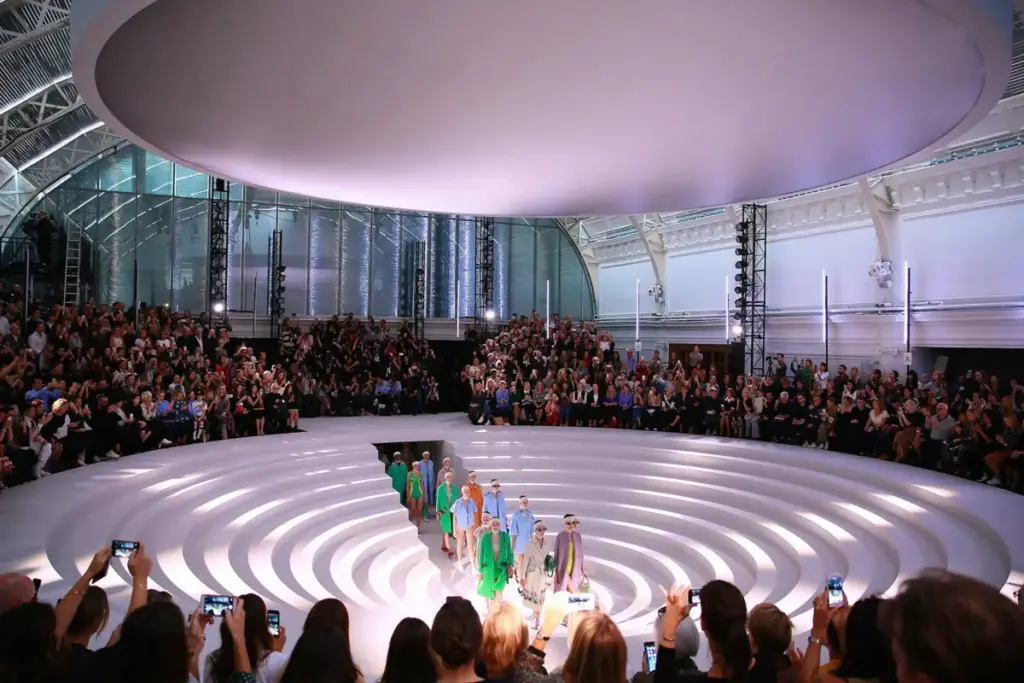
At first glance, Anya Hindmarch’s spring/summer 2017 set looked deceptively empty. A pristine white circular platform sat quietly within the historic Royal Horticultural Halls in London. When the show finally began, the platform lifted dynamically to reveal a sunken amphitheater and a hidden spiral path beneath it, with a model ascending slowly through the newly opened center. Overhead, a massive circular canopy rotated and tilted as the presentation progressed.
The surprise works so effectively because the runway begins as concealed architecture. Its route appears only once the floor physically moves, turning an apparently flat stage into a complex section of ramps and structural levels. Models circle upward through the open space, and spectators read their movement across both depth and distance. The runway is not simply presented; it is discovered in real-time during the unfolding of the show.