The global architecture and design community is entering a vibrant season of cultural exploration, marked by major international exhibitions, the adaptive reuse of industrial and educational infrastructure, and thought-provoking retrospectives. From London and Washington, D.C., to Karlsruhe, Germany, and Weston-super-Mare in the United Kingdom, cultural institutions are presenting diverse programming that bridges historical avant-garde movements with contemporary environmental and social discourse.
In London, the Design Museum has launched a sprawling, comprehensive exhibition that delves into the foundational roots of Surrealist art and design while examining how contemporary creators continue to respond to the movement’s legacy. Curated in close collaboration with the Vitra Design Museum in Germany, the landmark exhibition brings together an eclectic array of furniture, interior design pieces, fashion items, photography, and fine art. The showcase spans generations, featuring visionary 20th-century figures such as Salvador Dalí and Man Ray, alongside recent cultural tastemakers, including couture fashion houses Schiaparelli and Dior, as well as renowned Icelandic musician Björk. By exploring how irrationality, the subconscious, and uncanny juxtapositions have influenced decades of material culture, the exhibition offers visitors a deep dive into the enduring allure of Surrealism.
What’s Going On
The contemporary art landscape in the United States has expanded significantly with the arrival of a major new cultural destination in the nation’s capital. Collectors Don and Mera Rubell, who have been passionately acquiring contemporary art since 1965, currently maintain one of the largest and most wide-ranging private collections in the world. Following the landmark opening of their first museum in Miami in 1993, the Rubell Museum family has expanded with the launch of a second institution this month in Washington, D.C. Housed in a sprawling 32,000-square-foot space, the new museum occupies a former public high school that underwent an extensive renovation led by architecture firm Beyer Blinder Belle.
In a thoughtful nod to the building’s local history, the inaugural exhibition takes its title from a celebrated 1971 album by Marvin Gaye, who is an alumnus of the former school. The inaugural presentation features more than 200 works created by 40 distinct artists. Among the exhibition’s centerpieces is a striking 20-part ink-and-gouache series by Keith Haring, which the artist famously completed in a single continuous sitting while listening to the music of Marvin Gaye and Bob Marley.
Meanwhile, in Karlsruhe, Germany, the ZKM | Center for Art and Media is hosting the first-ever solo exhibition dedicated to the work of high-rise architect Ole Scheeren. Founded in 2010, Scheeren’s eponymous firm has gained international acclaim for monumental and experimental building projects that redefine urban density and human interaction. The German-born architect, who originally began his career at Rem Koolhaas’s OMA office in Rotterdam, is widely recognized for his visionary designs, including the award-winning China Central Television (CCTV) Station in Beijing and the interlocking residential volumes of The Interlace in Singapore. The winter exhibition, titled Ole Scheeren: Spaces of Life, offers an intimate look at the conceptual processes and architectural philosophy driving his transformative urban interventions.
Ongoing Exhibitions
In London, architectural discourse is turning toward ecological stewardship and sustainable futures through a notable exhibition currently on view at the AA Gallery. Curated by the Bologna-based practice Mario Cucinella Architects, the exhibition is titled The Future is a Journey to the Past: Stories about Sustainability. The showcase critically examines the evolving concept of sustainability and investigates how contemporary architecture can effectively counter the mounting conflicts between natural ecosystems and human environments. Visitors are greeted by a comprehensive timeline that traces the historical evolution of environmental stewardship and social activism, complemented by a curated selection of built and unbuilt projects by Mario Cucinella Architects that exemplify innovative sustainable building practices.
The exhibition draws its primary inspiration from principal Mario Cucinella’s book of the same name, published earlier this year. In the publication, the architect reflects deeply upon ten distinct journeys to cities and regions around the world, offering speculative insights into how modern society consumes finite natural resources and how the built environment must adapt in the decades to come.
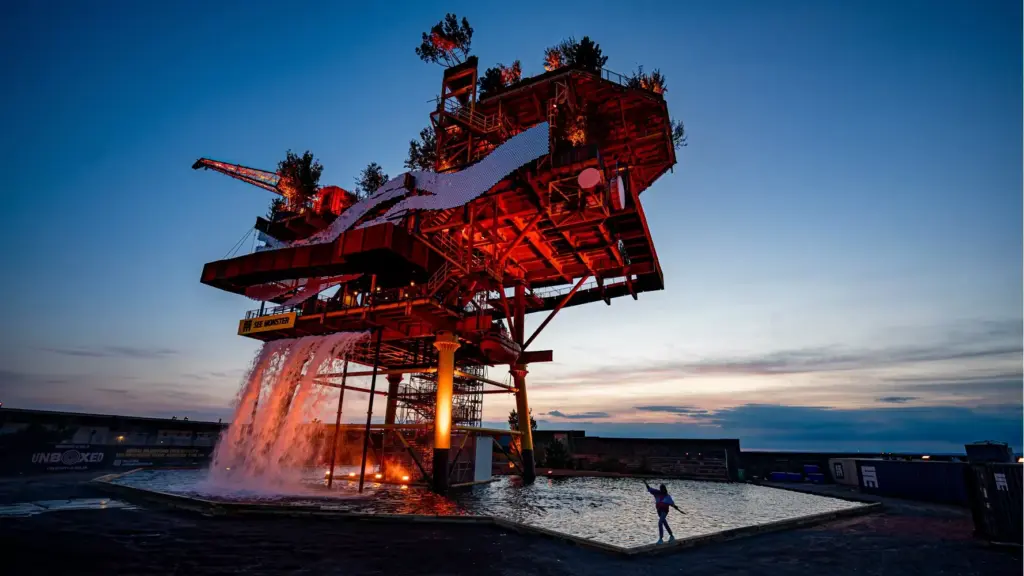
Along the coast of North Somerset, England, a striking feat of adaptive reuse is drawing visitors to the seaside town of Weston-super-Mare. Titled See Monster, the project transforms a retired North Sea oil rig into one of the United Kingdom’s largest public art installations. Conceived by the design studio Newsubstance, the massive structure spent much of the summer floating around the British Isles before finally docking in the Bristol Channel.
Visitors navigating the installation are invited to pass directly behind a dramatic water feature that cascades downward from the lower platform, granting access to four distinct stories of interactive elements. Among these features are a multi-level slide, a seated outdoor amphitheater, and elevated gardens populated by resilient coastal flora. Developed specifically for the nine-month-long Unboxed Festival, See Monster stands as a powerful testament to the potential for adaptive reuse, demonstrating how obsolete industrial infrastructure can be creatively repurposed for public engagement, education, and community enjoyment.
Back in London, the Korean Cultural Centre UK has partnered with the Art Center Nabi in Seoul to present Our Friendly Neighbors, an exhibition highlighting innovative new works by contemporary Korean artists Yiyun Kang, Bang & Lee, and Jinjoon Lee. The selected installations focus heavily on the intricate intersections between art, emerging technology, and the environment. Together, these works re-examine the fragile boundaries of community and human connection in the wake of the COVID-19 pandemic and an era of accelerating globalization.
In New York City, the Irwin S. Chanin School of Architecture at Cooper Union is hosting Model Behavior, an expansive exhibition featuring more than 70 works by 45 distinct artists and architects, including prominent figures such as Olafur Eliasson, Peter Eisenman, Eyal Weizman, and Greg Lynn. Curated by the collaborative group Anyone Cooperation, the exhibition probes a fundamental question: how do architectural models actively reflect and contribute to changing social behaviors well beyond the traditional realm of design?
On the West Coast, the Santa Barbara Museum of Art is currently presenting the first solo museum exhibition dedicated to the award-winning architect Marshall Brown. Titled The Architecture of Collage: Marshall Brown, the show features 25 of the architect’s provocative collages. Brown refers to these intricate artworks as chimeras—named after the mythical Greek creature composed of a lion, goat, and snake—because they are constructed using photographic fragments of existing buildings that are cut and recombined to generate entirely unprecedented architectural forms.
Events
Cultural preservation and architectural history are also taking center stage in the United States, where the Neon Museum in Las Vegas is hosting a specialized multi-day event. Designed by the celebrated mid-century modernist architect Paul Revere Williams, the museum grounds serve as the fitting backdrop for Duck Duck Shed: Celebrating Las Vegas Architecture, Design, and Culture. The four-day program is dedicated to celebrating the decades of radical architectural innovation that define Las Vegas, with a particular focus on the evolution of hospitality design. The event features a lineup of expert speakers, including renowned urban planner Alan Hess and architect Jon Sparer, the creative minds behind iconic destination resorts such as the Mirage, Paris Las Vegas, and the Bellagio.
Competitions
Looking ahead to the upcoming spring, the architectural products industry has launched a major creative challenge for the next generation of designers. Leading surfacing manufacturer Formica has officially opened submissions for its annual Student Innovation Competition. The 2023 design challenge calls upon eligible students to submit a detailed color rendering alongside a comprehensive project statement for an original furniture design heavily informed by the design concept of maximalism. To qualify, student submissions must incorporate three or more products from the Formica or FENIX brand portfolios, including at least one designated material from the recently released SurfaceSet 2022 collection.