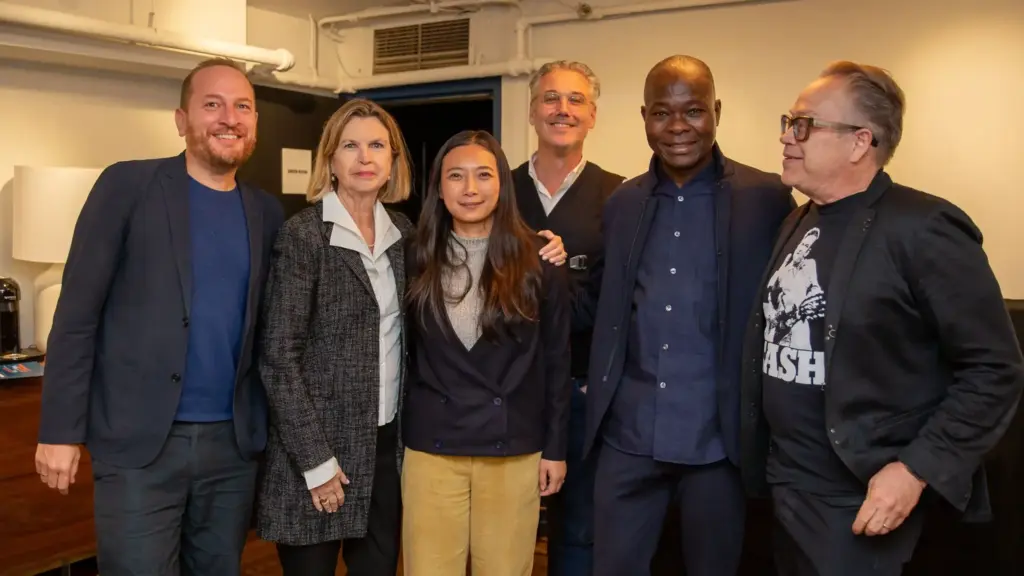
On Wednesday, the architectural community converged both physically and digitally to explore the evolving intersection of design, urbanism, and societal responsibility. Approximately 200 people gathered at the French Institute/Alliance Française in Manhattan, while more than a thousand others tuned in remotely to participate in Architectural Record’s annual Innovation Conference. Marking the first time the event has been held in-person since 2019, the conference was organized around the timely and expansive theme “Architecture and Its Alternatives.”
The day’s presentations, delivered by a robust lineup of globally renowned architects and designers, challenged traditional professional boundaries. Speakers examined how the built environment can better address pressing global crises, ranging from climate change and resource scarcity to housing affordability, social equity, and community preservation.
The conference kicked off with a presentation by architect Marlon Blackwell, whose opening talk was appropriately titled “Radical Practice.” For Blackwell, careful consideration of place and lived experience has always remained fundamental to every design endeavor. Since founding his practice, Marlon Blackwell Architects, in Fayetteville, Arkansas, in 1992, his portfolio has consistently been marked by dramatic, expressive forms. These projects draw rich inspiration in both color and materiality from their surrounding environments across a wide variety of scales and budgets. During his session, Blackwell discussed several recent projects, highlighting the intricate design considerations behind the Thaden School in Bentonville, Arkansas, and the Marygrove Early Education Center in Detroit.
Continuing the focus on site-specific design and ecology, Huang Wenjing of OPEN Architecture delivered a presentation centered on the early stages of the Beijing-based firm’s design process. Wenjing emphasized an overarching ethos that actively fosters harmony between the built and natural worlds. Discussing the UCCA Dune Art Museum on China’s eastern coast, she detailed how she and her partner, Li Hu, grappled with the fragile landscape of coastal sand dunes. Rather than altering or destroying the delicate topography, the architects embedded the 3,000 square feet of galleries entirely underground, thereby preserving the natural dunescape. Wenjing also shared insights into other ventures, including the Chapel of Sound in a mountainous region of Hebei Province—which served as Architectural Record’s December 2021 cover story—and a proposed scheme for the Shenzhen Maritime Museum. She concluded her talk with a timeless piece of advice drawn from Confucius: “What we do not want to happen to ourselves, we should not inflict on others.”
The conversation then shifted from large-scale cultural and institutional projects to the realm of adaptive reuse and urban community spaces. Paloma Strelitz, a co-founder of the Turner Prize-winning collective Assemble, discussed how her background in adaptive reuse, installations, and urban design has informed her current work as Creative Director at Patch. This emerging startup aims to facilitate coworking and other dedicated spaces for communities to gather and convene. The work of Assemble has historically ranged from transformative interventions, such as turning an old gas station into a neighborhood movie house, to creating the collective’s own homebase, Sugarhouse Studios, which provides affordable studio spaces in east London. With Patch, Strelitz and her colleagues plan to prototype coworking and community spaces to help neighborhoods and towns improve work-life balance and reduce long commutes.
Public infrastructure and the civic life of cities were brought to the forefront by Carol Ross Barney, winner of the 2022 Architectural Record Women in Architecture Award. Known widely for her transformative public infrastructure projects in her beloved hometown of Chicago—most notably the celebrated Chicago Riverwalk—Barney used her time on stage to argue for the enduring value of cities as beacons of efficiency. She underscored the critical importance of creating healthy, equitable, and sustainable infrastructure within urban centers. Using her designs for Chicago’s Morgan Street transit station, which incorporates durable polycarbonate and glass, and the Cermak-McCormick station, featuring a steel perforated shingle tube, Barney demonstrated how the best design solutions are deeply integrated. She also emphasized the vital role of continuous community engagement in shaping successful public infrastructure.
Representing the only virtual presentation of the day, architect Bjarke Ingels of Bjarke Ingels Group (BIG) expanded the scope of the conference to a truly global scale. Ingels discussed a myriad of pressing environmental pressures, touching upon carbon emissions, solar energy capture, pipeline infrastructure, and resource extraction. Utilizing lively and engaging graphics to illustrate his points, he acknowledged that some observers might perceive the firm’s broad and ambitious approach to environmental concepts as somewhat megalomaniacal. However, he countered this critique by stating his belief that humanity cannot find viable solutions without first thinking big. As prime examples of architecture born from this expansive vision, Ingels presented the recently completed Google Bay View Campus in California, alongside a striking cross-shaped furniture factory nestled in the Norwegian forest designed to generate 55 percent fewer emissions than a traditional facility. He concluded by imploring the audience to visit the firm’s website to explore its “Plan for the Planet,” an initiative aiming to serve as a comprehensive, Wikipedia-style knowledge base of sustainability for designers worldwide.
Bringing a crucial perspective on cultural heritage and preservation, Monica Rhodes addressed the audience on the intersections of community engagement, public lands, and philanthropy. A former Loeb Fellow at Harvard’s Graduate School of Design and currently a fellow in historic preservation and conservation at the American Academy in Rome, Rhodes has dedicated over 15 years to her field. She discussed her ongoing efforts to diversify and democratize the historic preservation sector, noting that fewer than 15 Black, Indigenous, and People of Color (BIPOC) women currently work professionally in preservation in the United States. “What is preserved depends on who is at the table,” Rhodes asserted. By intentionally expanding the involvement of diverse groups, she challenges preservationists to think more expansively about what society chooses to preserve and to actively engage with the past while envisioning a better future.
The dialogue on urbanism and housing continued with Florian Idenburg and Jing Liu, co-founders of the Brooklyn-based firm SO – IL. The partners spoke about their “Berlin-style” philosophy of urbanism, which actively promotes greater spatial equity and more porous boundaries between private and public enterprises. They highlighted their recent project, 450 Warren in Brooklyn, a six-story, 18-unit residential complex that weaves common and private outdoor spaces throughout the building structure. Connected by open concrete walkways and wrapped with flexible cable nets, the project offers a radical alternative to the blocky, uniform condominiums that have increasingly proliferated across Brooklyn neighborhoods. Idenburg and Liu also underscored the porosity and functional design principles behind the Amant Arts Campus, another notable Brooklyn project by the firm.
Shifting the lens from physical design to the broader ideological concerns of the profession, Tomas Rossant of Ennead Architects explored the changing societal role of the architect throughout history. Drawing a humorous historical comparison between two Renaissance-era Italian architects whom he affectionately nicknamed “Bruno” (Filippo Brunelleschi, 1377–1446) and “Al” (Leon Battista Alberti, 1404–1472), Rossant traced how contemporary architects have gradually limited their professional scope purely to the realms of form, theory, and aesthetics. He argued passionately for architects to reclaim a more expanded, proactive role in society, much like Brunelleschi did centuries ago. To illustrate how modern architects can successfully broaden their purview to benefit both the profession and the wider community, Rossant pointed to Ennead’s recent foray into affordable housing and its strategic partnership with the startup Juno to develop innovative off-site fabricated apartments.
The conference reached a poignant highlight when the 2022 Pritzker Architecture Prize Laureate, DDiébédo Francis Kéré, took the stage for his only public speaking engagement in the Americas this year. Kéré shared memories of his childhood in Burkina Faso in West Africa and his early academic journey at the Technical University of Berlin. While still a student there, he received the prestigious Aga Khan Award for Architecture for designing the Gando Primary School in his home village, a project that united the entire community to help construct it. That foundational community-driven approach, along with subsequent works such as the Startup Lions Campus in Kenya, defines Kéré’s distinctive practice of vernacular architecture. By utilizing local materials—such as mud bricks, teak, and eucalyptus—alongside traditional construction methods, his work has earned global acclaim and led to major international commissions, including the design for the national parliament in Benin, which draws inspiration from the traditional West African practice of convening to debate under the shade of a large tree.
At the conclusion of the conference, Architectural Record Editor-in-Chief Cathleen McGuigan asked Kéré how winning the Pritzker Prize had changed his life.
“The phone is ringing non-stop,” Kéré responded with a warm smile. Growing visibly emotional, he looked out at the audience and added, “I wish this for all of you.”
When McGuigan asked if Kéré had any upcoming projects planned in the United States, the architect offered a teasing, affirmative nod without revealing specific details.
For those who were unable to attend the day’s events in person or online, on-demand video recordings of all the speakers will be made available on the Architectural Record website by November 14th.