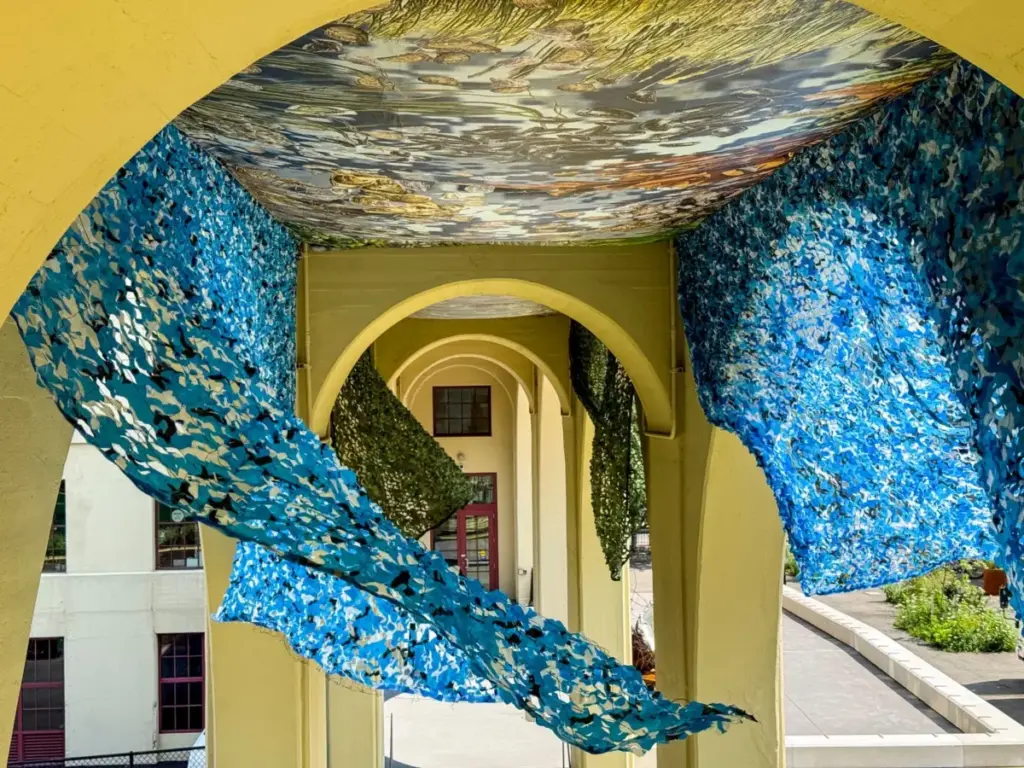
Military camouflage traditionally serves a singular, covert purpose: to obscure soldiers and equipment from the enemy, allowing military forces to blend seamlessly into foreign landscapes during times of conflict. However, in a striking new public art installation at the historic Brooklyn Army Terminal in Sunset Park, this utilitarian design is completely subverted, turned inside out to question the very nature of war, displacement, and environmental transplantation.
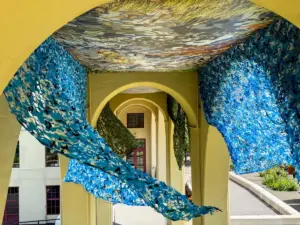
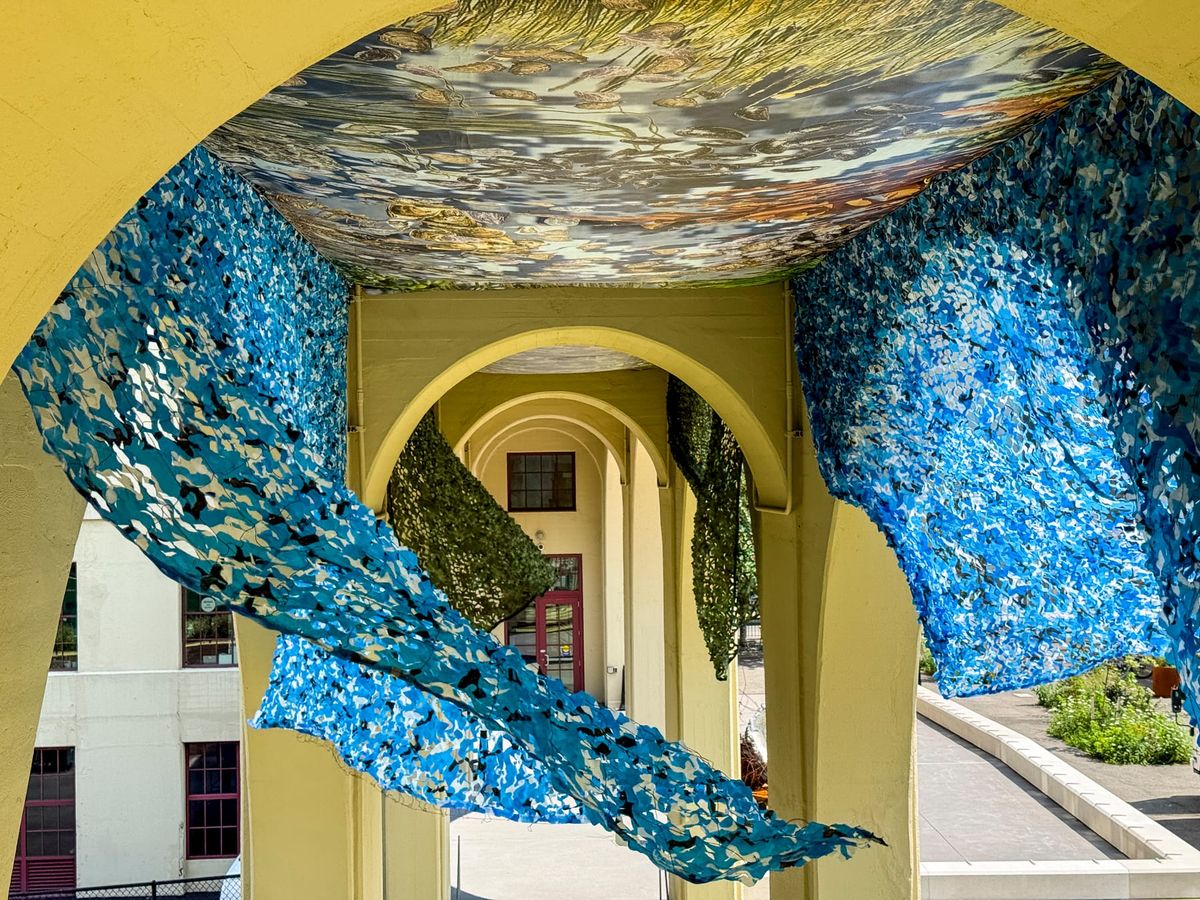
In her latest intervention, titled Tidal Crossing, artist Jean Shin presents three massive sets of military-style nets suspended expertly within the architectural arches of one of the terminal’s sweeping skybridges. Interwoven between each net are custom camouflage banners overlaid with delicate, vivid images of flora and fauna gathered from the myriad international regions where the United States military has historically waged wars. The installation, which opened to the public on September 19, marks the final and perhaps most monumental addition to In Plain Sight, a yearlong public art exhibition that has showcased the works of 12 distinct Brooklyn-based artists across the expansive waterfront complex and the nearby Brooklyn Wholesale Meat Market.
The venue itself serves as a profound historical backdrop for Shin’s work. The Brooklyn Army Terminal once operated as the largest military supply base in the United States, serving as a critical staging ground for troops and munitions dispatched across global conflicts. Today, the cavernous industrial site has been reimagined as a vibrant hub for modern commerce, artists, and local manufacturing. Yet, the deep echoes of its military past remain embedded within its towering concrete structures, making it a uniquely resonant site for an artwork that directly confronts the legacy of American military intervention abroad.
As visitors navigate the terminal, Shin’s installation presents a dramatic visual contrast. The rich, tactical swaths of green, blue, and sandy camouflage stand in sharp juxtaposition against the stark, weathered industrial concrete of the 20th-century complex. Beyond this immediate aesthetic clash, the military patterns evoke complex themes that resonate deeply with the surrounding immigrant communities of Sunset Park, a historic and culturally diverse waterfront neighborhood in Brooklyn. The artwork deftly probes the multifaceted question of belonging in unfamiliar environments. It draws a conceptual bridge between the tactical disguises donned by soldiers on covert missions overseas, the ecological transport of native plants to foreign lands through global trade, and the painful, forced displacement of human communities caught in the crossfire of war-torn regions.
"This project makes me think of the question, ‘who belongs here?’" Shin explained to Hyperallergic during an on-site interview at the terminal. "What’s foreign at one point is actually really familiar."

Flanked by robust netting that flutters continuously with the crisp onshore breeze coming off the New York harbor, each fabric banner in the installation features a distinct environmental theme paired with a historically significant camouflage pattern. These patterns trace a visual timeline of American military history, featuring designs that have appeared across battlefields since World War II. Among them is the mottled splotch design affectionately and grimly nicknamed "Frogskin," which saw heavy use by American forces during the Pacific War. Another featured pattern is the freckled configuration informally known as "Chocolate Chip," which became iconic during the Gulf War of the early 1990s.
In addition to these historical designs, the installation incorporates more contemporary motifs, reflecting the evolution of modern warfare and surveillance technology. Most notably, the exhibition highlights the U.S. military’s adoption of "Digital Camo," a pixelated, almost QR-code-like pattern deployed extensively between the 2000s and 2010s. This technologically advanced design was specifically engineered to confuse the digital detection and imaging systems utilized by adversaries in modern conflicts in Afghanistan and Iraq, marking a shift from analog concealment to algorithms and digital obscurity.
By superimposing images of local ecosystems, indigenous plants, and marine life—such as oysters, mussels, and seaweed native to regional waters—over these aggressive military patterns, Shin effectively neutralizes their intended function. The camouflage no longer hides instruments of war; instead, it highlights the delicate resilience of nature and the shared vulnerabilities of ecosystems impacted by human conflict. Through Tidal Crossing, the artist successfully reclaims a prominent military landmark, transforming tools of division and concealment into a contemplative public monument that speaks to migration, survival, and the complex tapestry of global interconnectedness.