New York City’s notoriously unpredictable autumn weather has rarely been kind to outdoor arts initiatives, but the elements reached a particularly grueling crescendo this past weekend as a relentless nor’easter swept across the five boroughs. Yet, despite the driving rain, heavy winds, and widespread transit-adjacent puddles, the annual public art festival Art in Odd Places (AiOP) pressed forward with stubborn resilience for its milestone 21st edition, transforming the bustling thoroughfare of 14th Street into a canvas for site-specific installations, performances, and public interventions.
The festival’s overarching theme this year—utopia—offered a stark conceptual contrast to the waterlogged reality unfolding on the ground. As sheets of rain alternated between a biting, sideways pelting and a heavy, mist-like drizzle, the notion of an ideal society felt delightfully absurd, yet deeply necessary. Spanning Saturday and Sunday, the 21st iteration of AiOP aimed to cut through the collective doom and gloom of a washout weekend, engaging commuters, weekend shoppers, and curious art lovers through spontaneous encounters with creative expression.
Even so, the optimistic ethos of the festival was not entirely immune to the friction of urban life under climate-induced duress. Artists and organizers faced a barrage of technical difficulties, logistical headaches, and the distinct, palpable ire of disgruntled New Yorkers channeling the collective frustration of yet another ruined weekend. By Sunday afternoon, participants had retreated to narrow building awnings, leaky construction scaffolding, and subway station entrances stretching from Sixth to Eighth Avenue. There, they attempted to summon utopian vibrations while simultaneously distracting harried passersby whose socks were thoroughly soaked through.
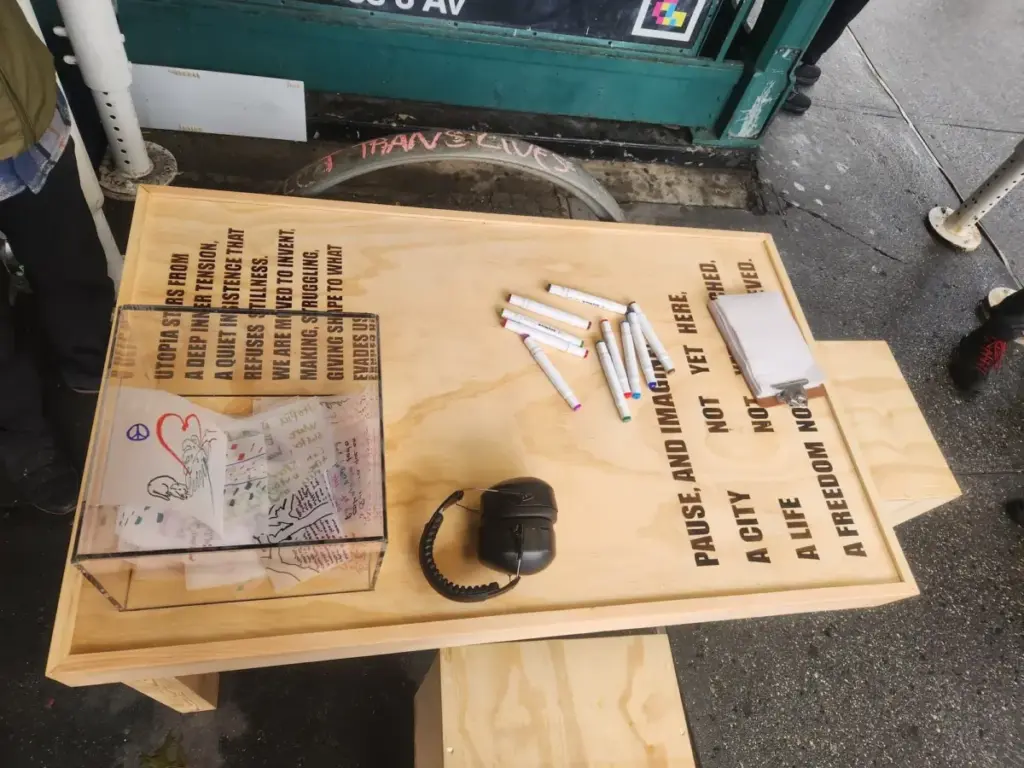
The friction between high artistic ideals and gritty urban reality played out in real-time on the sidewalk. Outside the Eighth Avenue subway stop, Massachusetts-based artist Nima Nikakhlagh staged his interactive performance piece, The Archive of Possibility (2026). The participatory installation invited anyone willing to pause in the downpour to put pen to paper and sketch a personal utopian vision—imagining a form of freedom not yet achieved or a city not yet realized.
Yet, the creative contemplation of a better world was routinely punctured by the mundane chaos of New York street life. While seated alongside Nikakhlagh to contribute to the project, observer and reporter Rhea Nayyar witnessed a heated verbal confrontation erupt just inches away. Two pedestrians exchanged furious curses over an accidental umbrella collision—a classic, petty urban scuffle that underscored just how far the damp and irritable crowd felt from any utopian ideal. Once completed, the participants’ contributions to Nikakhlagh’s project were deposited into a designated box, destined to remain sealed away forever, preserving fleeting thoughts of a better future inside a vault of urban anonymity.
Just blocks away, the harsh realities of staging unpermitted or unorthodox public art during a storm were playing out with similar intensity. Panama-based performance artist Susana Gonzalez-Revilla was forced to hurriedly pack up her props from beneath the relative shelter of a local laundromat’s awning. The air around her still carried the lingering, earthy scent of burning palo santo, but the performance had been cut short. Storefront tenants had lodged complaints with the artist, objecting to the presence of fire and drums in close proximity to their commercial property amid the already stressful conditions of the storm.
Similar tensions shadowed other participants striving to make their voices heard along the urban corridor. Ariel Kleinberg, an artist hailing from Astoria, faced a daunting installation process, carefully securing a series of cutout paintings depicting various goddesses along a vulnerable chain-link fence and against tarp-covered storefronts that rippled violently in the nor’easter’s gusts.
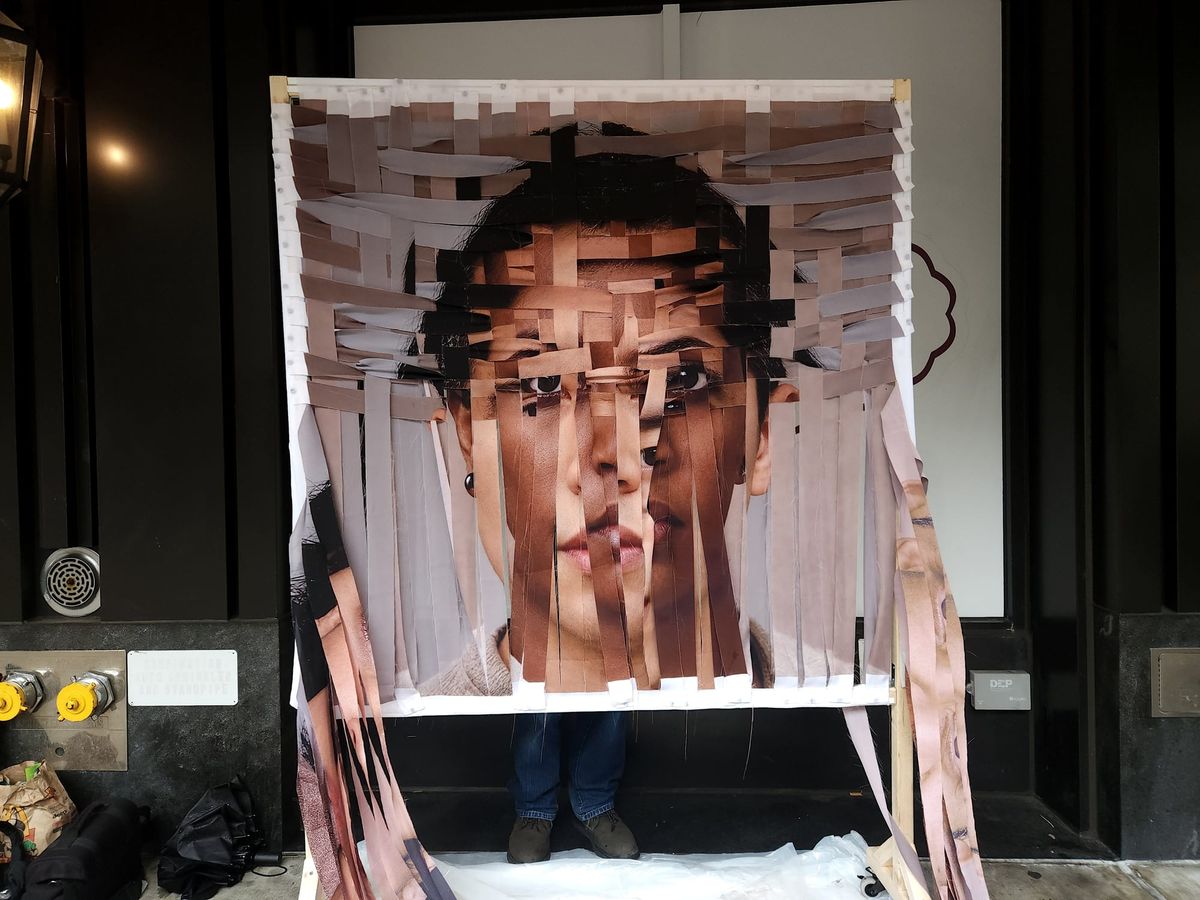
Despite the logistical nightmares, the hostile weather, and the occasional friction with local merchants and stressed commuters, the festival’s roster of artists continued to interrogate the complexities of contemporary life. Among them was Entung Liu, whose participatory performance piece Weaving You (2026) invited members of the public to physically interweave strips of four distinct, AI-generated portraits together. The striking visual metaphor served as a poignant commentary, directly questioning the increasingly bureaucratic and often impersonal role that advanced technology plays within modern immigration systems.
As the weekend’s events drew to a close under dripping awnings and grey skies, the 21st edition of Art in Odd Places proved that the pursuit of utopia—however messy, rain-soaked, or resisted by both the weather and weary pedestrians—remains a vital fixture of New York’s cultural landscape.