In the landscape of contemporary art and museum curation, few exhibitions arrive with the structural ambition and cultural urgency required to define a decade. Yet, that is precisely the distinction earned by “MONUMENTS,” a landmark group show that spent a decade in development before opening its doors to the public. Recognized for its exceptionally strong curatorial point of view and its engagement with a significant historical period, the exhibition successfully repositioned decommissioned Confederate monuments by integrating them into spaces traditionally reserved for contemporary art.
The exhibition, jointly hosted at The Geffen Contemporary at MOCA and The Brick in Los Angeles, runs from October 23, 2025, to May 3, 2026. Brought to life by an accomplished curatorial team consisting of Hamza Walker, Kara Walker, and Bennett Simpson, alongside collaborators Hannah Burstein and Paula Kroll, “MONUMENTS” challenged viewers to reconsider the very nature of public statuary, civic authority, and collective memory in the United States.
The Power of Repositioning History
For generations, Confederate monuments stood as elevated symbols of authority, placed high above public plazas, courthouse lawns, and park pedestals to enforce specific narratives of power and heritage. In contrast, “MONUMENTS” subverted this traditional dynamic entirely. Within the galleries of MOCA, these massive, controversial statues were brought down to earth, displayed directly on the gallery floor as sculptural objects rather than untouchable testaments to power. Many of the objects still bore the physical traces of their contested final days in public spaces, including layers of weathering and graffiti left intact by activists and protestors.
By stripping away the architectural height and civic framing that once shielded these objects from critical scrutiny, the exhibition invited visitors to confront the physical reality of the statues. This direct encounter laid bare the true legacy of these monuments, offering a tangible lens through which the public could examine how similar objects continue to shape, divide, and influence contemporary American society. Rather than hiding or destroying these relics of a painful past, the curators chose to expose them to the harsh, analytical light of the museum interior, transforming symbols of oppression into objects of profound historical inquiry.
Dialogue Between Past and Present
What elevated “MONUMENTS” from a purely historical exercise into a masterclass in contemporary curation was its deliberate placement of these decommissioned artifacts in active dialogue with works by leading contemporary artists. The exhibition featured powerful contributions from an array of visionary creators, including Bethany Collins, Julie Dash, Davóne Tines, Cauleen Smith, Torkwase Dyson, Andres Serrano, Martin Puryear, Nona Faustine, and Hank Willis Thomas, among others.
Each of these contemporary artists brought distinct stylistic approaches and conceptual frameworks to the exhibition, engaging directly with overarching questions of monumentality, institutional power, and the politics of visibility in public spaces. Their works created a dynamic tension within the galleries, demonstrating that the conversation surrounding historical memory is not static, but rather an ongoing negotiation between yesterday and today.
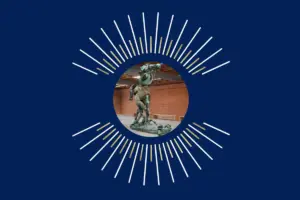
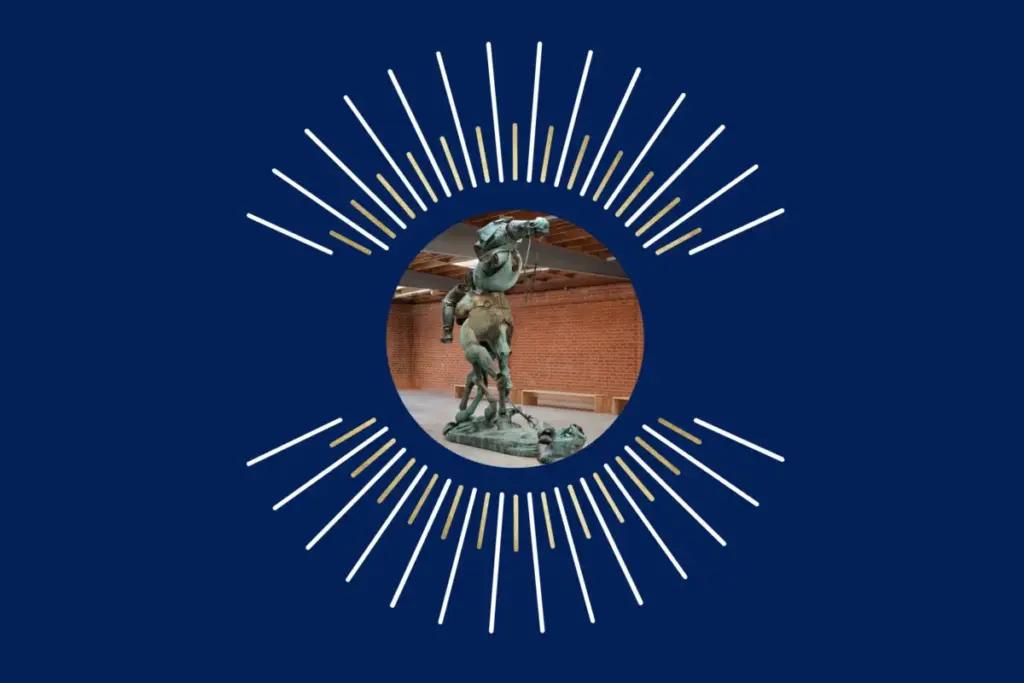
At The Brick, co-curator Kara Walker presented a striking installation titled Unmanned Drone (2023). For this piece, Walker took apart a decommissioned equestrian statue of Confederate General Stonewall Jackson, meticulously welding the fractured pieces back together in an entirely new, fragmented configuration. The resulting sculpture served as a potent metaphor for the broader national project of confronting a fractured history—suggesting that society must take apart the myths of the past and piece them back together to forge a more honest, inclusive understanding of history.
Taken together, these ambitious pairings illustrated that contemporary artists are not merely observers of culture, but essential guides who help the public navigate and process unsettled debates around the toxic and pernicious histories that Confederate monuments embody. Through these carefully orchestrated juxtapositions, “MONUMENTS” demonstrated the unique capacity of contemporary art institutions to reframe history, bringing the shadows of the past into productive friction with the realities of the present. As a singular, once-in-a-generation undertaking, the exhibition stands as an enduring study in what a thematic museum show can achieve when guided by intellectual rigor and moral clarity.
Special Citation: The Inaugural Hang of the David Geffen Galleries at LACMA
While thematic exhibitions like “MONUMENTS” rely on a sharply focused historical or conceptual thesis, museum curation can also excel through expansive, cross-departmental reimagining. Recognizing this distinct form of institutional achievement, the ARTnews Awards Jury awarded a special citation to the inaugural hang of the David Geffen Galleries at the Los Angeles County Museum of Art (LACMA), which opened on May 4.
Although not a traditional thematic exhibition in the narrow sense, the permanent collection installation at LACMA’s new and frequently discussed building—designed by architect Peter Zumthor—earned high commendation from the awards jury. The architectural centerpiece spans a single continuous floor reaching across Wilshire Boulevard, creating an expansive architectural footprint designed to house the museum’s vast permanent collection.
Rather than relying on a predictable, linear chronological narrative of art history, the inaugural hang was conceived as an exploration of how disparate eras, geographic regions, and artistic styles can spark unexpected commonalities when exhibited in proximity to one another. The success of this ambitious presentation hinged upon unprecedented collaboration among the museum’s 15 distinct curatorial departments. By pooling their expertise, the curators generated fresh insights into iconic, well-known works, brought long-overlooked and lesser-known pieces into the spotlight, and constructed elegant visual and conceptual juxtapositions throughout the expansive galleries.
Nominees in Curatorial Excellence
The recognition of both “MONUMENTS” and LACMA’s inaugural installation highlights a broader wave of ambitious institutional programming that defined the museum landscape. Several other exhibitions earned nomination for their exceptional curatorial vision and execution.
Among them was “Into the Time Horizon,” presented at the Nevada Museum of Art in Reno from November 15, 2025, to January 3, 2027. Curated by Apsara DiQuinzio with Kolin Perry, the exhibition explored expansive themes of time, landscape, and human presence within the changing American West.
The Carnegie Museum of Art in Pittsburgh, Pennsylvania, was recognized for “If the word we: 59th Carnegie International,” on view from May 2, 2026, to January 3, 2027. Curated by Ryan Inouye, Danielle A. Jackson, and Liz Park, the enduring international exhibition series continued its tradition of addressing urgent global dialogues, collective identity, and interconnectedness through contemporary art.
Buffalo AKG Art Museum presented “Let Us Gather in a Flourishing Way” from March 6 to September 6, 2026, before the exhibition traveled to the Des Moines Art Center for a run from October 24, 2026, to January 24, 2027. Curated by Andrea Alvarez, the exhibition focused on themes of community, resilience, and ecological and social flourishing through the practices of diverse contemporary artists.
Rounding out the nominees was “Several Eternities in a Day: Form in the Age of Living Materials,” hosted at the Hammer Museum in Los Angeles from April 5 to August 23, 2026. Curated by Pablo José Ramírez with Jessi DiTillio, the exhibition examined how contemporary artists and designers engage with living materials, biotechnology, and ecological systems to redefine sculptural form in an era of environmental transformation.