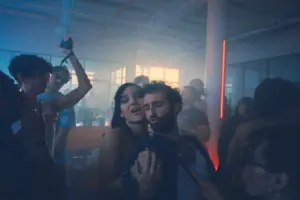
Los Angeles — In her ambitious and deeply atmospheric group exhibition titled “Horror,” hosted at Sprüth Magers in Los Angeles, artist Jill Mulleady takes an expansive and unconventional view of her titular genre. Rather than confining the exhibition to a single set of iconographies, cinematic tropes, or predictable artistic concerns, Mulleady approaches horror as a vast, universal catch-all for everything that human beings fear, dread, and struggle to articulate.
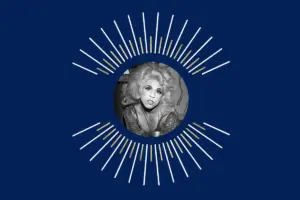
Running from November 21, 2025, through February 14, 2026, the exhibition does not offer a rigid academic thesis or a narrow historical overview. Instead, it deliberately evokes a pervasive, shifting vibe—an atmospheric tension that plays out across more than half a century of contemporary and modern art. Bringing together a diverse array of paintings, sculptures, photographs, and moving-image works, Mulleady reaches as far back as the historical roots of Surrealism by incorporating a haunting recording by Antonin Artaud. From there, the exhibition extends smoothly through the decades, bridging the historical avant-garde with recent, cutting-edge works by contemporary luminaries such as Anne Imhof, Henry Taylor, and Jordan Wolfson. Along this winding intellectual and visual path, the exhibition fearlessly addresses harrowing and resonant topics, including body horror, xenophobia and the fear of the other, abjection, and psychological dissolution.
“Horror” casts its curatorial net remarkably wide, refusing to adhere strictly to any single style, movement, or medium, while simultaneously executing a series of shrewd, provocative juxtapositions. Throughout the gallery spaces, historical and contemporary works converse with one another in unexpected ways. For instance, a striking painting by Andra Ursuta, which depicts a mysterious, solitary skeleton floating within a purplish void, is positioned in direct dialogue with a vintage Bruce Conner sculpture that houses a human skull within an intricate, shrine-like setting.
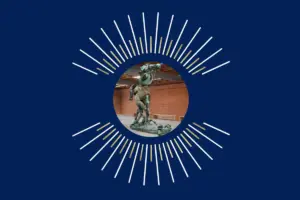
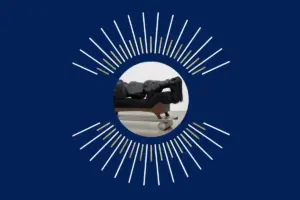
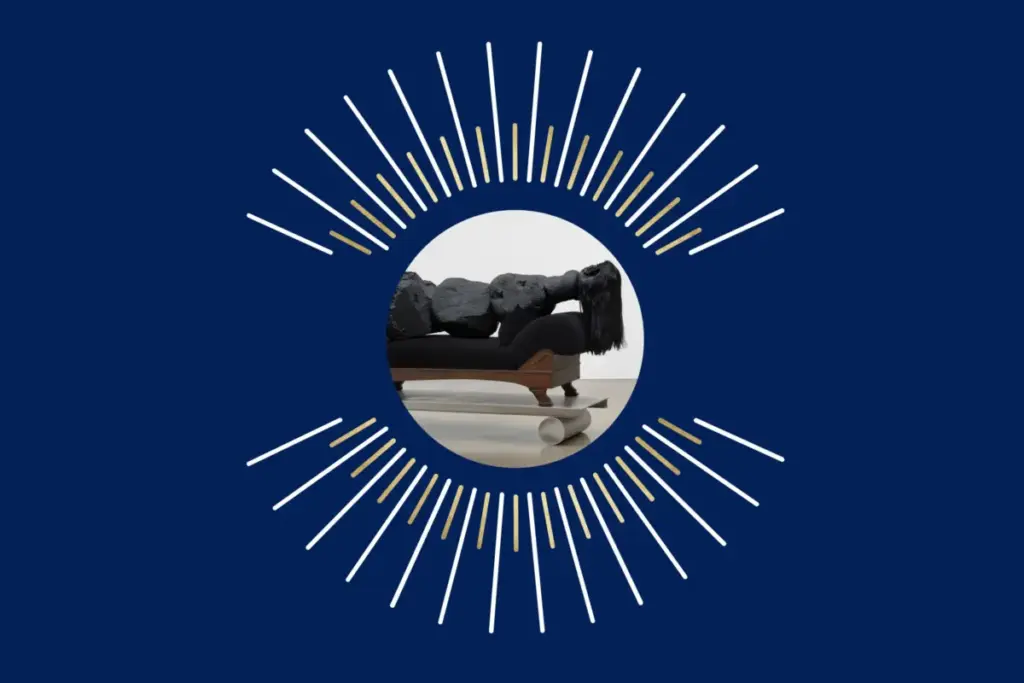
Nearby, a compelling painting by Pol Taburet showing two brown figures lying together in bed is placed squarely beside a controversial and politically charged sculpture by Precious Okoyomon, which is composed of a historical racist doll. Further amplifying the exhibition’s emotional weight, Mike Kelley’s monumental 1987 sculpture Odalisque—a hulking, misshapen black mass resting heavily upon a divan—is set directly before Sondra Perry’s 2001 video and installation work Flesh on Flesh, a haunting piece generated from a three-dimensional digital scan of the artist’s own facial skin.
The undeniable lodestar of the entire exhibition is the late Mike Kelley, a legendary Los Angeles-based sculptor and multidisciplinary artist whose influential body of work frequently invoked grotesque, abject, and uncanny imagery. Taking profound inspiration from Kelley’s landmark 1993 exhibition “The Uncanny,” Mulleady’s show seeks to explore what she eloquently describes in an accompanying catalogue essay as “the unsettling psychological tension created when the familiar is revealed to be disturbingly strange—a repressed domesticity surfacing in unsettling form.”
While Mulleady’s exhibition is not explicitly political in its messaging, that purposeful distance from direct political commentary is, in a profound way, the entire point of the project. Her enduring fascination with horror stems from the unique structural way the genre presents what she has described in interviews as “a controlled confrontation with chaos.” There is a profound sense of psychological catharsis that comes through viewing and engaging with artistic works of this kind, which Mulleady has described as a vital aesthetic “strategy to talk about real-life forces that are too hard to digest directly.”
The exhibition’s critical resonance has also placed it among a select group of notable curatorial projects nominated in the broader contemporary art landscape. Other prominent exhibitions recognized alongside this creative moment include “How Beautiful This Living Thing Is,” curated by Andrew Durbin at Ortuzar in New York, which ran from April 22 to May 30, 2026; and “Snake, Turtle, Alligator,” presented at David Peter Francis in New York and co-organized with Interrobang from January 10 to February 7, 2026.
Additional nominees featured in this cultural dialogue comprise “Statics of an Egg,” curated by Martin Germann at David Zwirner in New York from May 8 to June 27, 2026, and “What We Hold On To,” mounted by the Black Cube Nomadic Art Museum in Englewood, Colorado, which was on view from September 5 through December 12, 2025.