In 1949, fresh off a transformative tour across Scandinavia, the visionary French designer Jean Royère sat down to pen a detailed account of his travels for the Parisian design magazine Le Decor d’Aujourd’hui. Among the many stops on his itinerary, it was his visit to Stockholm that left an indelible impression on him, specifically his time spent wandering through Svenskt Tenn, the celebrated design emporium helmed by Josef Frank.
Royère was utterly captivated by the vibrant, untamed interior aesthetic of the shop, which blurred the lines between the built environment and the natural world. He gushed about the jungle-like atmosphere in his published entry, writing vividly of the spatial experience.
“One must lift aside vines and branches to select a candy dish,” he wrote, capturing the whimsical nature of the displays. “In all these Nordic countries, there is a charming custom of incorporating climbing plants into interiors. I have seen living rooms where ivy zigzags around paintings and mirrors, circling the walls several times, and dining rooms where Virginia creeper trails down into the chandeliers.”

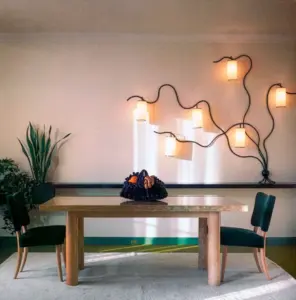
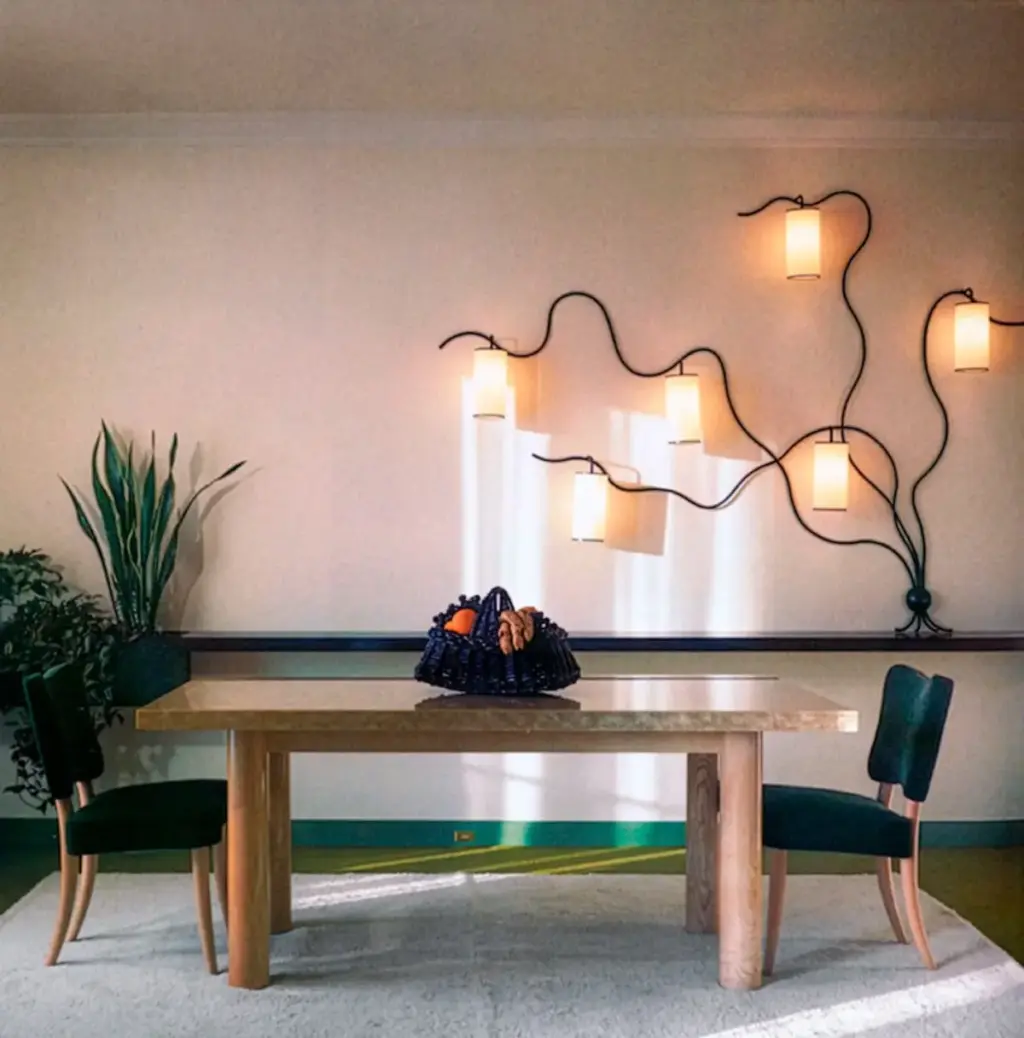
This striking Nordic penchant for letting nature run wild indoors struck a profound chord with the French designer, acting as a profound catalyst for his creative imagination. Soon after returning to his studio, Royère set to work translating the organic fluidity of climbing vines into a functional, sculptural lighting concept. The result was the Liane—the French word for vine—a remarkable series of squiggly, hand-forged tubular steel lamps designed to crawl across walls in a manner reminiscent of growing ivy, with their stems gracefully gathered at the base into a solid block resembling a bouquet.
The evolution of the Liane series spanned several years, maturing from site-specific wall pieces crafted in the mid-1950s into a diverse family of lighting fixtures. This botanical-inspired catalog eventually grew to encompass grand chandeliers, delicate wall sconces, and even an intricate, tangled floor lamp. To give these metal creations a tactile and organic quality, Royère coated them in vibrant, unconventional house paints—predominantly shades of coral, blue, and black—while occasionally employing gold leaf for a touch of opulence. These layered finishes lent the steel an aged, textural depth that softened its industrial origins. Complementing the sinuous metal stems were cylindrical shades fashioned from cellulose acetate, neatly finished with a color-matched paper trim that preserved the cohesive, artistic vision of each piece.
Royère’s fluency with tubular steel was a material fascination likely inherited from the broader modernist currents of the Bauhaus movement. However, true to his signature style, he consistently subverted the rigid, utilitarian conventions of industrial materials through his uniquely playful and expressive touch. His experimentation with wiggling, serpentine lines began with a more controlled, restrained wave during the 1930s, gradually loosening over the subsequent decades into forms that were progressively freer, more erratic, and explicitly naturalistic.

This tension between rigorous engineering and organic expression remains a cornerstone of the designer’s legacy. As Jonathan Wray, the creative director at Jean Royère, observes, the designer’s work was never purely decorative or arbitrary.
“It’s never purely expressive,” Wray notes, reflecting on the underlying integrity of the pieces. “The decorative elements are always structural.”
The enduring appeal of Royère’s work led to the formal revival of the brand in 2018, spearheaded by Vladimir Markovic, the great-nephew of Royère’s long-time partner, Micha Djordjevic. Under this modern stewardship, the heritage of the atelier has been carefully safeguarded, ensuring that historic designs continue to be produced with the same exacting standards that defined the mid-century era.

Today, the market for vintage and contemporary design has seen a proliferation of shoddy, unauthorized Liane look-alikes attempting to capitalize on the enduring popularity of Royère’s aesthetic. In response, authentic "Royère-heads" and serious collectors can source pieces directly from an official catalog featuring 35 original Liane varietals. Crafted today using modern powder-coated steel and traditional Japanese paper shades, these authorized editions nevertheless maintain strict parameters; clients are no longer permitted to specify bespoke or custom versions of the fixtures, protecting the integrity of the original designs as fixed works of art.
Inspecting an elaborate historical plan in the archive, Wray emphasizes the profound artistic skill required to bring these lighting sculptures to life, noting how each piece serves as a physical manifestation of the designer’s unique draftsmanship.
“It’s an expression of his hand,” Wray says, tracing the lines of the design. “The result really feels like a wall drawing.”