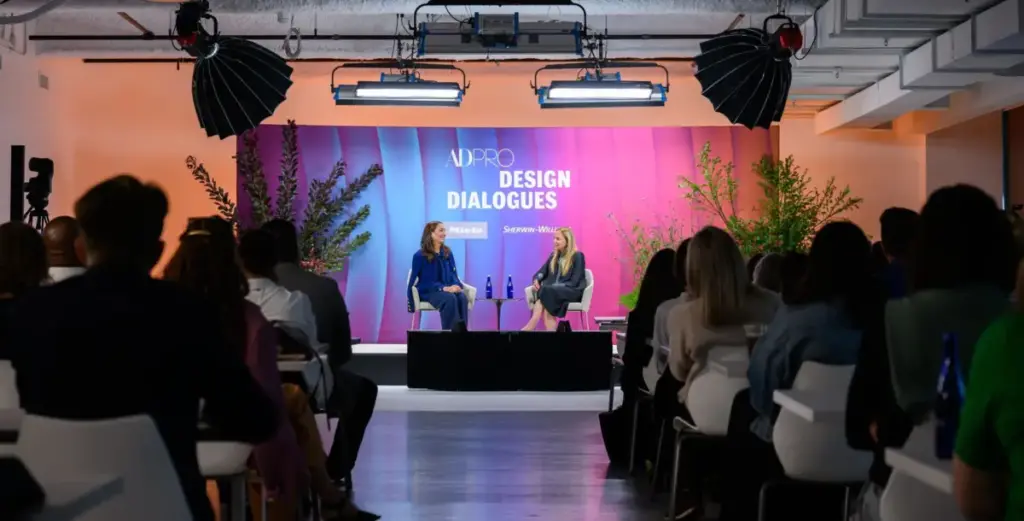
San Francisco-based designer Heidi Caillier is constantly pushing herself to reinvent her style, resisting the comfort of a signature look that might otherwise easily define her brand. Speaking at the inaugural AD PRO Design Dialogues summit on September 16, the AD100 and AD PRO Directory talent pulled back the curtain on a career that she launched just over a decade ago. In conversation with Architectural Digest’s Global Interiors and Gardens Director, Alison Levasseur, Caillier offered a candid look at her professional journey, discussing everything from the operational advantages of a fully remote team to the digital strategies that landed her high-profile commissions, including Kendall Jenner’s mountain home.
For Caillier, maintaining long-term viability in the fast-paced design industry is not merely about building a solid business acumen; it requires an active, continuous commitment to creative evolution. Reflecting on the body of work she has put out into the world over the years, the designer emphasized that staying power comes from deliberate reinvention and an unwillingness to stagnate creatively.
“I struggle with projects where clients ask for a ‘Heidi house,’” Caillier told the audience during the summit. “I don’t like to design the same thing twice. I get bored.”
This aversion to repetition dictates how she approaches her portfolio and her business. She stressed that as a designer grows their enterprise, the work they publish into the world tends to dictate the types of future commissions they will attract, making it vital to continuously put out projects that genuinely excite and inspire them.
A Remote Team as a Core Business Strength
One of the more unexpected operational insights Caillier shared during the AD PRO Design Dialogues was the structure of her firm, which operates as an entirely remote team. When she first began looking to expand her staff years ago, the decision was born out of local market constraints rather than a global trend.
“When I started to think about hiring, it was pre-COVID, and there was not a pool [of candidates in Seattle] where I was living,” Caillier explained to the audience.
Rather than settling for local limitations, she turned to the digital landscape. She recalled how a prospective team member serendipitously reached out to her through Instagram, becoming her very first hire—an employee who remains with the firm to this day.
What began as an isolated solution to a regional hiring shortage has since blossomed into a distinct competitive advantage. Today, Caillier’s staff has grown to six professionals spread across different locations. Operating without a traditional brick-and-mortar office allows the firm to recruit elite talent regardless of geographic boundaries. Furthermore, because Caillier takes on residential projects scattered across the United States, having a dispersed team often simplifies the logistics of site visits and localized coordination.

Streamlining Client Relations and Setting Firm Boundaries
Managing client expectations and creative direction is a perennial challenge in the interior design sector, but Caillier has engineered a deliberate, highly structured approach to keep projects moving forward efficiently. She relies on a method she describes as a "limited options program."
The process begins long before any physical samples are shown to a homeowner. Caillier’s team conducts a thorough, deep-dive discovery phase into the clients’ personal inspirations, lifestyle requirements, and unique aesthetic preferences. Following a dedicated three-month design process, the firm presents the comprehensive scope of work during a single, pivotal meeting.
This meticulously planned client presentation covers the entire project blueprint, encompassing the overall budget, projected timeline, and necessary construction requirements. During this meeting, Caillier delivers her overarching vision for the entire house while offering curated choices for only a select few individual pieces.
This streamlined methodology serves a dual purpose. It prevents clients from feeling overwhelmed by endless possibilities while simultaneously maintaining momentum for the design firm. Because Caillier intentionally limits her workload to handle just one major project at a time, keeping the decision-making phase concise is critical to her sanity and workflow.
“I don’t want to marinate on sofas or fabrics for the next six months,” she noted.
To protect this workflow and maintain a healthy, professional working relationship with homeowners, Caillier enforces strict communication boundaries. Among her most steadfast rules is a policy against informal digital messaging. As she bluntly advised her peers in the design community, “One big rule: I don’t text with my clients.”
Social Media as a Demanding Full-Time Job
Caillier’s path to interior design stardom was unconventional. Without a formal design education—she actually holds a master’s degree in public health—she initially broke into the industry as a lifestyle blogger before seamlessly transitioning her creative voice to Instagram. Today, she commands a following of nearly half a million users on the platform, managing her own digital presence without a dedicated social media agency.
That massive digital footprint, however, does not come easily. Caillier acknowledged that running an influential, conversion-driven social media account requires the time and effort of a full-time job. Nevertheless, she maintains that the immense time investment is entirely worthwhile because of the tangible business it generates.

Her digital portfolio serves as a direct pipeline to elite clients. Most notably, it was through Instagram that international superstar Kendall Jenner first discovered Caillier’s work, eventually leading to the high-profile commission to design Jenner’s striking mountain retreat.
To sustain this digital momentum and convert passive scrollers into active clients, Caillier follows a strict set of personal rules. Her strategy relies on consistency and high engagement, including publishing four to five morning posts per week, actively responding to direct messages, and interacting with user comments in real time.
Scaling Through Strategic Product Collaborations
As her design studio has matured, Caillier has found innovative ways to scale her business and expand her creative footprint without compromising the intimate, bespoke nature of her core interior design work. Rather than taking on an unsustainable number of full-scale residential clients, she has leaned into product design collaborations that allow her signature aesthetic to reach a broader market.
Earlier this year, the designer debuted a substantial 63-piece collection spanning furnishings, lighting, and wallpapers in partnership with Lulu & Georgia. For Caillier, these licensing ventures provide a balanced path for business expansion while allowing her to remain deeply hands-on with every private interior she accepts.
Looking ahead, Caillier’s product design pipeline remains robust. She is already preparing for another major rollout, gearing up to launch a brand-new line of textiles and wallpapers with Elizabeth Eakins at Deco Off in January 2027.
Reflecting on her career trajectory from public health graduate and design blogger to an acclaimed AD100 talent with major retail collaborations under her belt, Caillier offered a final piece of guidance to the design professionals in attendance at the summit.
“Be intentional about the goals you have, the scope of projects, and your collaborations,” Caillier advised. “If you can find a way to continue to reinvent yourself using things that you love, that’s the key.”