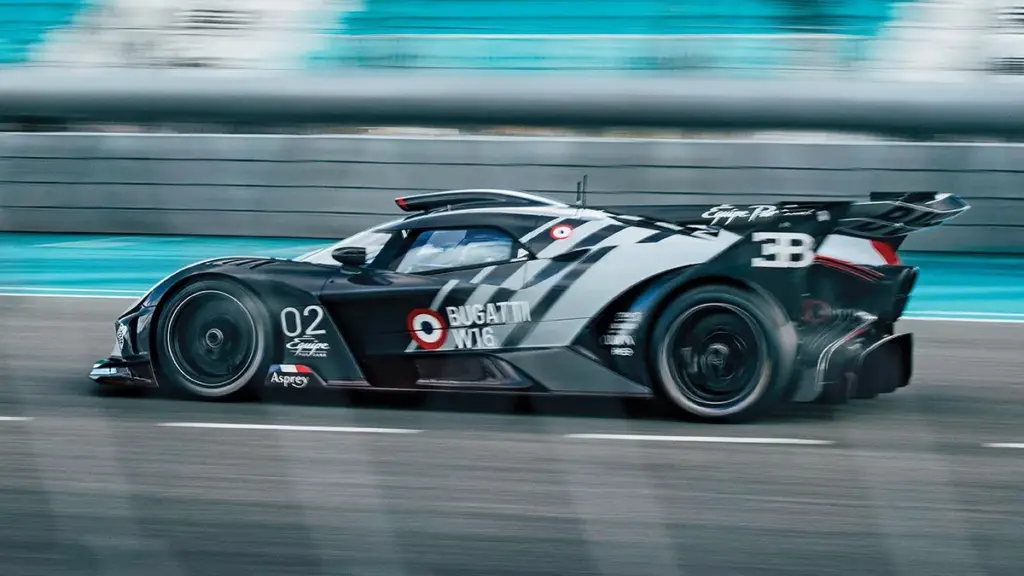
“It’s just a car,” Bugatti’s head driving instructor reminds me with a knowing smile, repeating the phrase a few times as I stand on the asphalt beside the French marque’s $4.8 million track-only hypercar. This casual reassurance comes at the tail end of a rigorous technical briefing filled with stern warnings and safety protocols, administered just moments before I am scheduled to pilot the limited-edition machine around the Miami International Autodrome. The circuit, renowned as the high-speed home of the city’s high-profile Formula 1 grand prix, offers a fittingly dramatic backdrop for an engineering feat of this magnitude. Pausing for a brief moment after his initial reassurance, the instructor adds with a smirk, “Actually, it’s a gun. But it’s just a car.”

Deriving its moniker from the French word for fireball or meteor, the Bolide is indisputably the most extreme, uncompromising machine that Bugatti has ever engineered. Built strictly for the racetrack with no road-legal concessions, production is strictly capped at just 40 examples worldwide—all of which have already been spoken for and delivered to an exclusive group of collectors. At the beating heart of each Bolide is the automaker’s legendary 8.0-liter, quad-turbocharged W16 engine. When fed standard pump gas, this monstrous powerplant churns out an astonishing 1,578 horsepower and 1,180 foot-pounds of torque. For owners willing to feed the beast with dedicated race fuel, those already staggering figures climb to an otherworldly 1,826 horsepower and 1,475 foot-pounds of torque, elevating the performance envelope into uncharted territory.
On the day of the test, a select handful of these elite owners are also gathered in the paddock to fire up their own ballistic machines for the very first time. Spotting even a standard Bugatti on public roads is an exceptionally rare occurrence; seeing an entire pack of Bolides lined up and eventually hurtling down the circuit’s main straightaway is a visceral experience that easily induces goose bumps. My introduction to the car begins when I contort my tall frame into the passenger seat of the carbon-fiber-monocoque cockpit. Sitting immediately to my left is Le Mans winner Andy Wallace, Bugatti’s chief test driver, who has taken on the task of acquainting me with the nuances of the course. Just as we prepare to roll out, however, the Florida sky darkens dramatically, opening up to unleash torrents of heavy rain upon the track. Wallace remains entirely unfazed, casually explaining that the Bolide handles wonderfully in the wet. It is an easy sentiment to express when you are one of the world’s most accomplished racing drivers, but one that requires a leap of faith from the passenger seat.

Once the sudden tropical storm passes and the racing line begins to dry, we are finally cleared to leave the pit lane. Within mere seconds, Wallace has matted the accelerator, unleashing the full fury of the quad-turbo setup. “Get on the brakes early and much harder than you think,” Wallace yells loudly over the roar of the mid-mounted engine as the hypercar rapidly accelerates past the 200 mph mark on the straight. To prove his point, he demonstrates by forcefully stomping on the brake pedal, an action that instantly and violently slams me deep into the six-point safety harness with terrifying G-force.
The stopping power of the Bolide has quickly become the primary topic of conversation throughout the paddock, and for good reason. Brake specialist Brembo spent two grueling years developing the stopping system specifically for this vehicle, resulting in the largest carbon-carbon brake setup the company has ever manufactured. The architecture shares its design philosophy and technical DNA with the braking systems utilized by supersonic jets like the Concorde and elite machines competing at the pinnacle of Formula 1. The tangible result of this engineering endeavor is that the Bolide is capable of generating braking forces of up to 2.5 G, hauling the lightweight track car down from astronomical speeds in breathtakingly short distances.

When it is finally my turn to transition from the passenger seat to the driver’s seat, my initial apprehension is immediately challenged by a surprising design reality: the forward visibility through the expansive windshield is remarkably generous for a dedicated track hypercar. My gaze then shifts toward the yoke-style, X-shaped steering wheel, a purposeful control interface that mirrors the striking visual design motif found on the car’s rear fascia and aerodynamic spoiler. Then there is the auditory experience. While the sonic signature of the W16 is undeniably marvelous when listened to from outside the pit wall, experiencing it from within the carbon cockpit is an entirely different sensory category altogether—an intoxicating, mechanical symphony of deep rumbles, explosive combustion, and high-pitched turbo whines.
Instructions from the team are simple yet demanding: bury your foot on the throttle and learn to completely trust the car. Under full, uncompromised acceleration, the physical sensation is nearly overwhelming to the human senses. Within the span of just a few quick blinks, the red-and-white curbing lining the circuit blurs into a solid pink streak, and the edges of my vision narrow as a slight hint of tunnel vision creeps in. Meanwhile, the advanced electronic stability control system works seamlessly behind the scenes to keep the Bolide tracking true and stable. Yet, despite the immense speeds and explosive power delivery, I feel virtually no mechanical resistance or intrusive electronic assistance fighting back through the chassis. The car always feels preternaturally planted, glued firmly to the asphalt surface. This stability is largely attributable to an advanced aerodynamics package capable of generating more than 6,000 pounds of downforce at speed—roughly double the downforce produced by a contemporary Formula 1 racer.

The massive W16 engine, accompanied by its layered, cacophonous howl of forced induction and internal combustion, sits intimately close directly behind your shoulders. Because of this proximity, you do not merely hear the engine; you feel it as a fundamental physical presence. It translates into a life-affirming vibration that pulses directly through the carbon seat and straight into your chest whenever the throttle is pinned wide open. Yet, what remains genuinely remarkable about the entire experience is that this meteoric, rocket-like machine ultimately drives with a surprising degree of straightforward docility, possessing a predictable nature that almost defies its extreme specifications. All the nervous apprehension I had carried into the circuit gates dissolved entirely somewhere around turn six. After all, as the instructor reminded me earlier that morning, it is just a car. But it happens to be a $4.8 million engineering masterpiece that only 40 people on the entire planet can officially call their own.