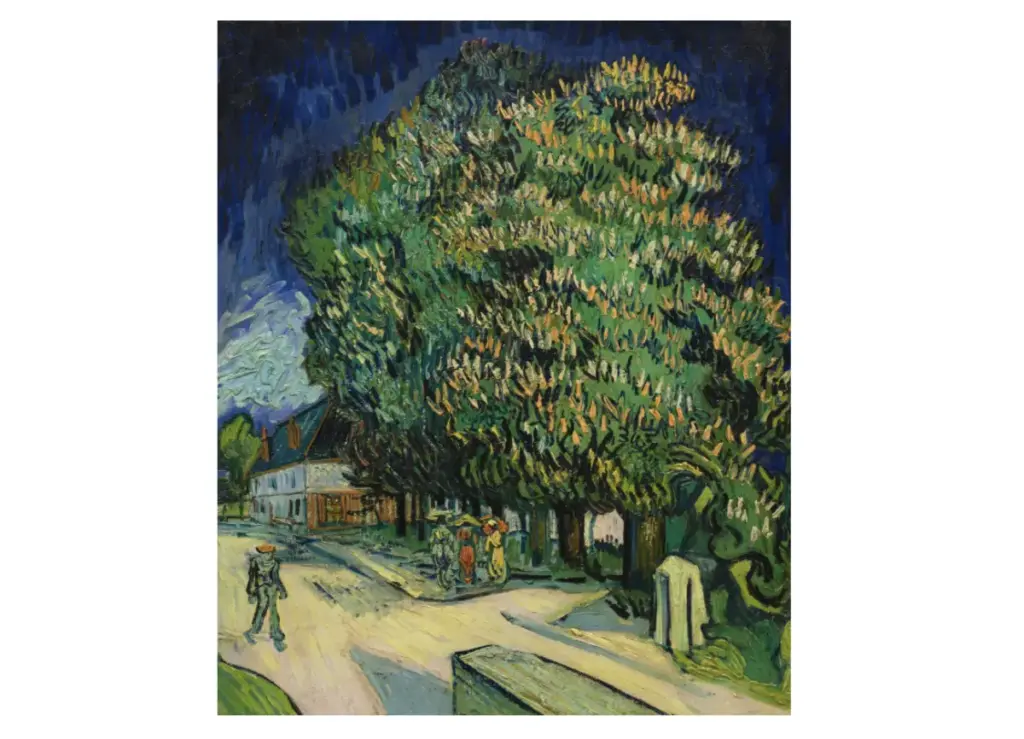
As a monumental $180 million painting by Vincent van Gogh prepares to go under the hammer, Sotheby’s is pushing back against a last-minute restitution claim that threatens to overshadow its premier autumn event. The auction house is firmly defending its position, pointing to detailed historical records of a 1936 transaction that it argues prove the masterpiece was sold voluntarily and for a strong market price.
At the center of the controversy is van Gogh’s Châtaigniers en fleurs (1890), also widely known as Blossoming Chestnut Trees. The breathtaking post-Impressionist work is scheduled to be auctioned off on Wednesday as the undisputed star lot of the Blaquier-Arrieta collection. Assembled by the late Argentine collectors Carlos Pedro Blaquier and Nelly Arrieta de Blaquier, the collection features twelve Impressionist and Post-Impressionist masterpieces collectively expected to fetch roughly $450 million. Sotheby’s has secured the high-profile offering with an undisclosed financial guarantee.
However, the path to the auction block has grown increasingly perilous. The auction house told ARTnews that the archives of the prominent German art dealer Paul Cassirer confirm the van Gogh was sold in June 1936 for 68,000 Swiss francs, which translates to approximately $22,000 at the time. Sotheby’s maintains that this figure represented a robust price for a van Gogh during that era. To contextualize the valuation, the house compared it to Verger avec cyprès (1888), a celebrated painting from the estate of Paul Allen that fetched $117.2 million at Christie’s in 2022. That picture had previously been sold at Parke-Bernet in 1935 for a modest $15,000.
The unfolding dispute burst into public view following a report by the New York Times, which revealed that the heirs of Samuel Fischer had formally requested that Sotheby’s withdraw the painting from its November 18 auction. Samuel Fischer was a towering figure in German publishing who founded one of the country’s most influential publishing houses, championing literary giants such as Thomas Mann and Hermann Hesse. Fischer passed away in 1934, leaving his business and family affairs to be managed during an increasingly hostile political climate.
According to the heirs and their legal counsel, the family was ultimately forced to part with the van Gogh due to mounting financial pressures brought on by systemic Nazi persecution. Gunnar Schnabel, the attorney representing the Fischer heirs, challenged Sotheby’s to provide definitive proof that the family received fair market value for the canvas and that they would have parted with the masterpiece even if the Nazi regime had never risen to power. In an email shared with the New York Times, Schnabel wrote that without such proof, “no auction may take place.”
Schnabel further noted that his client was fully prepared to work toward a fair and just solution under the Washington Principles, the internationally recognized guidelines established for handling claims involving Nazi-looted art. ARTnews reached out to Schnabel for comment regarding specific evidence of duress, any prior restitution efforts undertaken by the family, and their ideal resolution, but he did not answer before publication time.
The timing of the claim could hardly be worse for Sotheby’s, which has spent months orchestrating a massive promotional campaign around the Blaquier-Arrieta collection. The stakes are immense, particularly given the fierce competition behind the scenes to secure the consignment. According to industry insiders familiar with the negotiations, rival auction house Christie’s had also aggressively pursued the collection, offering competitive and in some cases even higher guarantees covering all the works, including the prized van Gogh.
A Sale in Amsterdam
To evaluate the legitimacy of the restitution claim, historians and legal teams have focused heavily on the unique timeline of the painting’s journey through Europe. After Samuel Fischer’s death, his son-in-law, Gottfried Bermann Fischer, took the reins of the publishing house just as the Nazi regime began banning its authors. The family relocated the business to Vienna in 1936, only to flee Austria following the terrifying Anschluss and annexation by Nazi Germany in 1938. In the aftermath, the Gestapo seized their Vienna home, personal library, and the remainder of their art collection.
Yet, the provenance of the van Gogh differs significantly from the assets the family lost during the 1938 flight from Austria. Historical documentation shows that the family placed Châtaigniers en fleurs on consignment with Paul Cassirer’s gallery in Amsterdam in 1932 or 1933, alongside two works by Paul Cézanne. The van Gogh remained on consignment for nearly three years, during which it traveled to Rotterdam and Bern for public exhibitions before its eventual sale. Crucially, the Netherlands remained entirely outside Nazi control at the time of the 1936 transaction.
Luke Nikas, a lawyer representing Sotheby’s, emphasized to ARTnews that the van Gogh was sold to an independent buyer at fair market value outside the borders of Nazi Germany. He also highlighted the fact that the family retained ownership of several other important paintings after the 1936 sale, many of which were the exact works ultimately confiscated by the Nazis years later.
“The family had pursued and recovered works from the 1938 forced sale, but never the works they sold in 1936, such as this van Gogh,” Nikas noted. He added that he reviewed a postwar inventory brochure published by Gottfried Bermann Fischer that explicitly detailed the paintings the family sought to recover, and the van Gogh was notably absent from the document.
The two Cézannes consigned alongside the van Gogh further complicate the family’s historical record. One of the Cézannes currently resides in the collection of the Harvard Art Museums, where it has been on public display for years without facing any formal restitution claims from the Fischer heirs. The second Cézanne was offered at Christie’s in 2007 and again in 2017, when it successfully sold for nearly $6 million. In 2007, Gisela Bermann Fischer—who managed the family’s art restitution claims until her death in 2014—informed Christie’s that she would not oppose the sale of that particular work.
However, archival records reveal a crucial caveat. In that same correspondence, as reported by the Times, she explicitly reserved her right to challenge the sales of other family paintings that she believed had been disposed of under duress. Sotheby’s stated that while it thoroughly investigated the 2007 Cézanne sale, it had no prior knowledge of that specific, confidential reservation made between Bermann Fischer and Christie’s.
The high-stakes controversy has also cast a spotlight on Sotheby’s internal restitution department. Industry observers and reports have noted significant recent departures from the house’s leadership. Lucian Simmons, who originally established Sotheby’s restitution department in 1997 and managed it for decades, departed for the Metropolitan Museum of Art in 2024. Meanwhile, Richard Aronowitz, who headed the auction house’s European restitution operations for 15 years, transitioned to Christie’s in 2022. Sources familiar with Sotheby’s operations indicate that the department has nearly doubled in size since Simmons’s tenure.
What Counts as Duress?
At the heart of the legal battle is a fundamental question: Can a painting sold outside Nazi Germany to an independent buyer at a strong price still be legally classified as a forced sale? Nikas argues that New York law draws a sharp distinction between the horrific conditions faced by Jewish families under the Nazi regime and an actual commercial sale where the buyer exerted no direct pressure on the seller.
To support this interpretation, Nikas pointed to recent federal court rulings involving Pablo Picassos sold by Jewish families during the Nazi era. In the 2018 case Zuckerman v. Metropolitan Museum of Art, a federal judge ruled that a 1938 sale did not satisfy the rigorous legal standard for duress. Although an appeals court upheld the dismissal the following year, it did so on the grounds that the family had waited too long to bring forth their legal claim. Similarly, in Bennigson v. Solomon R. Guggenheim Foundation, a New York judge ruled in 2024 that general economic pressure stemming from Nazi persecution was insufficient to establish duress if the purchasing party did not contribute to that pressure. That dismissal was also upheld on appeal due to excessive delay.
This emphasis on legal timelines intersects with significant legislative changes enacted earlier this year. In April, U.S. lawmakers amended the Holocaust Expropriated Art Recovery Act, or HEAR Act, effectively eliminating the legal defense of laches. Previously, this equitable defense allowed courts to swiftly dismiss restitution claims simply because heirs had waited decades to pursue their rights. While the legislative shift makes it considerably harder for museums, collectors, and auction houses to dismiss cases solely on the argument that too much time has elapsed, it does not alter the underlying legal threshold required to prove a forced sale.
Nikas maintains that this distinction remains vital, arguing that while Congress removed a defense based on delay, it left the strict legal definition of duress untouched—a test he believes the 1936 sale fails to meet.
Conversely, independent art lawyers suggest the legislative amendments have fundamentally altered the landscape. Judd Grossman, a New York art attorney not involved in the current litigation, noted that the statutory change has tipped the balance heavily toward claimants.
“With this year’s amendments to the HEAR Act eliminating the equitable laches defense, which had prevented heirs from unfairly sitting on their rights before making a claim, the pendulum has swung dramatically in favor of claimants regardless of whether they have ever taken steps to vindicate their rights,” Grossman told ARTnews. “Whatever the merits of the underlying title dispute, under this new statutory regime, we will see more of this sort of gamesmanship by claimants waiting to the very last minute to come forward before seeking their slice of the pie.”
As the clock ticks down toward Wednesday’s auction, Sotheby’s finds itself scrambling to negotiate directly with the heirs of the painting’s former owner to avoid jeopardizing its most lucrative sale of the season.
The involvement of attorney Gunnar Schnabel also underscores the organized nature of modern restitution investigations. Schnabel previously collaborated with provenance researcher Monika Tatzkow in 2016 to investigate Nazi-era losses involving works by Piet Mondrian, eventually leading to a prominent restitution claim against the Philadelphia Museum of Art. Whether Schnabel initiated contact with the Fischer heirs or was approached by the family remains unclear.
The rapid sequence of events has further fueled the tension. Sotheby’s states it was first contacted by representatives of the Fischer heirs on Thursday morning, November 12. The Times reached out to the auction house the following morning and published its report that very evening. By that point, the van Gogh had been prominently advertised to the public for more than six weeks, leaving the auction house with just five days to respond before the allegations became public knowledge.
Nikas questioned the strategic timing of the claim, noting that the sale had been publicly publicized since early October, though he emphasized that Sotheby’s was treating the matter with the utmost seriousness. While the heirs may possess legitimate historical questions regarding the 1936 transaction, the sudden disclosure gave the auction house virtually no window to resolve the issue privately.
Legal experts also note the profound difficulty in proving a counterfactual scenario nearly 90 years after the fact—specifically, whether a family would have chosen to sell a masterpiece in 1936 had the geopolitical landscape of Europe been entirely different.
For now, Sotheby’s maintains that the van Gogh remains officially scheduled to be offered during Wednesday night’s marquee sale. Meanwhile, the Blaquier family has indicated a willingness to engage in constructive discussions. In a formal statement provided to ARTnews, the family expressed deep respect for the historical complexities surrounding the era while standing firm on their ownership history.
“While the information available to date has not established that the painting was sold under duress, the family welcomes constructive dialogue with the Fischer heirs and supports efforts to reach a mutually satisfactory resolution,” the family stated.
Whether an agreement can be reached before the gavel falls on Wednesday evening remains to be seen.