Designing bespoke product collections using artificial intelligence and selling them directly through personal websites is no longer a futuristic concept—it is an idea whose time has officially arrived for the interior design and home furnishings industries.
Recently, while scrolling through professional updates on LinkedIn, Leslie Carothers, principal of Savour Partnership, came across a striking, visually evocative image. At first glance, she suspected it had been generated using artificial intelligence, though she was not entirely sure. Upon investigating further, she reached out privately to the creator, an acquaintance named Steve, to confirm its origins. Steve verified that the image was indeed AI-generated.
Carothers then asked for his permission to use the image as inspiration to train her own AI tools to conceptualize a modern bed tailored to her preferences. Steve readily agreed. Using a text prompt fed into ChatGPT and informed by Steve’s visual reference, Carothers generated a fresh concept for a modern bed. When she shared the resulting image in "Design Wealth," her private Facebook group dedicated to interior, kitchen, and bath designers, it generated a wave of positive commentary.
The reaction highlighted a powerful truth about modern digital marketing: using AI to produce images that mimic hand-sketched watercolor effects can instantly capture attention and stop the endless scrolling of potential clients. While talented professionals like Steve can easily hand-render these concepts—as can the vast majority of interior, kitchen, and bath designers—today’s fast-paced environment leaves little time for manual rendering. AI provides an efficient alternative, allowing creatives to produce compelling, emotionally resonant visuals swiftly.
The real-world potential of this workflow became even clearer when another member of Carothers’ Facebook group—an interior designer who had previously been a client—saw the post. Immediately, the designer shared an image of a bed she had conceptualized using AI text prompts. Her clients had fallen in love with the design instantly, purchased it, and commissioned a custom build. Her inspiration had sprung from her own bed combined with the specific design style her clients had repeatedly expressed a fondness for.
This digital exchange evoked memories of when Carothers was first invited to collaborate with Thompson Traders. During that project, she used Midjourney text prompts to conceptualize what ultimately became the real-world AILA sink. Thompson Traders later debuted the physical product in their exhibition space at the Kitchen and Bath Industry Show (KBIS). Side-by-side comparisons of the initial Midjourney AI render and the manufactured AILA sink demonstrated a true feat of technical genius, particularly highlighted by the sink’s unique, one-of-a-kind drain design.
This intersection of digital ideation and physical manufacturing points to a broader opportunity for creatives across the industry. Designers and other visual artists can leverage AI text prompting to design entirely unique product collections. By partnering with manufacturers that offer complete customization—such as Thompson Traders through programs like TAILOR MADE—designers can obtain accurate pricing and bring these visions to life, ultimately offering the finished pieces for sale directly on their own websites.
Consider the possibilities for the interior designer who conceptualized the custom bed for her clients. She could easily expand that single piece into a full suite, designing matching nightstands, a bespoke upholstered bench, or a pair of dressers, and launch them as a cohesive, branded collection on her website. Such a line could even carry a distinct moniker, such as "The Benediction Collection," credited directly to the designer.
Achieving success with this model requires effort, as sales will not happen automatically. Marketing these unique collections takes both time and financial investment, but the business model is entirely viable. Because each item can be treated as a one-of-a-kind piece, once a specific style sells, the designer can simply remove it from their website, develop a new design, and rotate it into the collection.
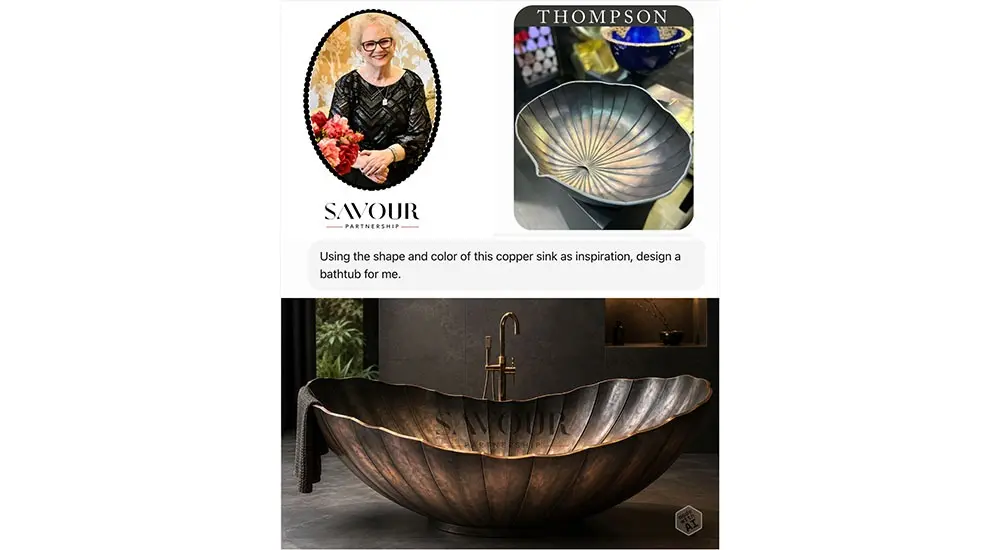
To test this concept further, Carothers asked ChatGPT to design a bathtub using her AILA sink as the primary visual inspiration. After uploading the image of the AILA sink alongside a specific text prompt, the AI generated a striking concept for a copper bathtub. Imagining a conversation with Thompson Traders, Carothers noted that asking their master coppersmiths if they could build such a piece would almost certainly result in an affirmative answer.
While such a piece would undoubtedly carry an exorbitant price tag, it would offer a truly one-of-a-kind solution for a client seeking something entirely exclusive. Furthermore, it would actively support traditional artisans who continue to employ the same heritage coppersmithing tools and techniques passed down through generations since the 16th century. Once sold, the design could easily be varied to create new iterations for a designer’s online shop.
Integrating artificial intelligence into the design workflow offers multiple layers of value. It enables professionals to offer clients genuinely bespoke products, supports manufacturers willing to execute authentic custom work, sustains the livelihoods of skilled traditional craftsmen, generates stunning marketing visuals, and opens up new revenue streams for designers. Embracing these technologies allows the industry to move forward productively and powerfully.
At the same time, industry professionals must exercise caution. Carothers emphasizes a critical rule for designers looking to adopt this approach: never market or sell an AI-generated concept until a manufacturing partner has officially confirmed that the item can actually be produced, accompanied by all necessary specifications, details, and pricing in writing.
Leslie Carothers is the principal of Savour Partnership, a firm that provides digital marketing strategies, public relations, and community management services to home-related brands and interior designers.