The acquisition, detailed by the museum in an announcement, represents a strategic combination of gifts and purchases facilitated directly through the artist’s daughter, Sing Sheng Chang, alongside critical financial support from a dedicated roster of museum patrons. This sweeping addition to the Met’s permanent holdings not only underscores the enduring global significance of Chang’s artistic output but also establishes the institution as a premier destination for studying the trajectory of 20th-century Chinese ink painting, known traditionally as guóhuà.

Max Hollein, the director of the Metropolitan Museum of Art, emphasized the profound historical and artistic weight of the acquisition. In a statement released by the museum, Hollein noted that Chang Dai-chien stands firmly as one of the preeminent painters of the modern era. He highlighted how the artist seamlessly merged a profound, rigorous understanding of classical Chinese culture with a truly transnational perspective, forging an innovative style of ink painting that remained deeply rooted in local tradition while simultaneously engaging with a broader, international outlook.

This global outlook defined much of Chang’s extraordinary life and career, which spanned more than three turbulent and creative decades. Born in China, Chang eventually embarked on a nomadic life that took him across South Asia, including extensive stays in India, Japan, and Taiwan, before ultimately settling during his later years in Monterey, California, in the 1970s. His journey was shaped by historical ruptures, notably his self-exile from mainland China in 1949 following the political shifts of the era. Despite the upheaval of displacement, Chang maintained an exceptionally prolific studio practice until his death in Taipei in 1983 at the age of 83.

Among the newly acquired 38 works is a striking self-portrait that Chang executed in Hong Kong in 1951, shortly after leaving the mainland. In this intimate yet arresting piece, the artist gazes directly out at the viewer, seated amidst a weightless, atmospheric expanse. The work captures both the technical mastery and the psychological introspection that characterized his output during a period of profound personal and professional transition.

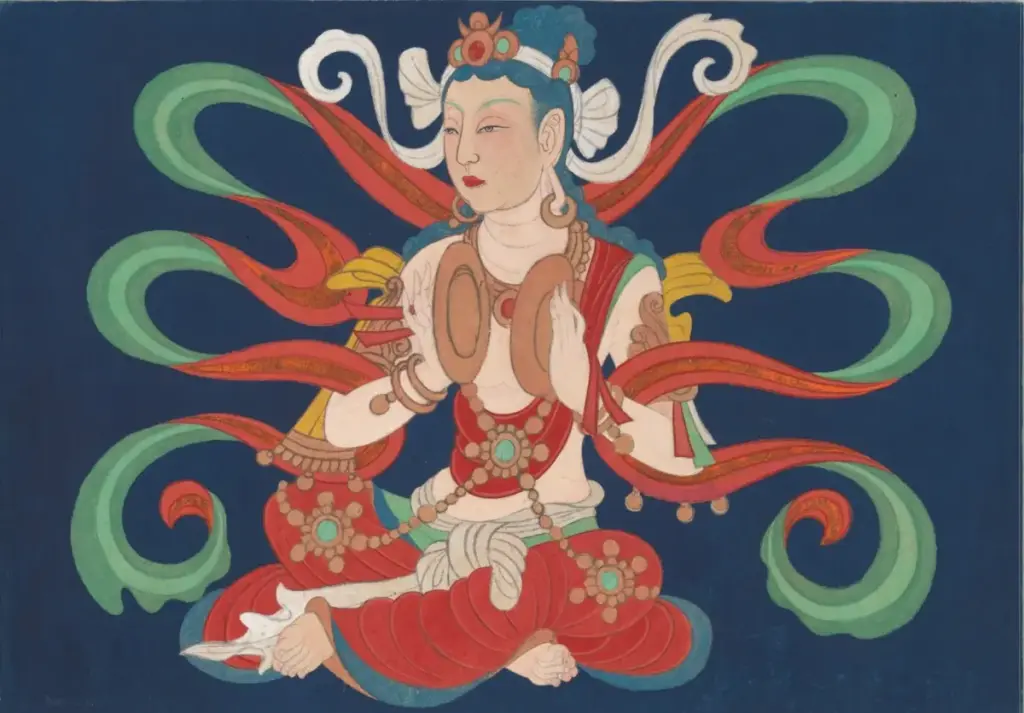
The historical foundation of the acquisition lies heavily in Chang’s pivotal time at Dunhuang, an ancient Buddhist temple complex situated strategically on the rugged edge of the Gobi Desert. During the early 1940s, Chang spent nearly three years at the remote site, meticulously copying and studying the ancient mural paintings dating from the Northern Wei to the Tang dynasties. This grueling campaign of copying required immense discipline and profoundly transformed his artistic vocabulary. The studies he produced during this desert sojourn provided him with an intimate technical mastery of mineral pigments, monumental composition, and line work, elements that would reverberate through his entire subsequent career.

As the decades progressed, Chang’s artistic vision underwent another radical evolution. Moving far beyond the classical replication and traditional landscape formats that had initially established his reputation, his work from the 1960s onward dissolved traditional boundaries. In these later creations, delicate landscapes and precise still-life motifs unraveled into radiant abstractions. Utilizing a signature splashed-ink and splashed-color technique—often developed while his vision was severely compromised later in life—Chang allowed broad pools of vibrant azure, emerald, and indigo to bleed organically across absorbent paper and silk, creating atmospheric vistas that bridged traditional Chinese literati aesthetics with the gestural freedom of Western Abstract Expressionism.

The newly acquired works reflect this remarkable duality, capturing both the disciplined historian of classical traditions and the daring modernist innovator. According to the museum’s roadmap for the collection, a curated selection of these acquisitions will be placed on public view later this year, offering museum visitors and scholars an immediate glimpse into the scope and brilliance of the trove. Furthermore, the entire collection is slated to serve as the structural anchor for a comprehensive exhibition dedicated to 20th-century Chinese ink painting, which the Met has scheduled to open to the public in 2028.