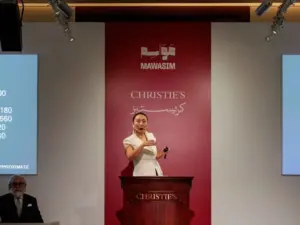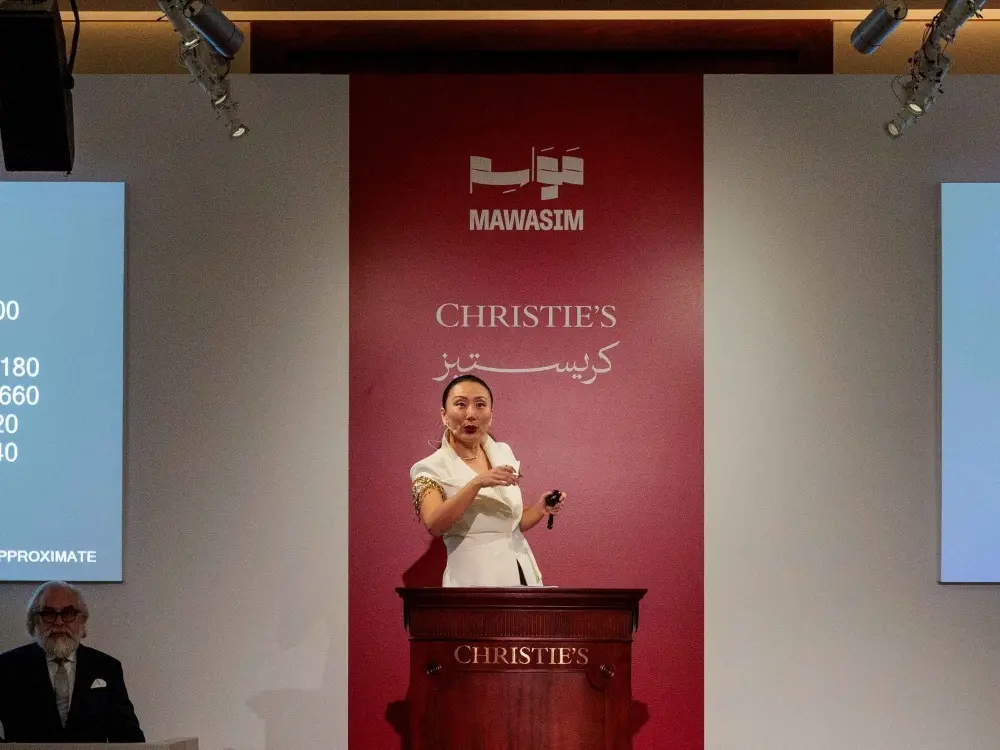
Christie’s made a resounding statement on Sunday evening in the United Arab Emirates, hosting its very first dedicated fine art sale in Abu Dhabi. Titled “MAWASIM: 20 Years of Modern and Contemporary Middle Eastern Art,” the milestone auction was designed to commemorate the prestigious auction house’s twentieth anniversary of holding auctions in the UAE. When the final hammer fell at the luxury Abu Dhabi Edition hotel, the high-profile evening sale achieved a solid total of $8.94 million, anchored by strong international participation, intense bidding wars, and a wave of newly established auction records for prominent artists from across the Middle East and North Africa.
The auction featured a carefully curated selection of modern and contemporary works created by celebrated artists from the broader MENA region. From the outset, the room buzzed with energy as collectors, dealers, and art enthusiasts vied for prime pieces of cultural heritage and contemporary expression. Leading the entire auction was Monir Shahroudy Farmanfarmaian’s mesmerizing mirror mosaic masterpiece, Variations on the Hexagon (2006). Estimated conservatively between $150,000 and $250,000, the work ignited a fierce seven-minute bidding contest among determined collectors in the room and on the phones. It ultimately sold for an astounding $844,800, setting a triumphant tone for the rest of the evening. The strong performance of Farmanfarmaian’s work arrives as the late artist continues to garner international institutional acclaim, notably being the current subject of a major retrospective exhibition at the Moderna Museet in Stockholm, Sweden.
The momentum continued throughout the night as several other premier lots exceeded expectations and commanded substantial prices. Among the notable highlights was Fahrelnissa Zeid’s vibrant Composition (1948–49), which realized $524,800, comfortably beating its low estimate of $500,000. Close behind was Faisel Laibi Sahi’s evocative Baghdad Café (The Coffee Shop) from 2016, which captured significant collector interest and fetched $512,000, surpassing its low estimate of $400,000. Ali Banisadr’s dynamic and complex canvas Homo Deus (2018) also proved to be a major draw, bringing in $512,000 and closely approaching its lofty high estimate of $550,000. All final sales figures released by Christie’s, in accordance with industry standards, accounted for buyer’s premium fees.
The depth of the market and the broad appeal of the catalog were further underscored by the sheer efficiency of the sale. Out of the 68 lots offered during the evening, only eight went unsold, resulting in an impressive 88.2 percent sell-through rate by lot. This robust figure illustrated not only the health of the regional collecting community but also the sustained global demand for modern and contemporary art originating from the Middle East and North Africa.
The historic evening also proved to be a watershed moment for individual market valuations, with new auction records achieved for a remarkable nine different artists. Collectors witnessed milestone prices set for Jellal Ben Abdallah, Paul Guiragossian, Faisel Laibi Sahi, Juliana Seraphim, Nabil Kanso, Samia Halaby, Rami Farook, Fatma Lootah, and Afra Al Dhaheri. Among these record-setting works, Paul Guiragossian’s powerful figurative composition Noces (Wedding), painted between 1958 and 1959, generated intense competition before selling for $486,400, coming within a hair’s breadth of beating its ambitious high estimate of $500,000.
Following the conclusion of the successful sale, leadership from Christie’s offered insights into the shifting demographics and expanding geographical footprint of the art market. In a joint statement, Ridha Moumni, Christie’s chairman of Middle East and Africa, along with Marie-Claire Thijsen, head of sale and specialist for Christie’s UK and UAE operations, emphasized the broader implications of the evening’s results. They noted that the exceptional breadth of bidding across the entire catalogue demonstrated the genuine international interest that the Middle Eastern and North African art category has successfully achieved in the contemporary global art market. Furthermore, they pointed out that the overall scale of the event reflected the impressive depth of the region’s domestic art sector and its demonstrated capacity to successfully support a major, high-stakes international sale of this magnitude.
Significantly, Christie’s highlighted shifting trends in collector engagement during the Abu Dhabi debut. Demographic data released by the auction house revealed that more than 30 percent of all registered bidders for the sale belonged to the millennial and Gen Z generations, signaling a healthy generational shift and fresh injection of capital into the regional art collecting ecosystem. Additionally, a noteworthy 37 percent of the participants taking part in the evening’s proceedings were completely new clients to Christie’s, highlighting the growing allure of the regional market and the auction house’s expanding reach in the Gulf.
The debut fine art sale in Abu Dhabi was further elevated by a simultaneous cultural presentation. Leading up to and during the event at the Abu Dhabi Edition hotel, Christie’s offered local collectors, connoisseurs, and visitors a rare preview opportunity. The auction house displayed three major museum-quality masterpieces sourced directly from its upcoming marquee autumn sales in New York. This high-profile museum-grade display offered regional audiences an intimate look at works of extraordinary global art-historical importance.
Among these preview highlights was Wassily Kandinsky’s seminal abstract painting Betonte Ecken (1923), which carries a staggering pre-sale estimate of $60 million to $80 million. Alongside the Kandinsky hung Mark Rothko’s meditative and luminous Untitled (1968), carrying an estimate of $10 million to $15 million, as well as Pablo Picasso’s striking cubist portrait Tête de femme (1939), which has been estimated at $12 million to $18 million. By bringing these blue-chip Western masterpieces to Abu Dhabi alongside the rich offerings of MENA modernism, Christie’s reinforced the emirate’s growing status as an increasingly vital nexus in the international fine art marketplace, bridging regional heritage with the global elite collecting sphere as it marks two decades of continuous presence in the United Arab Emirates.