As the design world turns its focus toward the fall season, cultural institutions, galleries, and public spaces around the globe are rolling out an ambitious slate of exhibitions, immersive events, and high-stakes competitions. From major retrospective explorations of twentieth-century modernist pioneers to cutting-edge contemporary dialogues on public space, urbanism, and environmental horticulture, the coming months offer a rich array of programming for architects, designers, and urban enthusiasts alike.
Kicking off the season in Northern Europe, Finland’s Design Museum is dedicating its primary fall exhibition to the enduring creative and cultural legacy of the renowned Finnish design couple Antti Nurmesniemi and Vuokko Nurmesniemi. Working both independently and in close collaboration across multiple disciplines—spanning architecture, fashion, and interior design—the duo played a foundational and widely influential role in shaping the trajectory of the Finnish design industry throughout the late twentieth century. Their distinct approaches to form, material, and spatial composition continue to resonate within contemporary practice.
Looking ahead to the winter months, the ZKM Center for Art and Media in Karlsruhe, Germany, is preparing to mount the first-ever solo exhibition dedicated to the high-rise architect Ole Scheeren. Founded in 2010, Scheeren’s eponymous firm has gained international acclaim for monumental and experimental structural interventions. The German-born architect, who originally launched his professional career at OMA in Rotterdam, is globally recognized for spearheading groundbreaking projects such as the award-winning China Central Television (CCTV) Station in Beijing and the intricately stacked Interlace residential complex in Singapore. Titled Spaces of Life, the exhibition will run from December 10, 2022, through June 4, 2023, offering visitors a comprehensive look into his visionary approach to vertical urbanism and human-centric architecture.
Ongoing Exhibitions
In Los Angeles, a major milestone in residential modernism is currently being celebrated at the historic Schindler House in West Hollywood. Constructed a century ago in 1922, R.M. Schindler’s iconic home has experienced countless distinct chapters over its lifetime. Originally conceived as an experimental model for communal living shared by Schindler, his wife Pauline, and their friends Clyde and Marian Chace, the residence has functioned since 1994 as the headquarters of the MAK Center for Art and Architecture, an independent satellite of Vienna’s Museum of Applied Arts (MAK).
To mark the centenary of the house, the MAK Center has curated an exhibition titled Schindler House: 100 Years in the Making, running through September 25, 2022. Curated by MAK Center director Jia Yi Gu alongside architectural historians Gary Riichirō Fox and Sarah Hearne, the exhibition presents a "gentle timeline" that traces the physical and conceptual making and unmaking of the building. Rare historical materials are thoughtfully juxtaposed with contemporary spatial and artistic interventions by a diverse roster of artists and designers, including Carmen Argote, Kathi Hofer, Fiona Connor, Julian Hoeber, and Peter Shire.
Milan is currently hosting a sweeping retrospective dedicated to another titan of twentieth-century design: Pritzker Prize-winning architect Aldo Rossi. On view at the Museo del Novecento through October 2, 2022, Aldo Rossi: Design 1960–1997 brings together more than 350 works spanning Rossi’s prolific career. Best known for his theoretical innovation and high-profile manufacturing collaborations with prominent Italian and international brands such as Designtex, Artemide, Alessi, and Up&Up, Rossi left an indelible mark on product design and architectural theory. Curated by Chiara Spangaro with layout and interior architecture designed by Morris Adjmi Architects, the exhibition unfolds across nine distinct galleries, emphasizing how Rossi’s experimental exploration of color and materials continues to influence contemporary design thinking.
In Vienna, the MAK Exhibition Hall is currently presenting the first comprehensive institutional overview of the avant-garde architecture group Missing Link. Active between 1970 and 1980, the collective was founded by Angela Hareiter, Otto Kapfinger, and Adolf Krischanitz. Their expansive body of work ranged from provocative utopian proposals for collective communal living to rigorous research studies mapping urban networks across Vienna. Running through October 2, 2022, the exhibition situates Missing Link’s output alongside works by influential contemporaries such as Hans Hollein and Joseph Beuys, while also delving into broader cultural histories, including traditional Viennese coffeehouse culture and the progressive municipal housing initiatives of Red Vienna.
Meanwhile, in Almere, Holland, the international horticultural exhibition Floriade Expo 2022 continues to draw international crowds through October 9, 2022. Held once every decade, this global horticultural showcase features temporary pavilions that highlight cutting-edge developments in landscape architecture, urban greening, and botany from around the world. Architecture firm MVRDV was commissioned to design the 60-hectare master plan for the six-month event, conceptualizing the site as a living model for sustainable urbanism anchored by a rigorous arboretum framework. An alphabetical library of trees and plants is organized into a strict grid system, dictating the overall layout and circulation for the international pavilions. Following the conclusion of the event, the entire site is slated to transition into a permanent, ecologically integrated residential neighborhood for the city.

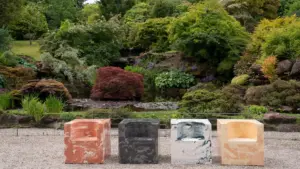
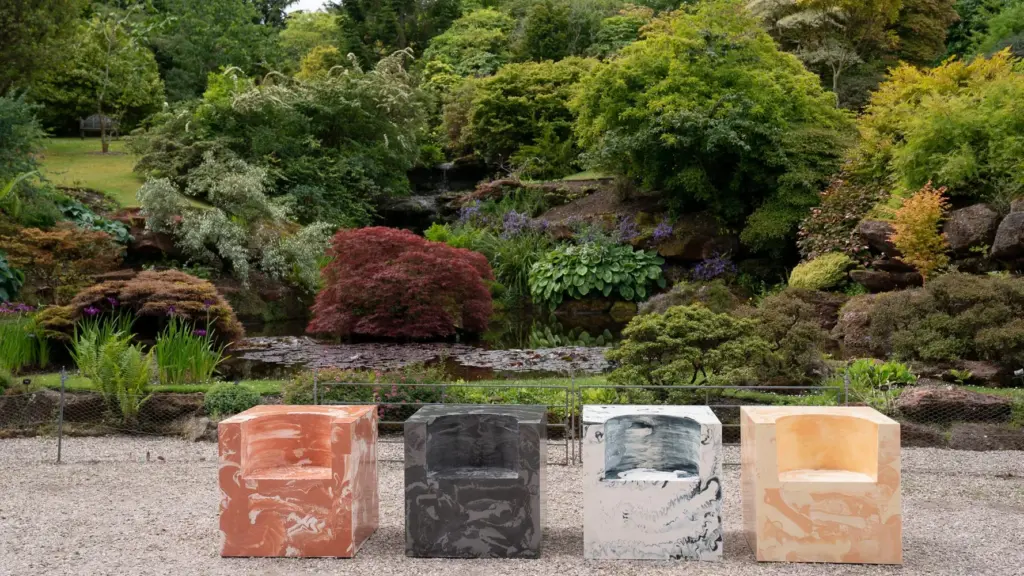
In Scotland, the Isle of Bute serves as the picturesque backdrop for Sitting Pretty, an outdoor exhibition running through October 15, 2022. Last September, Design Exhibition Scotland issued an open call inviting architects, designers, and artists from across the country to conceptualize innovative prototypes for the public park bench. The resulting selected designs—created by Rekha Maker, C.A. Walac, Chris Dobson, and the collaborative team of Dress for the Weather and Stefanie Cheong—are currently installed across the historic grounds of Mount Stuart, a nineteenth-century baronial mansion. Utilizing a diverse palette of locally sourced and reclaimed materials, including Scottish sandstone, marble, regional timbers, and recycled plastics, the benches pay direct homage to the rich material history and architectural context of the palatial estate.
London’s Building Centre is currently hosting The Garden of Privatised Delights through October 15, 2022. Originally featured at the Venice Architecture Biennale, the exhibition was commissioned by the British Council and curated by Madeleine Kessler and Manijeh Verghese of the London-based practice Unscene Architecture. Taking its evocative title from Hieronymus Bosch’s famous triptych, the exhibition critically examines the proliferation of privately owned public spaces throughout the United Kingdom, issuing a call to action for novel architectural approaches to resolve ongoing conflicts between private commercial interests and the public good. Seven architectural practices from across the UK—including the Decorators, Studio Polpo, and vPPR Architects—contribute imaginative, inclusive redesigns for various typologies of privatized public space, ranging from local pubs and high streets to playgrounds and public restrooms.
In New York, the Metropolitan Museum of Art is presenting the first major posthumous retrospective of the legendary German photography duo Bernd and Hilla Becher. Running through November 6, 2022, the exhibition features over 200 works documenting the rapidly disappearing industrial architecture of the twentieth-century postwar era. Armed with large-field view cameras, the Bechers meticulously captured water towers, grain silos, blast furnaces, gas tanks, and other utilitarian structures they famously termed "anonymous sculptures." They systematically organized these photographic studies into rigid "typologies"—structured grids consisting of anywhere from four to thirty individual images that highlight formal variations within standardized industrial typologies.
Events
The autumn calendar also features a robust schedule of symposia, film festivals, and cultural celebrations focused on the built environment. In Los Angeles, the inaugural LightSPEC West event is scheduled for September 21–22, 2022, highlighting the latest innovations and design strategies in architectural lighting for the built environment. Over the course of two days, the program addresses critical concerns for building designers, owners, and facilities operators through guided site tours, curated product showcases, and continuing education units (CEUs) delivered via individual presentations and panel sessions. Notable keynote addresses will be delivered by Lawrence Scarpa of the architecture firm Brooks + Scarpa and Thomas Paterson of the lighting design practice Lux Populi.
The Arquiteturas Film Festival is preparing for its ninth annual edition, relocating this year from Lisbon to Porto, Portugal, where it will run from September 27 to October 1, 2022. Under the thematic banner "Slow Down!", festival organizers invited international filmmakers to submit projects ranging from animated shorts to feature-length documentaries that engage with practices of "reducing, reusing, demolishing, or subtracting" within architecture and urban planning. The festival highlights the moving image as an essential medium for expanding public discourse around the interdisciplinary nature of the built environment, with awards distributed across categories including documentary, fiction, experimental, new talent, social awareness, and audience choice.
In Scandinavia, the Copenhagen Architecture Festival returns from October 6 to 16, 2022, as the largest architecture festival in the region. This year’s programming centers on the theme "Sense of Place," challenging architectural professionals and the public to investigate the critical threshold where physical space transforms into a meaningful "place," and where mere construction evolves into enduring architecture. Comprising a citywide network of public lectures, exhibitions, critical debates, and specialized film screenings, the festival has established a partnership with the Danish Architects Association to host parallel events at cultural institutions throughout Denmark.
Later in October, Las Vegas will host Duck Duck Shed: Celebrating Las Vegas Architecture, Design, and Culture from October 27 to 30, 2022. Headquartered at The Neon Museum—housed within a landmark pavilion designed by Paul Revere Williams that preserves the city’s iconic neon signage—the four-day event celebrates decades of radical architectural innovation, particularly within the hospitality sector. Featuring prominent speakers such as urban planner Alan Hess and architect Jon Sparer, the team responsible for major destinations including the Mirage, Paris Las Vegas, and the Bellagio, the event draws theoretical inspiration from Denise Scott Brown, Robert Venturi, and Steven Izenour’s seminal text Learning From Las Vegas. The book famously categorized commercial architecture into "ducks" (buildings whose overall forms explicitly represent unique shapes) and "decorated sheds" (generic structures reliant on applied signage and décor). The event is officially sponsored by the Commission for the Las Vegas Centennial.
Competitions
For practitioners seeking active design challenges, the Czech real-estate development group 4th Quadrant has launched an international architecture competition seeking a multidisciplinary design team to master-plan and revitalize the urban area surrounding Victory Square in Prague. The competition brief calls for designs that address a localized deficit of civic amenities, retail spaces, and essential services for residents of adjacent neighborhoods, while respectfully honoring the foundational 1924 urban master plan by architect Antonín Engel.
In the initial phase, a selection committee will choose between six and ten architectural firms based on submitted portfolios. Shortlisted teams will subsequently develop detailed design proposals in close collaboration with the 4th Quadrant development group, the City of Prague, and the Prague University of Chemistry and Technology. Participating practices will be awarded financial stipends distributed across three competitive design phases.