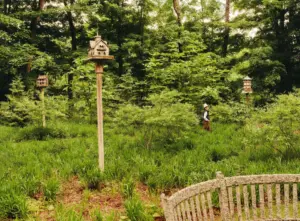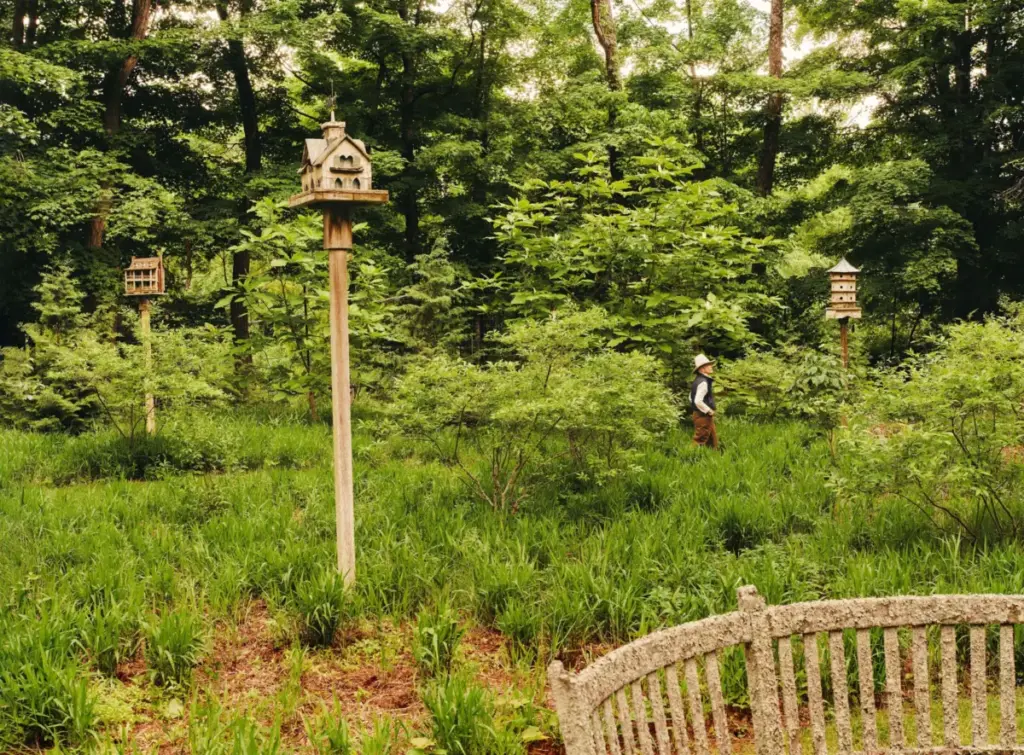
Among the apple trees at the edge of AD100 Hall of Famer Bunny Williams’s storied country garden in Falls Village, Connecticut, stands an eclectic, whimsical settlement. It features a church with a sensible tin roof, a thatched cottage, a pagoda, a red house flying a tiny flag that resembles a general store, and a shuttered confection reminiscent of a Russian dacha. Each structure is raised high on its own post, finished on every side, and painted and weathered like the buildings of a settled town—yet none of them features a door wide enough to fit a human hand through. It is an entire hamlet fashioned exclusively for birds, assembled building by building in the organic way real towns often grow: slowly, and entirely without a master plan.
For many years, as Williams and her husband, the antiques dealer John Rosselli, scoured fields and country fairs to source inventory for Treillage, their much-loved and influential shop that operated in New York City until 2015, the birdhouses kept finding her. They steadily gathered on shelves in the hayloft of her Connecticut barn.

"When I had two, I didn’t know what to do with them," Williams recalls. "Then all of a sudden there were 10."
Eventually, she decided that the decorative structures had been kept in storage long enough and deserved to see the light of day. At that point, Williams and Robert Reimer, the head gardener on her property, began the meticulous process of reclaiming a long-overlooked point of land on the estate. To create physical space and liberate a neglected stand of existing apple trees, they removed invasive plant species, subsequently planting oat grass, bird-friendly scrub plants, and fruit-bearing pawpaw trees.

To properly establish the avian neighborhood, Williams had uniform posts manufactured—deliberately tall, "so that you look up at them," she explains. Each post was wrapped with a smooth metal band to deter ambitious squirrels from climbing too high and disturbing the tenants she had in mind. Finally, the houses went up, eventually totaling 17 distinct structures.
The attraction to these pieces had nothing to do with financial value or high artistic pedigree. "Most of these birdhouses are sort of folk art," Williams notes. "They were somebody having fun building an unusual structure." They are not miniature versions of Monticello, nor are they precise replicas of someone’s actual residence; instead, they are the work of unknown makers, each possessing "an eye and a kind of humor," and none striving for sterile perfection.

The proof of this charm is found directly in the details: the delicate gingerbread scallops on a multi-holed high-rise where "somebody had a great time with their little saw," the thatched-roof cottage she treasures because she has never seen another example quite like it, and the decorative weather vane crowning the would-be dacha.
What Williams lacked initially was historical context, as the antique dealers who sold her the pieces seldom had any background information to pass along. Yet, as it turns out, the record of these vernacular objects is often recoverable through dedicated research.

"The period from 1890 to 1930 is really the birdhouse’s golden age," says Jacob Torkelson, an architectural historian and researcher at the University of Pennsylvania’s Stuart Weitzman School of Design. Torkelson is among the very few scholars in the country studying these specific objects, and he has painstakingly been identifying their makers and manufacturers whenever a name survives. Across those decades, government pattern books actively encouraged farmers to install birdhouses to reduce reliance on chemical pesticides, noting that the birds would naturally consume troublesome insects. Meanwhile, mail-order companies marketed the structures to homeowners as pure whimsy and an effective way of promoting biodiversity in their residential gardens.
Shown photographs of Williams’s eclectic collection, Torkelson was able to supply missing pieces of history that dealers could not provide. He successfully traced one particular house down to a specific catalog page: the six-room Bungalow Martin House sold by the E.F. Hodgson Company, which listed the model from about 1917 until the firm permanently closed its doors in 1944.

"Birdhouses are these wonderful mirrors to the human condition," Torkelson observes. "They tell us the values that we have as a society or as individuals, in our houses, in our gardens."
Williams’s collecting journey is far from over. Last May at Trade Secrets, the annual Litchfield Hills garden fair she cofounded in 2001 to raise crucial funds for a local nonprofit domestic violence support agency, she stopped at the tent of Jim Sidon. Sidon’s company, Sparrow 10:29, crafts avian-sized replicas of real buildings. Based outside Atlanta, Sidon transitioned to this unique craft after retiring from a career in the printing industry. His very first architectural birdhouse, built in 2017, was an exact replica of the 1792 Federal-style mansion in Newburyport, Massachusetts, where he and his wife had rented two rooms as newlyweds.

Remarkably, it was Sidon who recognized, in three of Williams’s existing houses, the unmistakable hand of his late friend Larry Smith, a North Georgia birdhouse builder widely known for his signature metal roofs and charmingly rustic details. Williams has since commissioned Sidon to build her something new, though she is still deciding precisely what form it should take. Unlike her anonymous folk-art makers, Sidon numbers and signs every single house he creates.
"My hope is that years from now, someone’s searching that out," he says, "and when they open it up, they’ll see my signature."

Back in Falls Village, the upkeep routine for the historic collection is minimal: Every couple of years, the houses are brought down, treated with a fresh coat of wood preservative, and hoisted back up to face the elements. Sidon’s modern constructions, featuring cedar exteriors and tight seals against the weather, require even less maintenance. His personal replica of the Newburyport mansion has stood in his own garden for nearly a decade completely untouched.
"I just hose it off," he notes.

None of this weathering troubles Torkelson, who is a preservationist by professional training. "These houses were made to be ephemeral," he explains. "They weren’t made to last forever, and they should absolutely be used."
As for the intended avian residents, Williams suspects that the local birds mostly prefer making their natural homes in the surrounding trees, where they carry on, as she describes it, like a symphony orchestra.

"I’ve always felt that one of the reasons they don’t live in these houses is the birds think it’s suburbia," she says. "But they like the atmosphere."
Come winter, however, when the surrounding woods go bare and the miniature village becomes visible through the stripped branches, Sidon would wager that the houses do indeed get used, with songbirds crowding inside two or three at a time for warmth. Williams cannot say for certain—she has never once climbed up a ladder to check.

"If they are nesting," she says simply, "I don’t want to bother them."