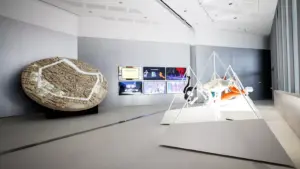
For an hour or so yesterday, I found myself functioning as little more than a willing lab rat in a living experiment orchestrated by artist Carsten Höller. As I settled down onto the mirrored carnival swings installed as part of Carsten Höller: Experience—a sweeping exhibition of his work occupying Manhattan’s New Museum—and began to spin very slowly through the air, I became acutely and self-consciously aware of my own performance. My carousel ride was serving just as much for the casual entertainment of the other gallery visitors as it was for my own personal amusement. A mobile of suspended wire cages housing live canaries in the same gallery space not-so-subtly drove that exact point home, reminding everyone present of the voyeuristic nature of the environment.
This awkward, disorienting shift from being a passive viewer to becoming the actual exhibit happens reliably in much of the Brussels-born artist’s work. Höller’s artistic practice consistently combines physical disorientation and playful interactivity with the clinical dynamics of behavioral research, all balanced with a healthy, theatrical dose of visual and experiential spectacle. One need only witness Giant Psycho Tank (1999) to understand this methodology. That particular installation dares museum visitors to completely undress, step gingerly up into a large plastic tank raised a few feet above the gallery floor, and float alongside similarly prone, completely naked strangers in a sensory-depriving pool of warm salt water heated precisely to amniotic body temperatures.
With works like these and other immersive installations, Höller successfully transforms the traditionally sterile white-cube architecture of the contemporary art museum into a functional laboratory—albeit one entirely stripped of any identifiable research objective or clinical safety net. It comes as little surprise to learn that Höller actually earned a PhD in agricultural science, where he spent his academic time studying insect communication, before making the definitive pivot to pursue art full-time. His work cleverly activates the complex social dynamics of the gallery space, but it does so in a way that deliberately elicits deep self-awareness rather than genuine, comfortable interactions with others. Everyone else in the room is simply there to serve as a living reminder that you are constantly being watched, evaluated, and consumed as spectacle.
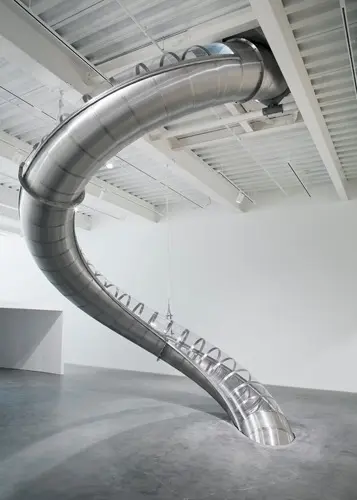
Perhaps the most dramatic and structurally disruptive inversion of the typical museum experience, however, is Untitled (Slide) (2011), an ambitious piece that directly intervenes in the museum’s striking building architecture. The structure itself was designed by the acclaimed Pritzker Architecture Prize laureates Kazuyo Sejima and Ryue Nishizawa of the Tokyo-based firm SANAA and was completed in 2007. An iteration of a site-specific concept executed by Höller in several other prominent global venues—most sensationally at the Tate Modern’s massive Turbine Hall in London back in 2006—Untitled (Slide) is a heavy, industrial steel tube that forcefully protrudes through the solid concrete floor of the museum’s fourth floor. It drops in a steep, terrifying twist down through the third floor before finally opening up to a cushioned landing area situated on the second floor.
As brave visitors slide rapidly down the metallic chute, they are routinely examined and watched by their peers through transparent Plexiglas windows lining various sections of the tube. Upon exiting, they are unceremoniously deposited directly among a collection of fluorescent sculptures depicting fatigued-looking animals that seem to exist somewhere in the bizarre aesthetic intersection of a natural history museum diorama, outsized children’s toys, and beached whales. Completely disoriented from the sudden two-story drop, and thoroughly dazed by the flashing, rhythmic stripes of white neon light that illuminate the installation space, one cannot help but feel a strange, sudden camaraderie with the day-glo specimens surrounding them on the gallery floor.
Although the actual physical ride down the tube takes only a few breathless seconds, the engineering and physical installation of the slide was no small feat for the institution. The museum was forced to cut directly through two of its heavy, nine-inch concrete floor slabs and underlying metal structural decks in order to properly insert the massive piece. To accomplish this safely, the institution consulted extensively with Gensler’s New York office, which originally served as the executive architect for the building, alongside structural engineering firm Simpson Gumpertz & Heger.
According to the museum’s deputy director, John Hatfield, the intricate process involved taking detailed x-rays of the building’s concrete floors to accurately determine the absolute best insertion points, carefully adjusting the tight physical twist of the slide to fit the constrained vertical space, and even intentionally severing some electrical wiring while drilling straight through the dense concrete. The invasive intervention took just a couple of months to properly permit and execute, and the gallery floors are scheduled to be fully and immediately restored right after the exhibition officially closes on January 15. Yet, within the current exhibition space, two delicate Pyrex-looking glass models and a detailed section drawing—conceived for a speculative skyscraper complex and a private house, both interconnected throughout by a sprawling nest of similar slides—allude to much bigger architectural possibilities for the future.
Höller’s ongoing experiments can occasionally begin to feel somewhat one-note or even superficially gimmicky as visitors become fully accustomed to the predictable self-awareness that his environments provoke. Yet, despite this risk, most of his interventions remain cunning, intellectually sharp, and giddily effective in practice.
Tucked away discreetly in an alcove located right along the notoriously narrow, four-foot-wide stair leading between the third and fourth floors, Höller has placed a standard office water cooler sitting immediately next to a careless pile of unlabeled white gel-caps. As another museum visitor and I stood there uncomfortably contemplating whether we were actually meant to swallow the unidentified pharmaceutical drugs sitting openly before us, we both jumped audibly when an unseen mechanical device hidden in the ceiling directly above suddenly dropped yet another handful of pills onto the growing pile. Standing there in the cramped stairwell, I felt uncomfortably like a lab animal desperately navigating a psychological laboratory maze as I scurried up SANAA’s notoriously restrictive architectural stairs.
Carsten Höller: Experience is currently on view at the New Museum in New York City, running from October 26, 2011, through January 15, 2012.