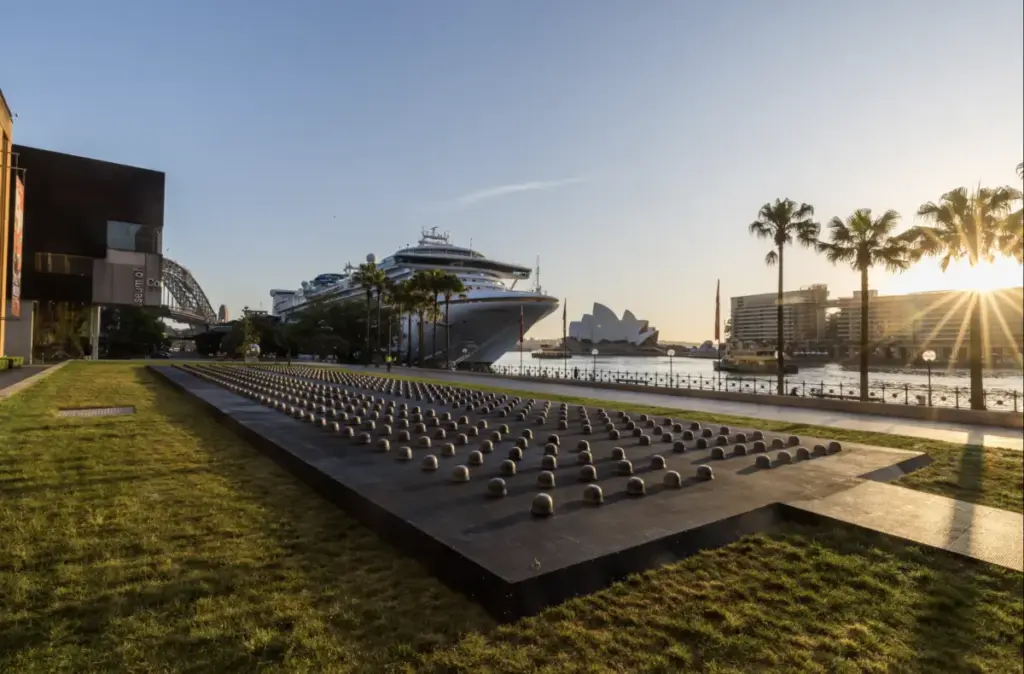
Renowned artist and dissident Ai Weiwei has unveiled his latest major public commission at the Museum of Contemporary Art Australia in Sydney, transforming the city’s busiest green space into a thought-provoking landscape of military symbolism and political critique. Titled Mushrooms, the expansive installation comprises 500 cast-iron combat helmets meticulously arranged in ten orderly lines across the harbor-adjacent Tallawoladah Lawn.
Measuring 131 feet in length, the installation is mounted on an elevated platform that is cleverly split by a pedestrian walkway, ensuring that the work is virtually impossible for visitors and locals navigating the famous Sydney Harbour to miss. The helmets themselves evoke various styles of 20th-century combat gear, complete with detailed inner padding sculpted into the heavy metal castings.
According to an official statement from the artist, the title of the work carries multiple layers of meaning, drawing a symbolic parallel between the curved lip of a military helmet and organic growth. As Ai explained, the word alludes to “growth in darkness, nuclear mushroom clouds, and in Chinese, the term also suggests endless delays.”
The monumental public art display serves as a stark reminder of the persistent shadow of global conflict in contemporary society. “We continue to exist in a time where war and peace interchangeably assume each other’s roles, shaping the identity of our age. I hope this work prompts people to reflect on war and peace,” Ai said.
The Inspiration and Controversy Behind Mushrooms
The newly unveiled installation serves as the latest iteration of the prestigious Neil Balnaves Tallawoladah Lawn Commission. The commissioning program is named in honor of the late Australian philanthropist and businessman Neil Balnaves, who tragically died in a boating accident near Tahiti in 2022 at the age of 77. The striking public artwork will remain on public view for a period of seven months, offering ample opportunity for visitors and art enthusiasts to engage with its complex visual vocabulary.
For viewers looking to delve deeper into the conceptual origins of the piece, the installation traces back to a specific geopolitical controversy that erupted in 2022. Following Russia’s full-scale invasion of Ukraine, the German government initially faced heavy international scrutiny and mockery when it declined to supply heavy military weapons to the embattled nation. Instead, Berlin offered a shipment of roughly 5,000 combat helmets—a gesture that officials in Kyiv publicly dismissed at the time as “an absolute joke.”
However, despite the historical reference to the diplomatic misstep, Ai clarified in an interview with the Art Newspaper that Mushrooms is not intended to be understood as a “political joke.”
Instead, the artist emphasized that the installation is designed to probe much deeper into the mechanics of governance and foresight. The work aims to “demonstrate how shallow an understanding today’s national leadership can have of the human condition and of what may happen in the future,” according to the artist. By transforming a piece of military equipment—historically meant for protection—into an eerie, mushroom-like landscape, the artist underscores the absurdity and inadequacy of bureaucratic responses to existential global threats.
Continuing a Legacy of Public Art at Tallawoladah Lawn
The arrival of Mushrooms follows the inaugural presentation of the Neil Balnaves Tallawoladah Lawn Commission, which was awarded last year to British sculptor Thomas J. Price. Price made a lasting impression on the Sydney waterfront with his striking installation, Ancient Feelings.
That inaugural commission featured a monumental, golden-bronze sculpture of a woman’s head that stood more than 10 feet tall. Gazing out serenely toward Sydney Harbor, Price’s work was designed to invite viewers to, in the artist’s own words, “reflect on the universal emotions and experiences that connect us all.”
While Price’s sculpture leaned into themes of universal human connection and introspection through figurative grandeur, Ai Weiwei’s 21st-century intervention approaches the public square through the lens of collective anxiety, historical irony, and geopolitical critique. Together, these commissions have quickly established the Tallawoladah Lawn outside the Museum of Contemporary Art Australia as one of the country’s most dynamic and anticipated platforms for ambitious, large-scale contemporary public art.