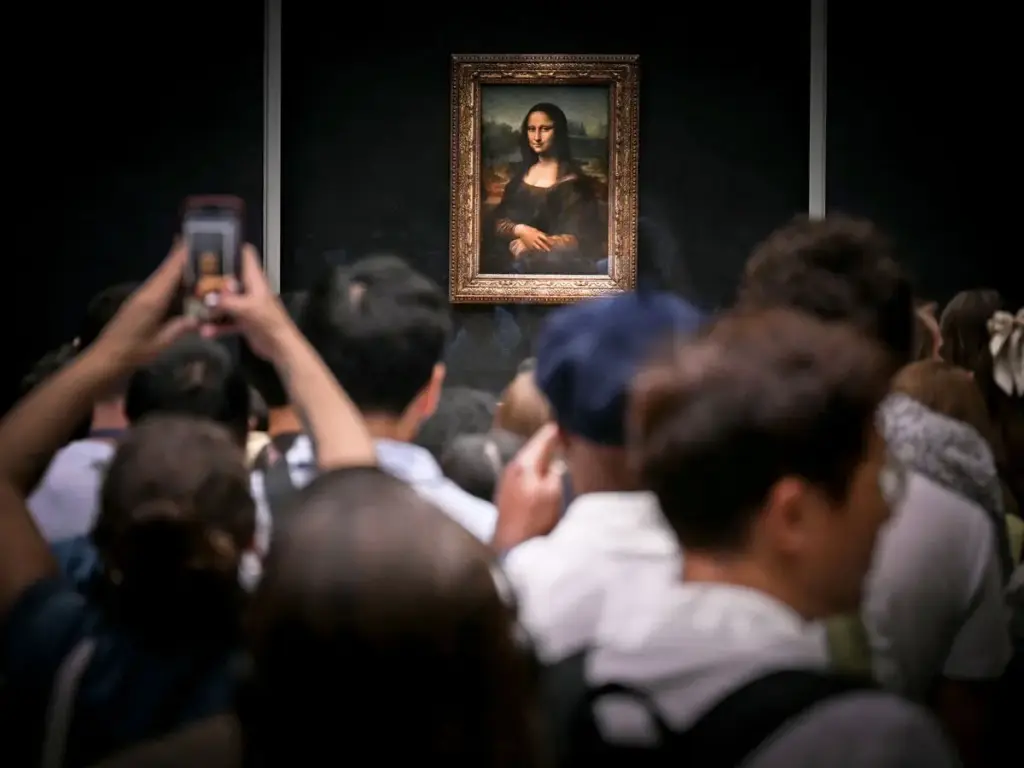
PARIS — Security at the world’s most visited museum faced an unusual test on Saturday when two visitors managed to bypass standard protocol to install their own unauthorized artworks directly onto the walls of the high-security Salle des États, the famous gallery that permanently houses Leonardo da Vinci’s Mona Lisa.
According to reports from Agence France-Presse (AFP), which cited police sources, the two German nationals used ordinary sticky tape to mount two small canvases—each measuring approximately 11.8 by 15.7 inches—onto the walls of the heavily guarded hall. One of the guerrilla-style installations depicted one of the suspects dressed in a medieval suit of armor, while the other portrayed both individuals posing alongside an unidentified woman.
Despite the high volume of foot traffic in the room, where crowds gather from the moment the museum opens until it closes to catch a glimpse of the sixteenth-century masterpiece, the Mona Lisa itself sustained no damage during the bizarre incident. Museum security personnel quickly intervened, detaining the two individuals before turning them over to local law enforcement. Police sources reported that the suspects claimed they carried out the stunt purely "for fun."
In accordance with standard French legal procedures and privacy laws, the full identities of the two visitors were withheld, with authorities releasing only their nationality. When contacted regarding the breach, representatives for the Louvre did not immediately respond to requests for comment from ARTnews.
While the prank ultimately resulted in no harm to the museum’s priceless collections, the security breach arrives at a particularly sensitive time for cultural institutions across France and the broader European continent. For the past year, European museums have remained on high alert, though security apparatuses have typically been focused on preventing the theft of valuable artifacts rather than the unauthorized addition of inconsequential items by mischievous visitors.
The Louvre itself was the site of a major security failure nearly a year ago, when thieves successfully executed a brazen daylight heist, making off with an estimated $102 million worth of historic crown jewels. The stolen items were taken directly from the Galerie d’Apollon, a gallery situated only a short distance away from the Salle des États. That high-profile robbery triggered a wave of similar thefts and attempted thefts at various other museums, placing intense scrutiny on the vulnerability of public cultural institutions.
The fallout from the Louvre heist extended deep into the museum’s administrative leadership. Shortly after the robbery, a leaked government audit revealed severe shortcomings in the museum’s protective measures, describing the Louvre’s security infrastructure as "outdated and inadequate." The audit further pointed to "repeated postponements of the scheduled modernization of security systems."
The political and institutional consequences were swift. Laurence des Cars, who had made history as the first woman to serve as the president-director of the Louvre, resigned from her post in February. She was replaced the very next day by Christophe Leribault.
Over the course of the summer, Leribault offered a stark assessment of the institution’s operational realities during an appearance before the French Senate. He stated bluntly that the Louvre was "at the end of its ropes," explaining that "urgent building issues are piling up, and we are facing a massive investment challenge."
At the same time, Leribault assured lawmakers that the administration was addressing "the necessary emergencies head-on." Among the immediate upgrades prioritized by museum leadership is a comprehensive overhaul of security, including the scheduled installation of a new perimeter video surveillance system slated to go live in January.
Beyond immediate security fixes, the museum is preparing for a massive, multi-year transformation designed to address long-standing structural challenges. The Louvre is set to undergo a major renovation project expected to cost upwards of one billion euros—equivalent to roughly $1.2 billion.
The primary objective of this expansive initiative is to alleviate chronic overcrowding within the historic palace and construct a dedicated, 33,000-square-foot exhibition space specifically for the Mona Lisa. Under the current architectural plans, the famous portrait would eventually feature its own dedicated entrance to better manage the millions of tourists who visit the museum each year.
Although these ambitious expansion plans experienced a brief pause earlier this year, the project ultimately moved forward. In May, the museum officially announced the selection of the architectural team tasked with bringing the vision, officially titled the "New Louvre Renaissance," to life.