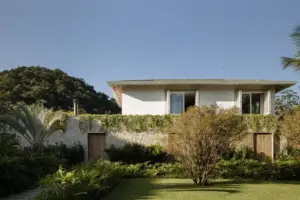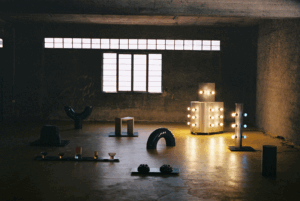
On Artists Walk in Park Forest, the landscape is one of unassuming charm. It is a corridor where the rhythmic pulse of community life plays out against a backdrop of local landmarks: the village hall, a long-standing barbershop, the Illinois Philharmonic Orchestra, and the local theater. Yet, tucked into this familiar setting is the Tall Grass Arts Association, an institution that has served as the heartbeat of the local creative scene for over seventy years. In a village of fewer than 25,000 residents, Tall Grass has remained a steadfast guardian of art, education, and the broader cultural ecosystem. However, even with seven decades of history behind it, the gallery recently broke new ground with an exhibition that challenged its own traditional boundaries.
The exhibition, titled Mented, marked a significant departure for the organization, serving as its inaugural foray into a truly contemporary, collaborative pairing. The show featured the work of Gretchen Jankowski, an associate professor at Governors State University, and her former student, Heather Cox. As the clever title suggests, the exhibition was built upon the foundation of their relationship as mentor and mentee. During the final weeks of preparation this past September, Director Katie Ziebell noted the uniqueness of the project, stating, “This will be the first of its kind.”
The public unveiling occurred on October 3, and the reception was nothing short of a local cultural milestone. More than fifty guests filled the gallery, creating a lively atmosphere of celebration that bridged the gap between the local Park Forest community and a broader, more geographically dispersed network of supporters. The turnout was particularly poignant given that Cox has since relocated to South Carolina; the opening served as a homecoming of sorts, bringing together her family, friends, and former peers to witness the evolution of her craft alongside that of her mentor. Visitors were immediately struck by the versatility of the works on display, which showcased a creative, multimedia approach to the age-old practice of printmaking.
The professional trajectory of Jankowski and Cox is a testament to the enduring power of academic mentorship. The two first crossed paths at Governors State University more than a decade ago. Over time, their connection evolved from the structured environment of a classroom into a deep artist-to-artist friendship and, eventually, a formal working partnership. This transition from teacher and student to collaborative peers formed the thematic core of the exhibition. By utilizing massive aerial installations, expansive painting techniques, felted reliefs, and even interactive interior design, the duo transformed the Tall Grass gallery into a whimsical, immersive wonderland.
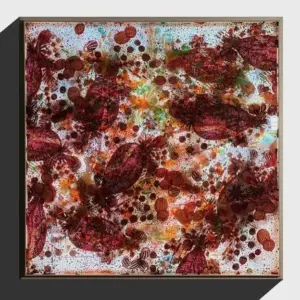
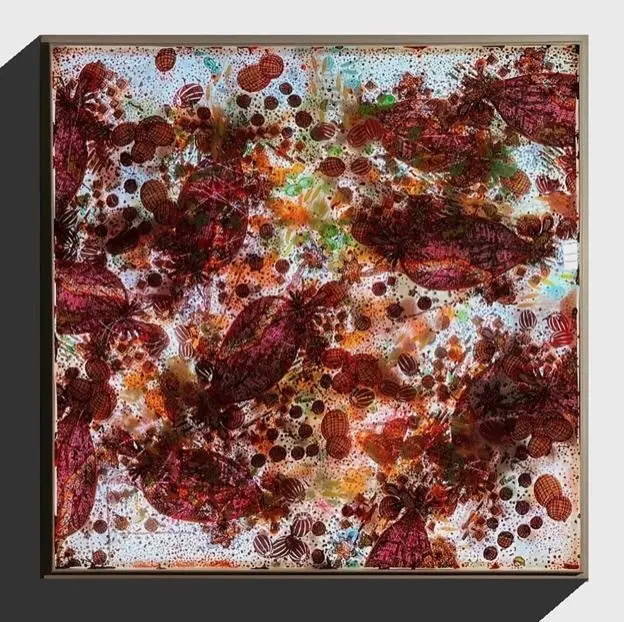
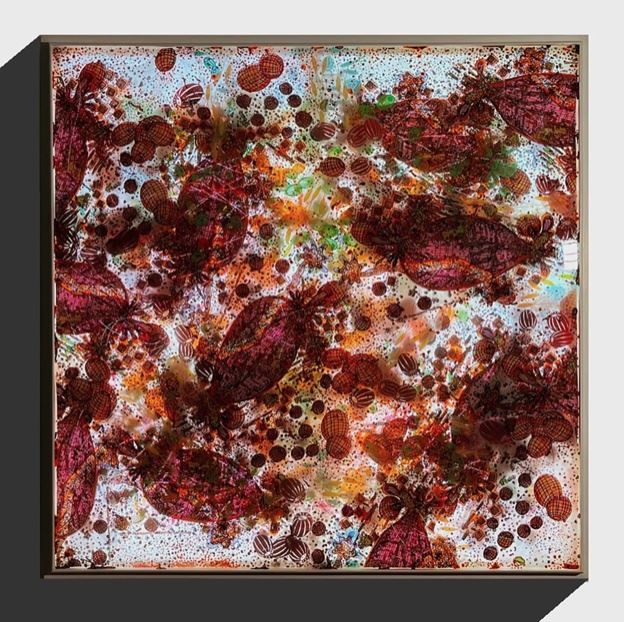
The exhibition highlighted the technical rigor that defines both artists’ practices. Gretchen Jankowski’s contributions were marked by a meticulous, labor-intensive resin-laying process. In these works, sections of traditional prints and paint were carefully embedded within multiple layers of resin. The resulting pieces were substantial—each weighing more than twenty pounds—and required specialized installation using French cleats to ensure their stability.
A centerpiece of this collection was West Wind Wars #2, a 52-by-52-inch light box that occupied a commanding position in the center of the gallery. Surrounded by other works, the piece acted as a beacon. By pushing LED light through the resin-embedded layers, Jankowski allowed viewers to perceive the internal print components as if they were suspended in time, resembling bubbles trapped deep within the heart of a glacier. It was a sophisticated demonstration of how printmaking can transcend the flat surface of paper to become an architectural, light-responsive object.
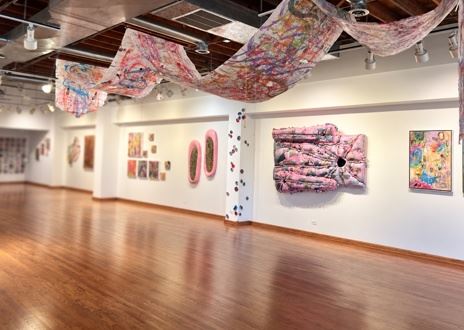
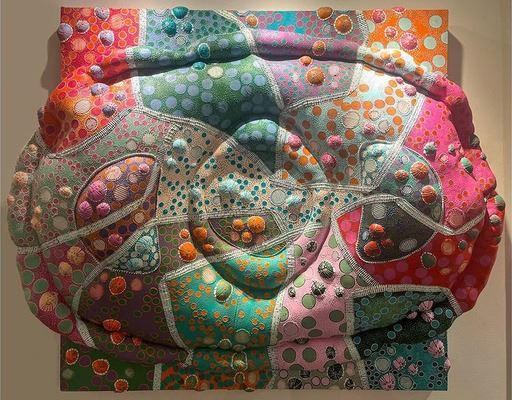
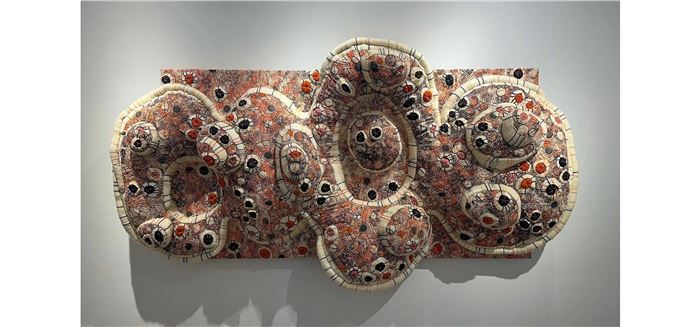
Jankowski’s experimentation extended beyond resin into the tactile world of fiber arts. She presented Untitled 1960 (Ode to Lee Series) and Crustacean, two large-scale, wool-felted reliefs stuffed with cotton. These pieces invited an interactive engagement from the audience, encouraging visitors to touch, peer through, and physically experience the textures of the work. In these pieces, prints were integrated into the fiber, serving as a continuous, fabricated multitude of mediums. The vibrant, playful nature of these reliefs made them visually arresting, with every viewing angle revealing new, previously unnoticed areas of detail and exploration.
At the heart of Jankowski’s philosophy is a desire to synthesize the macro and the micro. By creating massive structures defined by delicate, almost microscopic details, she forces the viewer to oscillate between standing back to admire the scale and leaning in to investigate the nuance. This intentionality proved successful; it was common to see patrons caught in a cycle of inquiry—looking closely at the fibers and resin, stepping back to take in the broader composition, and returning to the work to find yet another layer of meaning.
Heather Cox’s contributions to the exhibition underscored her belief that printmaking is not a static medium, but a foundation for experimentation and play. Her practice is defined by a refusal to be constrained by traditional techniques. Instead, she moves fluidly between screen printing, woodcuts, stamping, collage, and thread work. One of the most striking elements of her installation was the use of space; prints on canvas and long, flowing paper installations stretched several feet across the gallery, suspended from the ceiling beams.
Particularly notable was Willow Tree, a thirty-foot roll of Japanese paper draped from the gallery’s ventilation beams. The installation was intentionally tactile, inviting visitors to handle the individual threads that hung from the paper. This invitation to engage with the work on a physical level stripped away the traditional barriers between the art and the viewer, reinforcing the exhibition’s theme of accessibility and growth.
The collaborative works—pieces created by both Jankowski and Cox—carried a unique, shared energy. These prints, which utilized a mix of marker, paint, and collage, were displayed in Plexiglass frames hung by wire in the gallery windows, while the duo’s joint prints were placed beneath the exhibition description on the wall. The color palette was dominated by fluid, interconnected tones of blue, yellow, purple, and pink, weaving together in complex patterns that felt organic, almost reminiscent of a three-dimensional model of a virus. This synergy demonstrated that the pair had moved beyond individual ego, leaning into intuition and a shared visual language that only years of mutual respect could produce.
For a resident of this community, witnessing the Tall Grass Arts Association embrace such a forward-thinking, contemporary exhibition was a moment of genuine pride. Park Forest has long played a significant role in the cultural and historical fabric of the Chicagoland area, and seeing the local gallery receive such a positive, enthusiastic reception for a show that pushes the boundaries of modern art is an encouraging sign for the future.
While the preservation of tradition is undoubtedly necessary for any cultural institution, the success of Mented proves that making space for new techniques, collaborative experimentation, and contemporary voices is essential for growth. The exhibition functioned not just as a display of artistic skill, but as a bridge between the past and the future of the village’s creative life. As the exhibition closed on November 7, 2026, it left behind a legacy of curiosity and a high bar for future collaborations. Both teacher and student have demonstrated that their work, at this juncture in their careers, possesses a profound clarity—it does not need to be explained; it speaks for itself. For the community of Park Forest, the experience was a reminder that even in a small town, there is always room for a new perspective, and that the best art is that which invites us to look closer, reach out, and learn something new about the world—and each other.