When David Hockney passed away on June 11, 2026, at the age of eighty-eight, the global art market braced for the inevitable surge of auction-house volatility. Collectors, investors, and institutions alike looked to the major houses to set the new post-humous benchmark for one of the 20th century’s most prolific artists. Yet, when Phillips London convened on June 26, the market’s initial response was characterized by a measured, almost respectful restraint rather than the feverish, speculative bidding often associated with the death of a titan.
The sale of The Only One with Waves (1991) for £2.42 million (approximately USD $3.24 million) placed the work comfortably within its estimated range of £1.8 million to £2.5 million. This pattern of rational valuation continued into September, when the house’s dedicated single-artist sale in London, titled David Hockney, successfully cleared seventy-five of its seventy-seven lots, totaling £2,038,071 (approximately USD $2.73 million) including fees. While these figures command headlines and define the "secondary-market" narrative that dominates financial reporting, they represent only the most visible tip of the iceberg. Beneath these high-stakes, hammer-falling dramas exists a quieter, more accessible tier of the market: the gallery world. Here, the very same names—and the profound artistic traditions they embody—remain available to private collectors at price points measured in hundreds or thousands of dollars rather than millions.
The Power of the Line: Hockney, Lee, and Vasarely
The true thread connecting this season’s market discourse is the line itself. It is the fundamental unit of visual expression that reveals the artist’s hand, whether it is the etched line that established Hockney’s reputation as a serious printmaker long before he became a household name; the relentless, meditative ballpoint marks that IL LEE has drawn across paper and canvas in New York for four decades; or the ruled, repeated geometric unit from which Victor Vasarely engineered the visual oscillations of Op art.
Each of these artists is currently represented through specialized partner galleries—from the historic districts of Mayfair to the industrial lofts of Tribeca and the quiet galleries of Braselton, Georgia. These venues offer a practical advantage that the auction room cannot: the ability to engage in a direct dialogue with a dealer, to verify the edition and condition of a work, and to scrutinize its provenance long before any capital changes hands.
Hockney’s Dialogue with Picasso
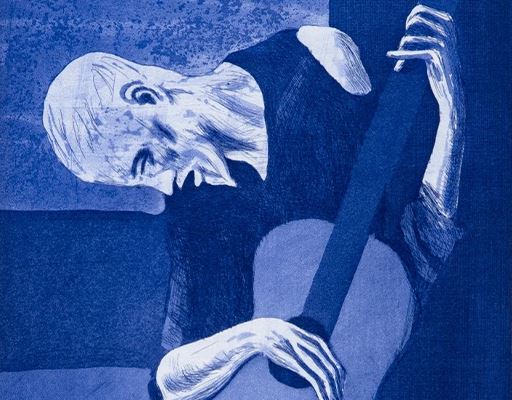
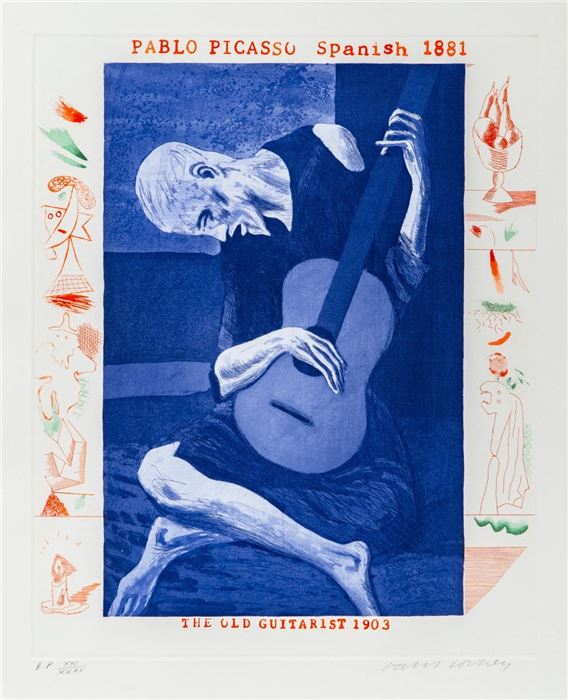
Among these offerings, The Old Guitarist stands out as a profound conversation across seven decades of art history. In this work, Hockney revisited the hunched, blue-shadowed musician famously captured in Picasso’s 1903 masterpiece. He redrew the figure for The Blue Guitar, a monumental twenty-plate suite created between 1976 and 1977. The series was conceived as a visual response to Wallace Stevens’s poem, The Man with the Blue Guitar, and was etched in Paris in collaboration with Aldo Crommelynck—the very printer who had worked intimately with Picasso himself.
The resulting sheet is a fascinating palimpsest, carrying the presence of two masters simultaneously. It captures the heavy, encroaching melancholy of Picasso’s original in the bowed head and folded limbs, yet it is undeniably marked by Hockney’s quick, self-aware draughtsmanship. Through his signature hatching and the use of aquatint to lay down flat fields of color, Hockney allows a few bitten lines to suggest an entire room of shadow. It is a work that serves as a thesis on how pictures are born from other pictures, an inquiry that remained at the heart of Hockney’s practice until his final days.
Offered through Gerrish Fine Art at £13,500 (approximately USD $18,100), this etching occupies a significant position on a carefully constructed ladder of value. Hilary Gerrish, who began dealing in 1972 and established the firm in 1985, is a seasoned member of the IFPDA and CINOA. Operating by appointment in Mayfair, the gallery maintains one of the most comprehensive stocks of Hockney etchings in the trade, listing around ninety works. Their inventory provides a rare look at the breadth of Hockney’s career, ranging from the more accessible rungs—such as Ossie and Mo (1968) at £4,500 and the Portrait of Richard Hamilton (1971) at £9,000—to more significant early works like the 1964 etching Jungle Boy at £45,000, and the vibrant 1980 lithograph Potted Daffodils at £55,000.
September’s auction results indicate that buyers are becoming increasingly discerning, sorting "image from image" with growing sophistication. The sale was led by Autour de la maison, été (2019), which fetched £193,500, while notable records were set for An Image of Gregory (1984-1985) and Tyler Dining Room (1984), each reaching £141,900. With the Tate planning an expansive seven-decade retrospective at Tate Britain and a major installation at the Turbine Hall in 2027, the institutional assessment of Hockney’s legacy is only beginning. Gerrish Fine Art also represents contemporary figures such as Harland Miller, whose cult-following Penguin-jacket paintings, like the 2023 work XXX, are listed at £11,500, bridging the gap between historical printmaking and contemporary cultural commentary.
The Meditative Accumulation of IL LEE
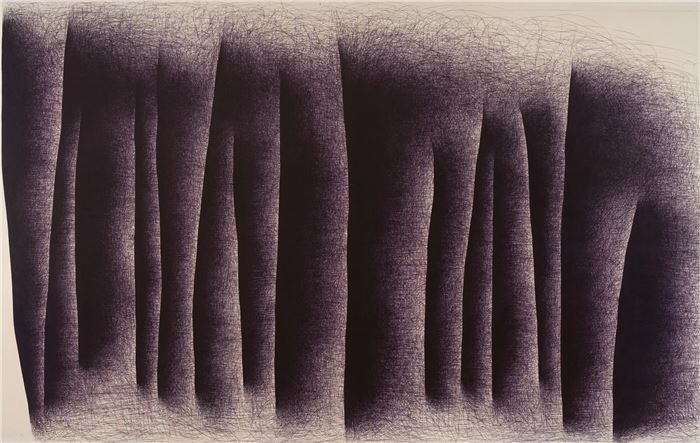
While Hockney’s line is celebrated for its economy—a handful of strokes doing the work of many—IL LEE takes an entirely different approach, allowing the sheer volume of marks to become the subject itself. His work, BK-002 (2006), is a testament to this method. At first glance, it reads as a landscape, but upon closer inspection, it reveals itself as an intricate, non-representational drawing. Massed black ballpoint lines rise to form trunks that resemble a dense grove of trees. At the edges, these lines are so compressed they hold as solid pillars, yet toward the margins, the looping strokes loosen and thin, allowing the viewer to trace individual marks until the grove dissolves into open ground.
Born in Seoul in 1952 and relocated to New York in 1977, Lee developed his signature style by 1981. The humble office pen has been his primary instrument for decades, used on paper and canvas, often alongside oil and acrylic. His work occupies a unique space between drawing and painting, bridging the inheritance of traditional East Asian ink work with the imposing scale of the New York School.
Represented by Art Projects International, a Tribeca gallery that hosted his first comprehensive survey in 1997, Lee is the focus of the current exhibition IL LEE: Works from the Collection. Running through November 21, 2026, the show juxtaposes recent examples of his mature style with early career highlights like BK-002. His institutional presence is well-established, with works held in the Metropolitan Museum of Art, LACMA, and the National Museum of Modern and Contemporary Art in Korea. In a market season where Korean modernism has seen renewed interest, Lee’s patient, rhythmic accumulation of line offers a distinct and vital contribution to contemporary practice.
Vasarely and the Precision of Systems
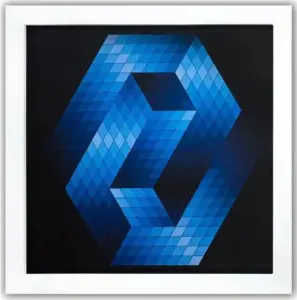
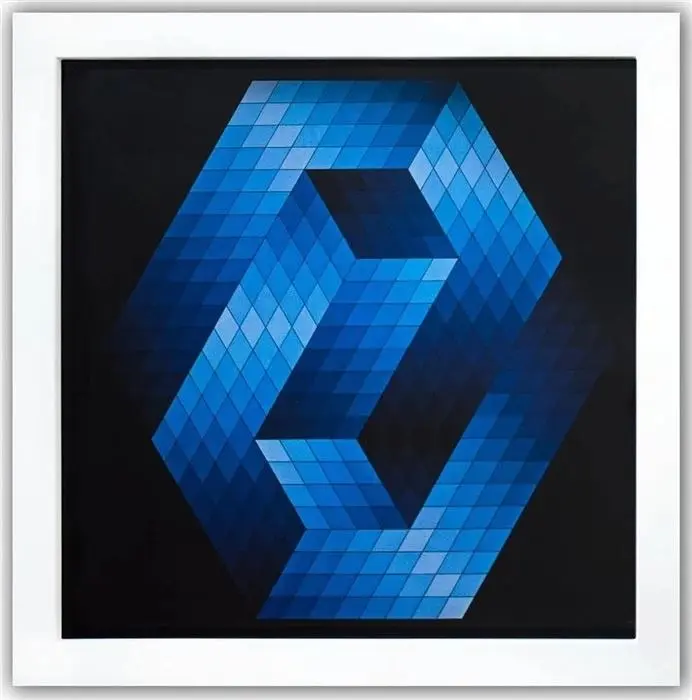
If IL LEE’s repetition behaves like human breath—irregular, organic, and deeply personal—Victor Vasarely’s work is engineered to the millimeter. In Gestalt – Bleu (1971), a heliogravure measuring just 25.4 by 25.4 cm, a blue cube appears to twist against a black ground. The bands of color compress and widen, creating a classic Op art effect that leaves the viewer uncertain whether they are looking into a hollow box or at a projecting corner.
This small, framed sheet carries the core of Vasarely’s philosophy: the systematic geometric unit, repeated and altered by precise degrees. For the Hungarian-born artist, the heliogravure process was essential, as he championed the idea that his visual language should be reproducible and widely accessible rather than restricted to unique, high-priced canvases.
Offered through Braselton Art Gallery in Georgia, this print is priced at $635, a figure that highlights the vast chasm between the accessible gallery market and the auction house. In Paris this spring, the market for Vasarely was notably polarized; a major work like VEGA-ZETT-VA (1972) sold at Sotheby’s for the equivalent of USD $166,400—far exceeding expectations—while other works have seen more modest results. This variance serves as a reminder that regardless of the price point—be it a $635 heliogravure or a six-figure canvas—the factors of quality, date, and historical provenance are the true determinants of value.
Ultimately, these three artists represent a singular, evolving arc of 20th-century art: Hockney’s line as a vehicle for narrative, IL LEE’s line as a process of accumulation, and Vasarely’s line as a rigid, intellectual system. While the auction room continues to set the headline prices, the gallery wall remains a vital space for the collector. It is here that the conversation remains direct, and the essential questions regarding the life and history of a work can be answered before the commitment is made. Interested parties may reach out to Gerrish Fine Art, Art Projects International, and Braselton Art Gallery directly through MutualArt to inquire about current availability, pricing, and condition reports.