Industrial designer Igor Dzukovski has unveiled an experimental surfboard prototype that shifts the focus of board design away from conventional performance metrics toward a deeply immersive sensory engagement with the marine environment. Titled “Tidal Wave,” the concept bypasses traditional surface-level graphics and opaque laminates entirely. Instead, it relies on structural transparency to draw the surrounding aquatic ecosystem directly into the physical composition of the board, allowing riders to experience the ocean’s shifting optical conditions, underlying currents, depth, ambient light, and surface reflections directly beneath their feet.
Rather than treating the surfboard merely as a rigid platform for riding waves, Dzukovski’s design transforms it into a dynamic lens. The ocean is no longer just the medium upon which the rider floats; it becomes an active, visible component of the object itself. By merging advanced manufacturing techniques with a minimalist aesthetic, the project prompts a reevaluation of how industrial design can mediate our relationship with nature, prioritizing mindfulness and direct observation over speed or competitive edge.
The genesis of the Tidal Wave prototype lies in a deliberate critique of standard surfboard aesthetics. For decades, the industry has relied on foam cores encased in fiberglass and polyester resins, often decorated with printed graphics, opaque paints, or tinted resins to establish a distinct visual identity. While these finishes can be striking, they visually isolate the surfer from the underwater world unfolding just inches beneath the board. Dzukovski’s design challenges this separation. By engineering a transparent body supported by a high-performance skeletal frame, the prototype dissolves the visual barrier between the rider and the sea.
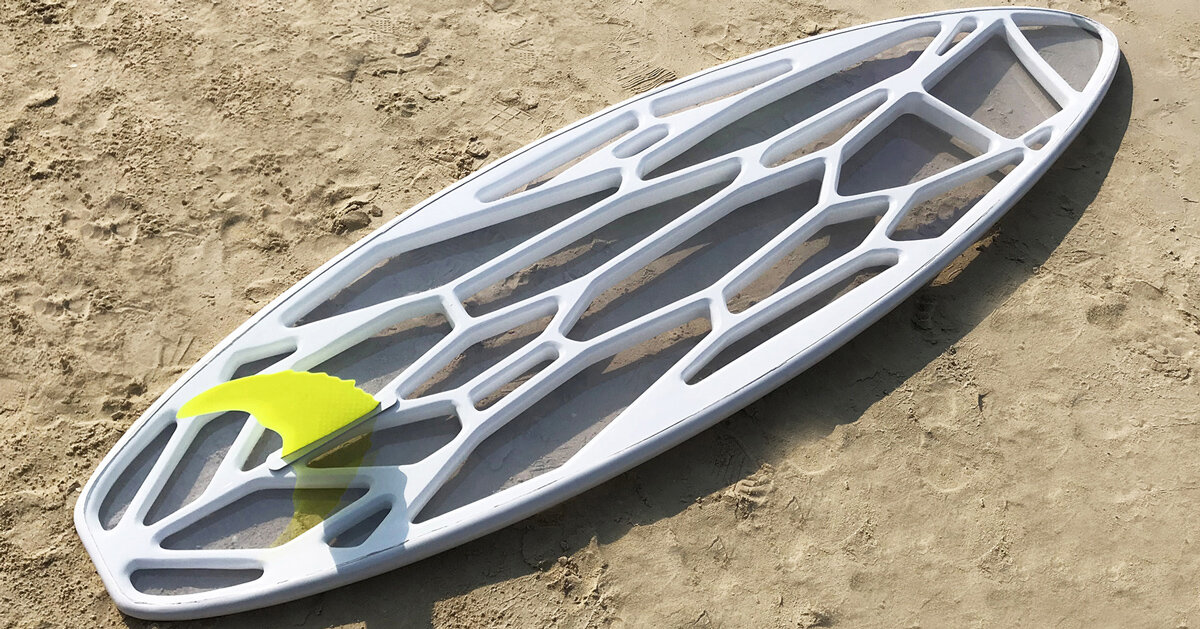
Carbon-Fiber Skeletal Ribs Frame Uninterrupted Sightlines to the Ocean Floor
At the core of the Tidal Wave prototype’s engineering is an exposed carbon-fiber skeleton. Characterized by fluid, organic ribbing, this intricate framework provides the necessary structural backbone while framing large transparent apertures. Designing a surfboard that is simultaneously see-through and structurally sound presents significant engineering challenges. Surfboards must endure immense hydrodynamic pressure, torsional flexing, and the dynamic impact of breaking waves. To achieve the required rigidity and lightweight profile for high-level aquatic handling without resorting to a traditional solid core, Dzukovski utilized carbon fiber to construct a supportive ribbing system that distributes stress evenly across the hull.
This skeletal layout does more than ensure mechanical integrity; it purposefully opens uninterrupted sightlines directly through the deck of the board to the water below. As the surfer paddles, glides, or carves across a wave, the ocean floor, marine life, and shifting water columns remain in constant view through the clear panels set between the carbon ribs. The interplay between the dark, geometric precision of the carbon fiber and the fluid, ever-changing organic patterns of the ocean creates a compelling visual contrast, grounding high-tech composite engineering within a natural context.
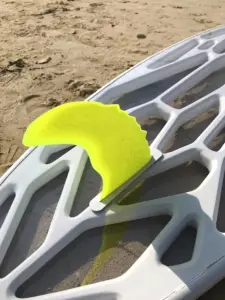
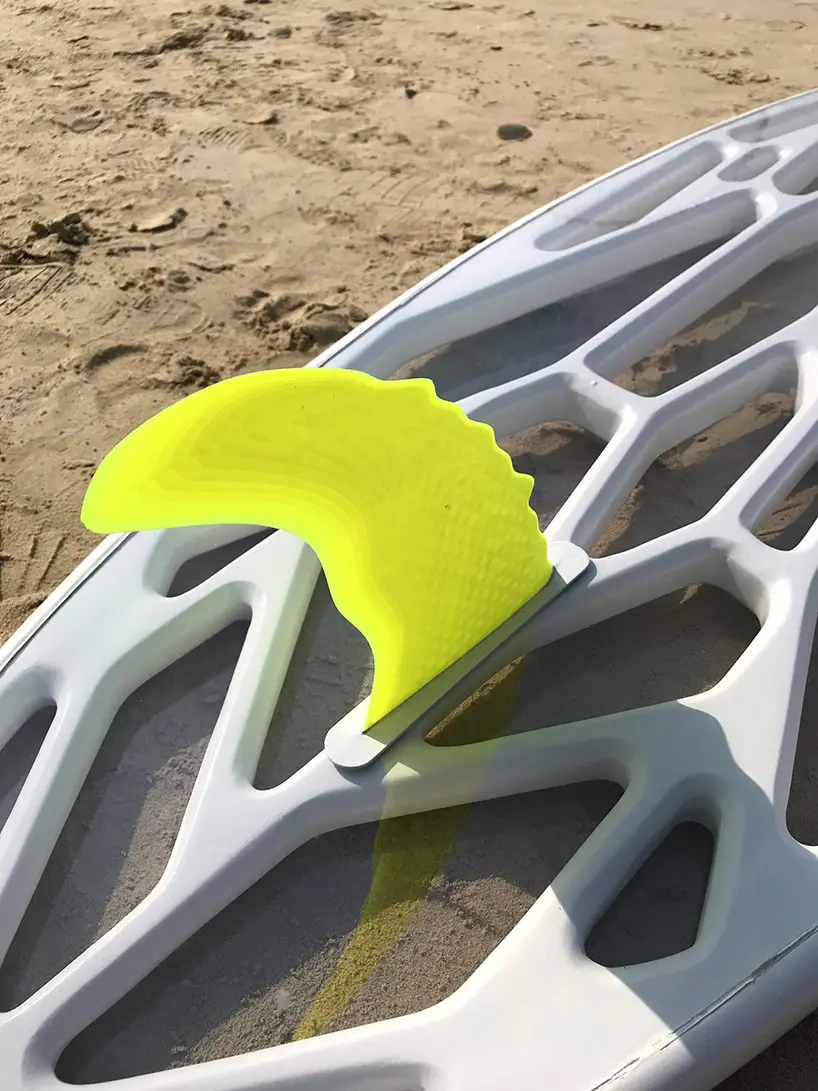
Complementing the skeletal deck and clear resin skin is a custom 3D-printed pectoral fin positioned at the stern. Fabricated through advanced additive manufacturing processes, the fin features a complex sculptural geometry optimized for hydrodynamic efficiency. Rather than relying on standard injection-molded or fiberglass templates, the 3D-printed manufacturing technique allows for precise control over the fin’s cross-section and flex patterns, directly improving water-flow control and maneuverability. Furthermore, the fin serves as a striking visual accent. Rendered in a high-visibility fluorescent yellow, the neon tone provides a sharp chromatic contrast against the dark carbon frame and the crystal-clear body of the board, anchoring the design with a vibrant flash of color at the tail.
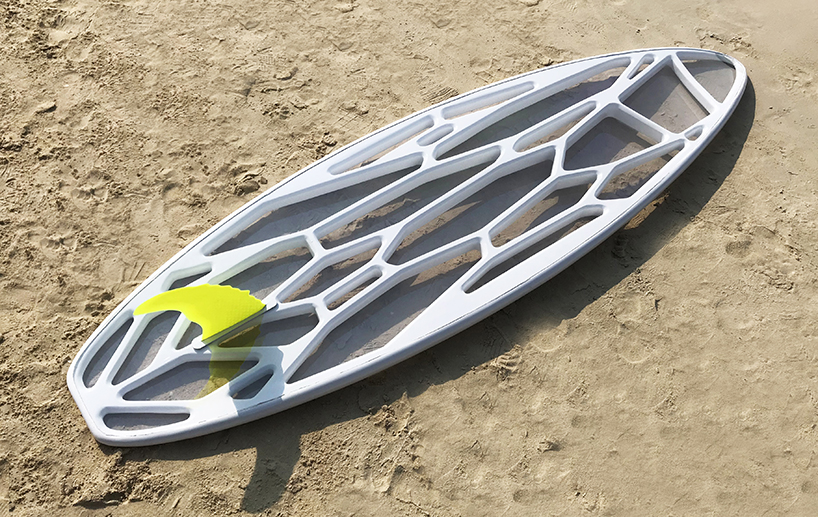
Exhibited Globally as a Tectonic Feature of Modern Aquatic Design
The Tidal Wave prototype has previously been showcased on international stages, appearing at Expo 2020 Dubai and during Dubai Design Week 2021. These exhibitions brought the experimental project to a diverse global audience of designers, technologists, and art enthusiasts, sparking conversations about the intersection of advanced manufacturing and sustainable outdoor gear. By presenting the board in these high-profile contexts, Dzukovski highlighted how industrial design can elevate functional sports equipment into contemplative objects of art.
Throughout its development and public exhibition, the project has consistently reframed advanced composites and 3D printing not as hidden industrial processes, but as exposed tectonic features. Every element of the Tidal Wave—from the precision-laid carbon-fiber ribs to the transparent panels and the meticulously sculpted neon fin—is laid bare for the observer to inspect. By stripping away extraneous ornamentation and celebrating the structural honesty of its materials, Dzukovski’s prototype successfully transforms the traditional surfboard into an optical frame for the surrounding aquatic landscape, offering a fresh perspective on how humans interact with the marine environment through design.