In modern urban planning, the street curb has long served as an unyielding line of demarcation. It is the definitive boundary where the engineered world of asphalt and pedestrian walkways abruptly ends, and the managed or neglected earth begins. These rigid municipal thresholds are designed to manage water runoff, organize traffic patterns, and maintain a strict separation between the organic earth and the built environment. However, a thought-provoking new urban intervention is challenging this conventional paradigm by reimagining the humble street curb not as a solid wall, but as an active, porous threshold that invites nature to reclaim its space within the city.
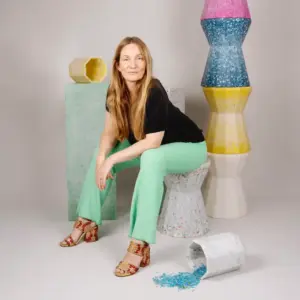
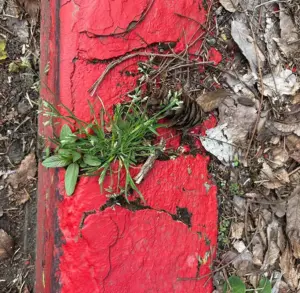
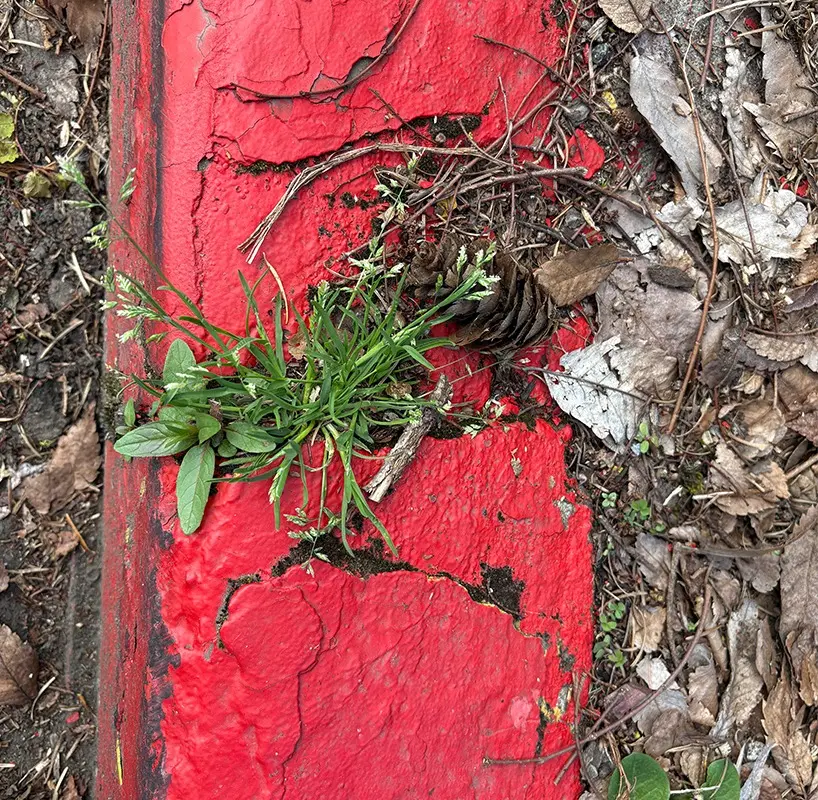
Conceived by innovative designer Sara Fernandes, the project—titled Giving Nature a Voice: Let Them Through—takes a critical look at the standard concrete infrastructure that defines our streets. Rather than treating the natural intrusion of weeds, grasses, and mosses through cracks in sidewalks and curbs as a sign of decay or structural failure, Fernandes treats it as a natural blueprint. The project translates this spontaneous plant growth into intentional landscape architecture, fundamentally questioning how standard municipal boundaries segregate soil from pedestrian corridors and challenging the long-held assumption that cities must maintain an adversarial relationship with nature.
Non-Uniform Openings Revise Standard Pavement Thresholds
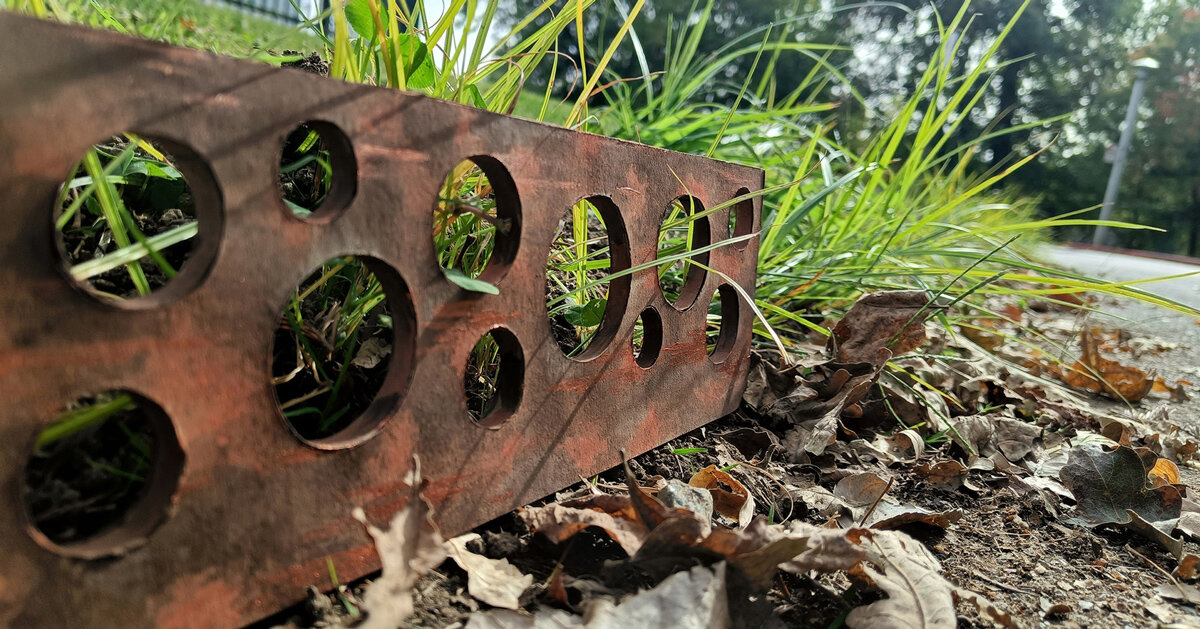
At the heart of Fernandes’s intervention is a physical replacement of the ubiquitous cast-concrete street curb. In its place, the designer introduces weathered Corten steel profiles that have been deliberately punctured by an irregular series of circular apertures. These perforations vary dramatically in diameter, creating a dynamic surface that breaks away from the monotonous uniformity typically associated with municipal infrastructure.
These strategically placed openings allow adjacent soil and low-lying vegetation to permeate the boundary, effectively transforming what was once a harsh, linear barrier into a porous edge condition. As the grassroots, vines, and wild plants push through the metal cutouts, the rigid line separating the sidewalk from the earth begins to dissolve. The installation demonstrates how small-scale physical modifications can accommodate biological agency within civic infrastructure, allowing green spaces to bleed organically into the pedestrian realm without compromising the structural integrity required of a street edge.
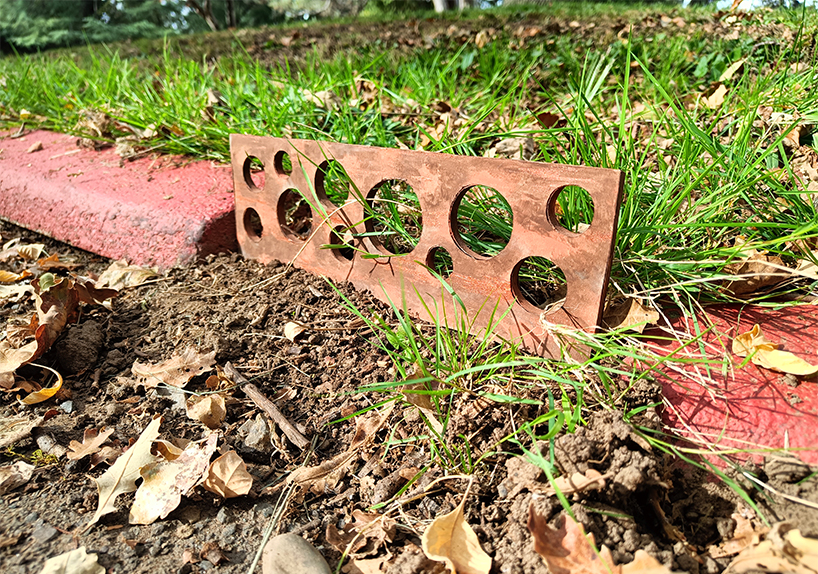
The choice of material plays a critical role in the conceptual success of the project. The weathered patina of the Corten steel establishes an immediate tonal bridge between the raw earth and the paved pedestrian surfaces. Over time, the oxidized, earthy finish of the metal visually aligns with topsoil, fallen leaves, and organic groundcover, making the barrier feel like an organic extension of the landscape rather than an intrusion of industrial manufacturing.
Furthermore, the non-uniform distribution of the circular openings introduces intentional irregularities that accommodate natural succession. Instead of imposing a rigid grid or a mass-manufactured civic standard that forces nature to conform to human geometry, the prototype adapts to the unpredictable patterns of biological growth. By welcoming these irregularities, Fernandes’s design offers a compelling conceptual critique of hard urban thresholds, proving that civic engineering can be reimagined to foster a more symbiotic coexistence between urban populations and the natural environment.