The commercial market for prehistoric fossils has produced yet another monster sale, demonstrating that the appetite among elite collectors for museum-grade dinosaur skeletons shows no sign of cooling.
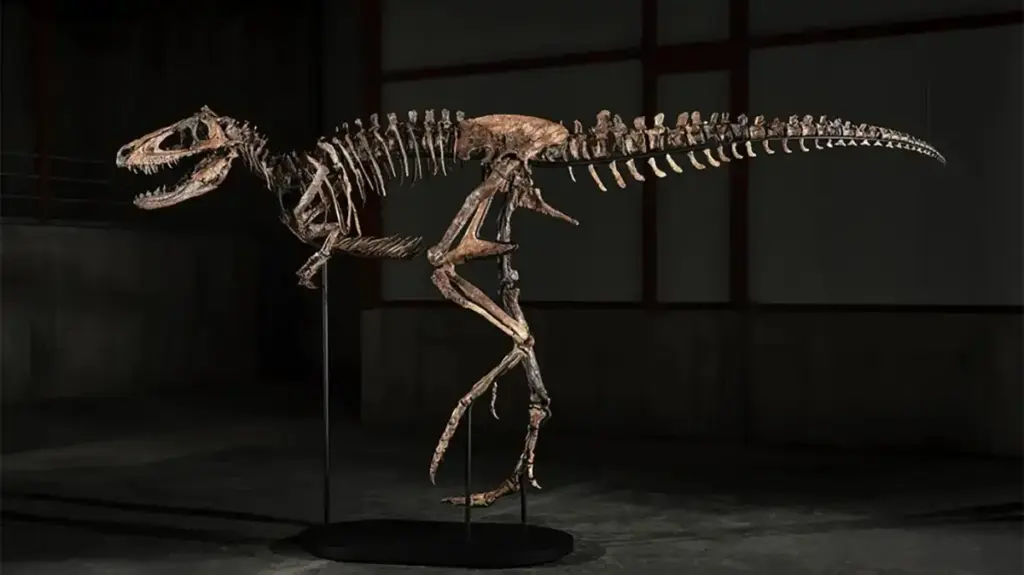
“Jodi,” an exceptionally well-preserved and remarkably complete 67-million-year-old Nanotyrannus skeleton, sold on Tuesday at Sotheby’s in New York for a staggering $47.3 million, including fees. The final price tag more than quintupled the auction house’s high pre-sale estimate of $9 million. The skeleton hammered down at $40.5 million, instantly cementing its status as one of the most expensive dinosaur fossils ever sold at public auction and reinforcing the unprecedented financial heights currently dominating the high-end antiquities and natural history market.
This blockbuster result arrives just three months after Sotheby’s made headlines with the sale of “Gus,” a magnificent Tyrannosaurus rex skeleton that fetched a record-breaking $50.1 million. That high-profile July sale, which had carried a pre-sale estimate of $20 million to $30 million, established a dramatic new benchmark for prehistoric fossils, surpassing the $44.6 million paid for the famous Stegosaurus known as “Apex” earlier in 2024. Remarkably, Jodi came within striking distance of breaking Gus’s record, despite being considerably smaller in stature and lacking the globally recognized brand recognition and pop-culture dominance carried by a Tyrannosaurus rex.
Measuring nearly 20 feet in length, the Jodi skeleton was originally discovered in 2019 within the fossil-rich terrain of Montana’s Hell Creek Formation by rancher Jodi Pierson, the individual for whom the historic specimen was ultimately named. According to documentation provided by Sotheby’s, the specimen stands as one of only three known Nanotyrannus skeletons ever recovered and meticulously prepared. It includes an impressive 191 individual fossil bone elements, anchored by a nearly complete and remarkably undamaged skull that offers researchers an extraordinary window into the anatomy of the prehistoric predator.
The astronomical price fetched by Jodi is all the more fascinating given the intense academic debate that has surrounded the species until very recently. For decades, paleontologists and evolutionary biologists engaged in a vigorous scientific debate over whether Nanotyrannus represented a genuinely distinct dinosaur genus or if the smaller predator was simply a juvenile phase of the much larger and more famous Tyrannosaurus rex. However, a landmark study published in the prestigious scientific journal Nature last year helped settle the long-standing argument. The research provided compelling anatomical evidence identifying Nanotyrannus as a distinct genus that coexisted alongside its much larger cousin in the ancient ecosystems of North America.
Despite its recent scientific validation, Jodi is no stranger to the high-stakes world of the art and luxury market. The skeleton has already carved out a unique career trajectory across international galleries and auction houses. In 2023, when the specimen was marketed under the moniker “Chomper” and was still broadly identified and categorized as a juvenile T. rex, London-based art and antiquities dealer David Aaron offered it for sale with a price tag of $20 million at the Frieze Masters art fair. The skeleton did not find a buyer at that specific venue, and the current consignor subsequently acquired the specimen in 2021, according to detailed provenance listings published by Sotheby’s. Just three years later, fortified by a new name, a distinct scientific identity, and renewed scholarly legitimacy, the fossil has successfully commanded more than twice its previous asking price.
The sensational result of Tuesday’s auction offers undeniable additional evidence that dinosaur fossils have firmly transitioned into serious trophy objects for the world’s ultra-wealthy collectors. At the absolute apex of the luxury market, these prehistoric titans now routinely rub shoulders with blue-chip contemporary paintings, ultra-rare vintage watches, and investment-grade sports memorabilia. Over the past several years, market valuations for top-tier fossils have climbed at a remarkable and unprecedented pace, driven by a surge in demand from private buyers seeking unique, conversation-starting centerpieces for their estates and private collections.
This modern trend has deep roots in a series of landmark sales over the past half-decade. Christie’s famously initiated the modern luxury fossil boom in 2020 when it sold “Stan,” a massive T. rex skeleton, for $31.8 million. More recently, the appetite for smaller or more unusual specimens has proven equally robust, as demonstrated when a juvenile Ceratosaurus brought in a stunning $30.5 million at Sotheby’s last year, completely obliterating its conservative pre-sale estimate of just $4 million to $6 million.
At the same time, this multi-million-dollar boom has continually raised serious concerns among paleontologists and academic researchers. Many scientists worry that increasingly exorbitant market valuations are pricing rare and scientifically critical fossils far beyond the financial reach of public museums, university research departments, and public institutions. Consequently, valuable specimens risk disappearing entirely from public view and academic study into private vaults and residential collections.
Conversely, major auction houses and private collectors strongly defend the commercial trade, arguing that private investment provides essential financial backing for the exceptionally expensive, painstaking work required to locate, excavate, preserve, and scientifically study these fragile prehistoric specimens—efforts that might otherwise go unfunded in an era of constrained public budgets for scientific research and museum acquisitions.