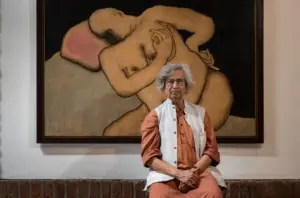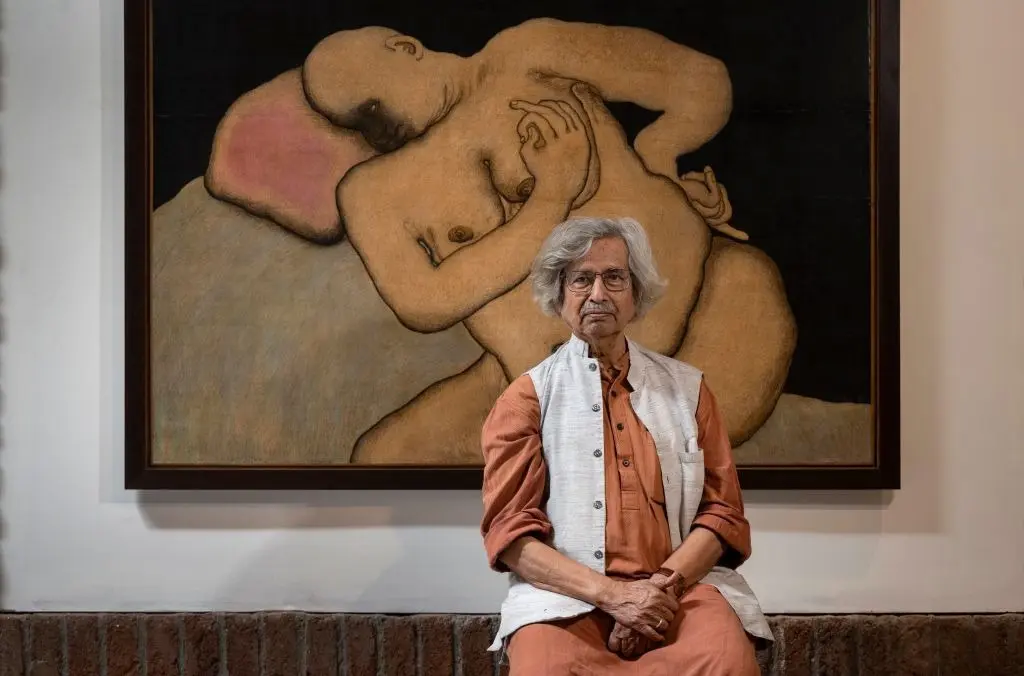
Jogen Chowdhury, celebrated as one of India’s most influential modern painters and a defining voice in twentieth-century figurative art, passed away on October 25 at a hospital in Kolkata. He was 87 years old. According to local Indian media reports, the artist had been battling a rare form of blood cancer for more than a year before his death.
Chowdhury’s passing has triggered an outpouring of grief, tribute, and reflection across India’s cultural and political landscapes. Tributes have poured in on social media platforms from political leaders, fellow artists, and cultural institutions alike. Writing on the platform X, West Bengal Chief Minister Suvendu Adhikari paid tribute to the late artist, praising Chowdhury as "a towering pillar of our cultural world," whose monumental artistic legacy would remain "immortal through the ages."
The loss was felt with equal intensity among his peers within the artistic community. Samir Aich, a prominent Kolkata-based painter, publicly mourned his death not only as a profound personal loss but also as the closing of a significant chapter in the history of Indian art. He noted that Chowdhury’s passing marks the fading of a generation deeply connected to the foundational ideals of the Bengal School of Art—an influential early twentieth-century art movement that first originated in Kolkata, then known as Calcutta, and Santiniketan during the British Raj. The movement later flourished across the broader Indian subcontinent, dynamically buoyed by the momentum of the Indian Independence Movement.
The Roots of a Movement and Santiniketan’s Influence
The Bengal School of Art emerged in large part as a conscious artistic reaction against the rigid dominance of Western realism that had been imposed upon Indian art education at the time. Seeking to reclaim and redefine an indigenous visual vocabulary, the movement drew deep inspiration from traditional Indian art forms. Artists within this circle looked to Mughal miniatures, pastoral themes, and the rich, complex intermingling of history and mythology to shape their works.
For Chowdhury, this traditional grounding was further enriched by his deep connection to the distinctive red earth landscape of Santiniketan, where he maintained a home. The environment of Santiniketan, with its unique topography and rich intellectual history, served as a constant wellspring of visual inspiration for his creative practice. Furthermore, the broader Bengal School was characterized by a subtle yet profound cross-pollination of ideas; elements of Cubism and Japanese modern art sensibilities were threaded throughout the movement, made possible by a thriving and progressive cultural exchange between India, Japan, and Europe during the period.
A Mastery of Line and the Psychic Interior
Within this rich artistic lineage, Chowdhury carved out a distinct and unforgettable niche. He was internationally renowned for his extraordinary command of line work, which excelled in the tactile, expressionistic quality that remains unique to modern Indian art. Rather than relying solely on conventional realism or strict abstraction, Chowdhury frequently employed a delicate cross-hatching technique to subtly and deliberately distort the human figure.
This distortion was never deployed as a mere mockery or simple caricature. Instead, it served as a sophisticated visual tool for capturing and visualizing psychic interiors, mapping the hidden complexities of human emotion, anxiety, vulnerability, and existence. His figures seemed to breathe with an inner life, shaped by the contours of psychological depth rather than mere physical anatomy.
Reflecting on this unique aesthetic, the prominent Indian art critic R. Siva Kumar once wrote of the artist’s distinctive approach: "The figures are wrought by a combination of decorative wilfulness and expressive distortion and are imbued with an effusive sensuality."
Kumar further observed the profound interpretive depth of the artist’s output, noting that "Chowdhury’s art is rich in suggestions; it is to be apprehended without bracketing our fund of knowledge, experience or memories, but also cannot be narrativised without trivialising it, without depleting its sensory particularities."
Early Life, Upbringing, and European Training
Jogen Chowdhury was born on February 16, 1939, in Daharpara village in Faridpur, which was then a region located within undivided Bengal. His birth preceded the turbulent geopolitical shifts of 1947, when British occupying forces partitioned Bengal along religious lines for a second time, following a previous, failed attempt at partition in 1905.
Chowdhury frequently described his formative years as being shaped by a creative, cultured, and aristocratic upbringing. Art was woven into the fabric of his family life; his mother was widely recognized and celebrated for her exceptional skill in traditional Alpana ritual floor drawings, while his father was an accomplished painter and sculptor in his own right. This early exposure to creative expression laid a solid foundation for his future vocation.
Pursuing his passion formally, Chowdhury enrolled in the prestigious Government College of Art & Craft in Kolkata in 1955. He completed his rigorous training there between 1955 and 1960, absorbing the classical and modern techniques taught within the institution. Eager to expand his global perspective, he later traveled to France, undertaking further specialized studies at the École Nationale Supérieure des Beaux-Arts in Paris during the 1960s. His time in Europe broadened his artistic horizons before he ultimately chose to return to India in 1968, bringing back a synthesized vision that merged international modernist sensibilities with deeply rooted Indian expressions.
A Life in Art, Curation, and Parliament
Chowdhury’s professional life extended far beyond the confines of his private studio, encompassing institutional leadership, public service, and high-level cultural administration. In 1972, he assumed the role of curator at the Art Gallery of Rashtrapati Bhavan, overseeing the prestigious collection housed within the official residence of the President of India.
Decades later, in April 2014, Chowdhury made a significant transition into the realm of national governance. He entered politics by successfully running for election to the Rajya Sabha, the upper house of the Parliament of India, serving as a member representing West Bengal’s ruling Trinamool Congress party. He maintained an active role in national legislation and parliamentary affairs until the conclusion of his term in April 2020.
Throughout his long and distinguished career, Chowdhury received numerous accolades both at home and abroad in recognition of his monumental contributions to the arts. His international recognition includes receiving the Prix de la Jeune Peinture in Paris in 1966, followed by critical acclaim and recognition at the Second Havana Biennial in Cuba in 1986.
Within India, his achievements were honored with prestigious state awards. In 2001, he received the Kalidas Samman from the government of Madhya Pradesh in recognition of his enduring contributions to contemporary Indian art. Later, in 2012, he was awarded the Banga Bibhushan, the highest civilian honor conferred by the government of West Bengal, cementing his status as a cultural treasure of the region and the nation.