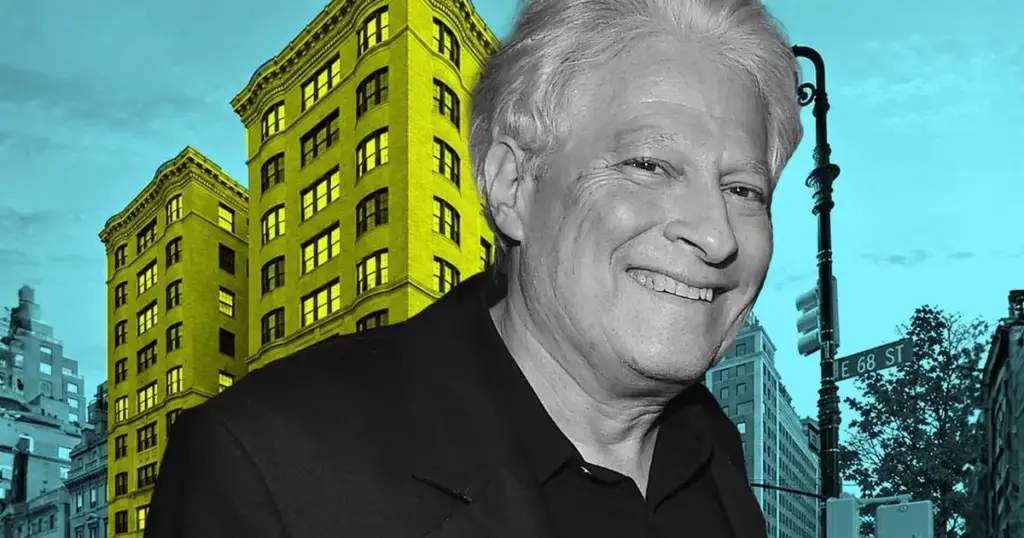
When the luxury condominiums at the Marquand—a prewar residential conversion located at 11 East 68th Street—first debuted on the Manhattan real estate market a little over a decade ago, they were presented as a masterclass in restrained elegance. The design choices curated by the development team leaned heavily on a palette of creams and neutrals, reflecting the kind of tasteful, subdued finishes that contemporary new-development consultants routinely recommend to appeal to a broad base of high-net-worth buyers. However, when it came to his personal residence within the building, the project’s developer, Ziel Feldman of HFZ Capital Group, threw standard playbook conventions out the window.
Feldman opted for a radically different aesthetic for his own triplex penthouse, choosing a dramatic color scheme dominated by deep blacks and dark browns, enlivened only by the occasional sharp contrast of book-matched white marble. The resulting interior space cultivated a moody, bold atmosphere that frequently evoked comparisons to a modern-day lair. It was characterized by rich dark woods, exotic stones, and heavily veined marble surfaces that served as a striking backdrop for high-end contemporary artworks, including pieces by noted creators such as Tracey Emin and Sanford Biggers. As one industry peer previously observed of Feldman’s penchant for theatrical design, the developer was widely recognized within New York real estate circles for always favoring a distinct sense of razzle-dazzle.
Now, years after initially trying to part ways with the property amidst mounting corporate turmoil, Feldman and his wife, Helene, are officially offering the 21-room monument to their personal taste for $27.5 million. The high-profile listing is being handled by brokers Madeline Hult Elghanayan and Sabrina Saltiel of Douglas Elliman.
The expansive residence stands as far more than just a physical reflection of the couple’s lavish aesthetic leanings; it also serves as a tangible remnant of a much more flush era in Manhattan real estate. Feldman, who transitioned from a career as a real estate attorney to become a prominent luxury developer, had harbored grand ambitions of cementing his legacy alongside the city’s old-line real estate dynasties, such as the Zeckendorfs and the Dursts. That ambitious goal appeared within striking distance when HFZ embarked on the development of the XI in 2015, a visually arresting, twisting twin-tower complex designed by renowned architect Bjarke Ingels along the High Line in West Chelsea.
The promotional efforts for the XI matched the grand scale of the architecture itself. Even the sales gallery for the development was executed as a theatrical spectacle, featuring an immersive art installation conceived by acclaimed set designer Es Devlin. Yet, before the ambitious project could be brought to completion, HFZ suffered a catastrophic corporate implosion. Feldman experienced a very public and bitter falling out with his former business partner, Nir Meir, who was subsequently arrested and faced serious criminal charges connected to an alleged $86 million fraud scheme involving the financing and management of the XI project.
While Feldman publicly maintained that Meir bore the primary responsibility for the spectacular collapse of HFZ Capital Group, the fallout left the firm’s portfolio in disarray. Meir’s legal proceedings have continued to wind through the judicial system as he awaits trial. Despite the turbulent circumstances surrounding its development, the underlying concept of the XI proved fundamentally sound. The condominium units ultimately sold briskly after veteran developer Steve Witkoff stepped in to take over and complete the troubled project. Following a prolonged period of maintaining a low profile while untangling various legal and financial obligations, Feldman has gradually re-entered the real estate sector, quietly launching a national affordable and workforce housing firm called GoodHomes, where he works alongside his daughter.
The history of the Marquand penthouse itself mirrors the shifting fortunes of its creator. Back in 2020, as Feldman was actively fending off a wave of investor lawsuits, restructuring delinquent loans, and fighting desperately to save the remnants of HFZ, he initially listed the 6,100-square-foot triplex penthouse with an asking price of $39 million. Years later, facing a changed financial reality, the developer has lowered his price expectations considerably, signaling a potential scaling back of his previous lifestyle as well.
Whether a prospective buyer will ultimately embrace the distinct lifestyle and uncompromising design choices embedded within the penthouse remains to be seen. In several rooms of the residence, both the flooring and the vertical wall surfaces are enveloped in striking black marble. In other areas, the walls are wrapped in gleaming dark hardwood paneling that intentionally frames furniture upholstered in deep black and dark-gray velvets.
The physical scale of the property is equally dramatic. The layout encompasses five bedrooms, four full bathrooms, and a grand formal dining room capable of comfortably seating up to 22 guests, complete with an integrated wet bar for large-scale entertaining. Additional luxury appointments include private elevator access, sweeping proximity to Central Park just under a block away, wood-burning fireplaces located both inside the home and out on the grounds, and an expansive 2,600 square feet of private outdoor terrace space.
During the Feldmans’ occupancy, the sprawling rooms were populated by museum-caliber blue-chip art and installations, ranging from John Chamberlain sculptures and George Condo paintings to a taxidermied bunny art piece by Maurizio Cattelan—though these high-value pieces will not convey with the sale. The Marquand triplex primarily functioned as a sophisticated Manhattan pied-à-terre for the couple, who simultaneously maintained sprawling suburban estates. Among these was an 18,500-square-foot mansion in Englewood, New Jersey, inspired by a historic Fontainebleau château they had admired during their honeymoon. That grand estate was successfully sold in 2020, followed shortly thereafter by the sale of their sprawling Bridgehampton property in early 2021 for $50 million.
For prospective buyers who appreciate the prime Upper East Side location and monumental scale of the triplex but cannot quite envision themselves residing amidst such dark-hued opulence, the real estate listing provides a practical solution. It includes a series of digital architectural renderings illustrating the apartment completely reimagined in a palette of soft creams and understated neutrals. Through these visualizations, the residence transforms to look very much as it might have back in 2013, had it originally been released to the open market as a standard sponsor unit alongside the other residences in the building.