For decades, the prevailing wisdom in materials science has treated molecular rigidity as the holy grail of nanoscale engineering. Scientists working to build advanced materials from the bottom up operated under a strict consensus: when designing the molecular connectors that bind tiny nanoparticles into ordered arrays, flexibility was the enemy. Any deviation from rigid, tightly controlled bonding angles was believed to spell certain failure for the assembly process.
Now, a team of researchers at the Massachusetts Institute of Technology and their collaborators has turned that two-decade-old dogma entirely on its head. In a discovery that challenges foundational assumptions in the field, the researchers have found that doing the exact opposite—embracing extreme flexibility in molecular connectors—yields remarkable, previously unseen results.
Instead of relying on rigid molecular connections to hold nanoparticles in painstakingly pre-planned arrangements, the MIT team developed highly adaptable connectors that bend, twist, and adjust organically as particles come together. This counterintuitive strategy provides scientists with an entirely new mechanism to govern how nanoparticles self-assemble, unlocking the ability to forge crystal structures that have never been observed before in laboratory settings.
The findings, detailed in a forthcoming paper in the journal Nature Materials, illuminate how the inherent flexibility and electrical charges of molecular connectors can dictate the complex architectures formed by nanoparticles. The breakthrough could help dismantle a major bottleneck in materials science, clearing a pathway toward the creation of substances with hyper-optimized properties for electronics, medicine, energy storage, agriculture, and advanced chemical manufacturing.
Challenging Two Decades of Dogma
"People are interested in nanoparticle superlattices because of the promise of building designer materials where you have more say in what types of structures they can actually build into," says Rob Macfarlane, the Richard P. Simmons (1953) Professor in Metallurgy in MIT’s Department of Materials Science and Engineering. "This is a new approach in nanoparticle assembly that hasn’t been investigated before. It’s exciting to have a new tool that is so counterintuitive. It’s the exact opposite of what the dogma has been for 20 years: that you need to make connector ligands rigid, and any deviation causes assembly to fail. We showed if you just crank it all the way to the opposite extreme, it works just as well."
Macfarlane led a multidisciplinary research team that included MIT PhD candidate Nicholas Sbalbi, University of Delaware doctoral student Stephen Kronenberger, MIT undergraduate Hana Shinzawa, Matthew Ye PhD ’26, and Arthi Jayaraman, a former professor at the University of Delaware.
The breakthrough centers on a fundamental law of materials science: the macroscopic behavior of any material is ultimately dictated by how its smallest atomic or molecular components are arranged.
"That means if you know what your building blocks are and how they’re arranged, you can explain what properties materials have," Macfarlane notes. "Controlling that is how you make materials that have new properties."
This principle carries profound weight when dealing with nanoparticles. These microscopic parcels of matter possess shapes, sizes, and intrinsic properties that can be meticulously tuned for specific functions. Already, scientists harness individual nanoparticles in diverse technological applications, ranging from targeted drug delivery vehicles and high-capacity energy storage systems to advanced computing components and hyper-sensitive detectors.
Yet, translating these minute building blocks from isolated agents into larger, cohesive, and structurally organized materials has historically presented a formidable engineering hurdle.
The Persistent Challenge of Nanoparticle Assembly
One of the most complex barriers in nanotechnology is orchestrating how nanoparticles attach to one another. Researchers must meticulously dictate not only the coordination number—how many neighboring particles each individual nanoparticle links with—but also the precise spatial directions in which those chemical bonds form.
Without precise governance over these connection parameters, nanoparticles naturally default to tightly packed, dense arrangements. These conventional configurations severely restrict the variety of structural geometries researchers can produce, thereby capping their ability to engineer materials with unconventional, highly specialized chemical or physical properties.
Historically, the scientific community has pursued two primary pathways to solve this assembly dilemma. The first strategy involves physically altering the shapes of the nanoparticles themselves to influence how their geometric facets fit together. The second approach relies on chemically modifying localized regions of their surfaces so that only targeted zones attract neighboring particles.
In essence, these methods attempt to force particles to behave like custom-cut puzzle pieces that can interlock only at designated angles and positions.
Although these bespoke methods can yield useful structures, they are notoriously intricate, highly specialized, and exceptionally difficult to scale up for industrial manufacturing.
"The challenge with both of those approaches is they’re difficult to do synthetically as we make the particles," Macfarlane explains. "The methods for defining stickiness that have been developed are always bespoke: They work for one material, at one size scale, in one condition. It’s good for studying, but you can’t do much with it."
Both traditional strategies fundamentally depend on molecular connectors known as ligands. These organic molecules attach themselves to the outer surfaces of nanoparticles, serving as the physical tethers that bridge neighboring particles together.
For the past twenty years, the standard approach required researchers to engineer these ligands for maximum rigidity. The goal was to lock chemical bonds at strict, predetermined angles to preserve a targeted arrangement. While this rigidity maintained structural integrity in some contexts, it fundamentally handcuffed the types of geometric configurations that could form and limited the functional capabilities of the resulting materials.
Refusing to accept these limitations as an immutable law of chemistry, the MIT team decided to investigate a radically different hypothesis.
Harnessing the Power of Extreme Flexibility
Instead of fighting to keep molecular connectors frozen in fixed spatial orientations, the researchers wondered if granting them near-total freedom of movement could unlock an entirely novel paradigm of structural control.
"We thought, ‘Let’s do the exact opposite: make the bonds so flexible it doesn’t matter what direction they’re initially pointing.’ The ligands can then reorganize as the particles come together, and that reorganization itself limits how many neighbors each particle can bind," Macfarlane says.
This philosophy completely inverts traditional nanoparticle assembly workflows. Rather than predetermining the geometric orientation of every single molecular bond ahead of time, the scientists allow the connectors to adapt organically as the particles physically interact and settle.
For years, Macfarlane’s laboratory has pioneered methods for constructing diverse nanoparticle architectures using attached polymer chains. Polymers—large macromolecules composed of repeating subunit chains—exhibit natural flexibility, making them ideal candidates for creating dynamic, adjustable molecular bridges.
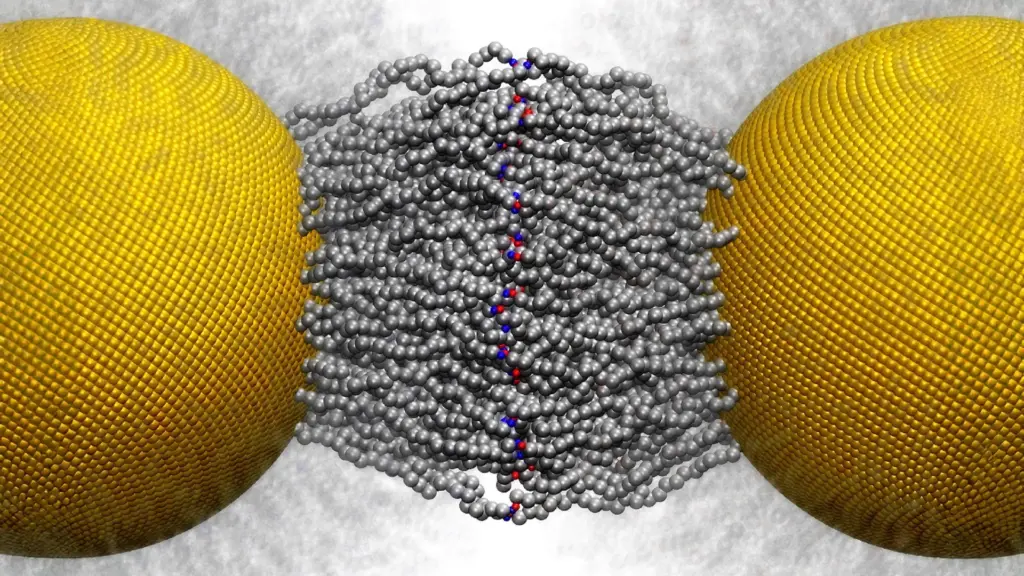
For their latest system, the team armed nanoparticles with exceptionally flexible ligands tipped with opposing electrical charges. Some polymer chains carried positive charges at their extremities, while others terminated in negative charges.
Because electrostatic forces dictate that opposite charges attract, these functionalized connector molecules naturally bend and reach toward neighboring particles carrying complementary charges. This electrostatic attraction drives the nanoparticles together, while the inherent flexibility and spatial footprint of the polymer chains govern the ultimate valency—the number of connections each particle can sustain.
"The idea is, instead of defining a specific direction the bonds are going to occur in with complicated synthesis methods, we just said, ‘The bonds are going to be as flexible as they want to be, and they’ll spontaneously go to whatever valency is going to maximize bond stability,’" Macfarlane notes.
By allowing the connectors to move fluidly, the system naturally finds a stable thermodynamic equilibrium without requiring engineers to hardcode every single connection point in advance.
Creating Unprecedented Crystal Structures
Laboratory experiments spearheaded by Sbalbi proved that the research team could seamlessly tune the interparticle connections by manipulating two relatively simple variables: the physical sizes of the nanoparticles and the chain lengths of the flexible polymer ligands.
Modifying these parameters directly altered how the particles packed together, granting the researchers precise command over the coordination number of each individual particle.
Most significantly, this method allowed the team to synthesize entirely new crystal structures that had never been documented before.
Crystals are ordered materials whose internal building blocks arrange themselves into repeating, symmetrical lattices. In this context, the repeating grid is constructed from organized networks of nanoparticles rather than traditional atoms or small molecules, forming what scientists call nanoparticle superlattices.
By engineering conditions that reduced the number of bonds each particle could form, the team successfully produced more open, porous architectural arrangements, successfully bypassing the densely packed default structures that usually dominate nanoparticle assembly.
"Without having to predesign where the particles connect or what their shapes are, we can control the number of bonds each particle has," Macfarlane explains. "The amount of flexibility of the polymer dictates how many bonds it has. It allows us to lower the number of bonds each particle has and make lattices we have never seen before."
These findings strongly indicate that molecular flexibility—long dismissed by the scientific establishment as an impediment to precision manufacturing—can be reframed as a powerful design tool for advanced materials engineering.
Toward Customizable Designer Materials
The research team believes this methodological shift brings materials scientists closer to realizing a long-sought, elusive objective: achieving entirely independent control over the inherent properties of individual nanoparticles and the macroscopic superlattice structures they ultimately form.
In an ideal theoretical framework, scientists should be able to select nanoparticles based exclusively on their unique electrical, optical, or chemical properties, and then assemble those particles into whatever structural lattice best serves a specific technological application.
In practical execution, however, existing assembly techniques have made that level of modular freedom exceedingly difficult to achieve.
"We in the nanoparticle assembly community talk about having completely independent control over what your particle is and what assembly it goes into," Macfarlane says. "In theory, that should be the case. In reality, it absolutely has not been."
The newly unveiled approach narrows this long-standing gap. Because researchers can now steer nanoparticle arrangements simply by tuning ligand flexibility and electrostatic interactions, they can bypass the cumbersome, bespoke manufacturing techniques mandated by older methods.
Furthermore, the team views this discovery as a vital stepping stone toward scaling up the production of customizable materials, potentially bridging the gap between academic laboratory discovery and viable industrial applications.
Expanding Horizons in Electronics, Medicine, and Energy
The capacity to construct wider arrays of open, versatile nanoparticle architectures holds immense promise for the development of cutting-edge technologies.
In the field of photonics—which focuses on the manipulation and control of light—precisely engineered nanoparticle superlattices could allow researchers to craft materials with unprecedented optical refractions and characteristics. In chemical catalysis, where specialized substances accelerate industrial reactions, novel particle geometries could unlock more efficient pathways for chemical synthesis.
Beyond optics and catalysis, the flexible bonding approach could catalyze future innovations across medicine, agricultural technology, electronics, and next-generation energy storage.
A core advantage of nanoparticle technology is that individual particles can be engineered to exhibit a vast spectrum of desirable characteristics. By mastering how those particles organize into larger assemblies, scientists can synergize their individual capabilities in entirely novel ways.
"Nanoparticle superlattices offer a way to create designer materials where your building blocks have all sort sorts of unique properties," Macfarlane says. "But just densely packing these nanoparticles together limits your applications. This offers a way to get less dense formations of nanoparticles, and that’s where a lot of the interesting applications are."
Although substantial development work remains before this laboratory technique transitions into commercial manufacturing, the discovery firmly establishes molecular flexibility as a viable, potent strategy for engineering next-generation materials.
Rather than viewing flexible molecular connections as a flaw to be engineered away, scientists can now leverage that very flexibility to unlock structural configurations that rigid designs could never attain.
The research received financial support from the National Science Foundation, the Department of Energy, the U.S. Army, and the U.S. Navy.