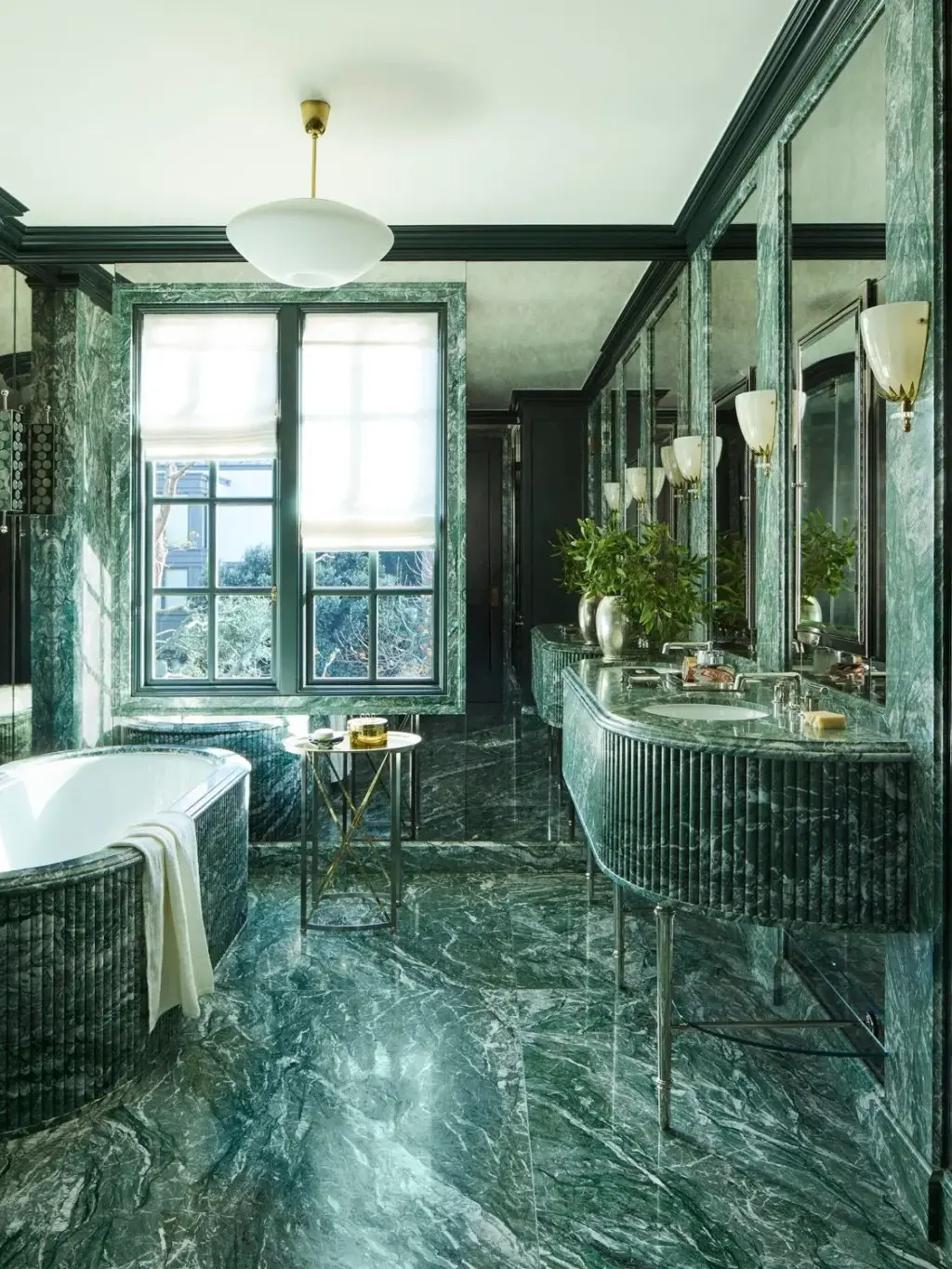
For years, the gold standard of luxury residential design was the ubiquitous gray-and-white "spa bathroom." These spaces—defined by spare layouts, brilliant floods of natural light, and acres of pristine Calacatta Viola marble—dominated high-end interior architecture and social media feeds alike. But as design sensibilities shift away from clinical minimalism toward maximalist warmth and historic pastiches, the reign of the all-white spa bathroom appears to be rapidly waning.
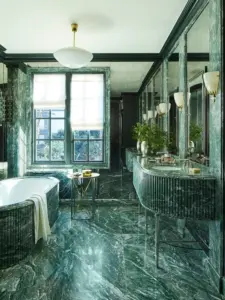
In its place comes a dramatically moodier, more tactile aesthetic. The new look is characterized by heavily veined natural stone in deep forest greens and dusky reds, sculptural Art Deco-inspired fixtures, and rich, layered woodwork. This revival can currently be seen in the private sanctuaries of prominent design figures and cultural tastemakers, including interior designer Athena Calderone and supermodel Paloma Elsesser, both of whom have recently showcased these decadent spaces in major shelter publications.

The primary historical reference point for this modern renaissance is 1930s Milan, an era when Italian architects turned utilitarian spaces into absolute showpieces by utilizing bold material combinations, unexpected color palettes, and precise, uncompromising geometry.
Few historical figures are as closely associated with this opulent yet rigorous look as Piero Portaluppi (1888–1967), the visionary Rationalist architect behind legendary Milanese landmarks like the Villa Necchi Campiglio and Casa Corbellini-Wassermann. While Portaluppi’s dramatic entry halls and sweeping architectural staircases have inspired interior designers and architects for decades, it is specifically his rooms with plumbing that are currently experiencing a massive cultural moment.
At the iconic Villa Necchi, Portaluppi used mirrored walls to endlessly multiply the swirling, organic patterns of Arabescato Orobico marble. At the nearby Casa Corbellini-Wassermann, he set vibrant, saturated green Verde Challant marble directly against graphic, contrasting black stonework.

"He frequently used contrasting materials to frame hallways, thresholds, and architectural elements, allowing these moments of juxtaposition to draw the eye and bring a sense of ceremony to the space," explains interior designer Athena Calderone, who traveled to Milan to visit Villa Necchi alongside architect Danielle Siggerud while she was in the process of reimagining her own Tribeca apartment.
AD100 designer Gregory Rockwell notes that he has long been drawn to Portaluppi’s deeply unconventional approach to color and material composition.
"What I love about Portaluppi is how controlled everything is architecturally, but then he’ll do something extravagant with the marble or an unexpected color," Rockwell observes.

This philosophy was put into practice when Rockwell and his colleague, Hester Hodde, designed the primary bathroom for supermodel Paloma Elsesser’s Brooklyn townhouse. To achieve a space that felt both historically grounded and utterly fresh, they layered burgundy Rosso Francia marble, rich walnut-and-mirror paneling, and soft pistachio-green walls.
"It’s a slightly strange combination when you think about it, but I love the colors together," Rockwell says, acknowledging the unconventional nature of the palette.
For Calderone, the true magic of this design movement lies entirely within the meticulous execution of the stonework.

"There was such ingenuity in the way Portaluppi clad entire bathrooms in stone, often using smaller, individually composed pieces," she notes.
In her own primary bathroom, Calderone paid homage to this technique by edging sweeping expanses of pale stone with intricate inlaid tile borders, complemented by Art Deco-inflected fixtures and geometric mirrors. Looking back at Portaluppi’s historic examples, she observes that his philosophy stands in stark contrast to contemporary interior trends.
"It feels almost at odds with how we approach stone today, where expansive, perfectly bookmatched slabs have become the prevailing ideal. He embraced the irregularity and variation in the veining," she explains.

That deep appreciation for the unique individuality of natural stone is also prominently displayed in Calderone’s home powder room, which features a custom pedestal sink crafted from deeply veined Verde Alpi marble, paired with historic sconces by Émile-Jacques Ruhlmann and a 1940s Italian mirror.
A strikingly similar sink fashioned from the same deep-green stone can be found in the powder room of a Milan pied-à-terre recently designed by Giampiero Tagliaferri for a young art collector.
"The custom pedestal sink takes its bold, geometric form from Rationalist architecture, but we kept the lines clean and the layout modern," Tagliaferri says. As the designer explains, revisiting the design language of 1930s Milan is not about slavishly or literally replicating a Portaluppi bathroom from scratch. "Reinterpretation is about extracting a period’s core DNA, not literal replication."

This sophisticated design thinking now extends far beyond bespoke, one-off architectural interiors. Contemporary commercial bath and tile collections are actively borrowing from the Portaluppi vocabulary, providing consumers with accessible ways to incorporate patterned stone, geometric silhouettes, and saturated color palettes into their homes without requiring a full-scale, ground-up renovation.
Artistic Tile’s Calacatta Gold marble mosaic, for instance, successfully brings the intricate visual complexity of Calderone’s inlaid borders directly to walls and floors. Meanwhile, Kelly Wearstler’s oxblood-hued Treillage tile collection for Ann Sacks introduces a rich, dimensional spin on the burgundy tones seen in Elsesser’s Brooklyn bathroom. For Clé Tile, Reath Design has developed marbleized patterns that successfully evoke the natural, flowing movement of quarried stone.
The influence has even trickled down to smaller decorative and hardware details. Charles Edwards offers an alabaster dish light boasting an unmistakably Art Deco-inspired silhouette, while retailers like Crate & Barrel have introduced Verde Green marble soap pumps and tissue holders that bring the distinctive color and rich veining of those high-end Verde Alpi sinks down to an everyday countertop scale.

Whether a project involves an entire room completely wrapped in dramatic, patterned marble or simply a single, well-chosen decorative detail, the underlying impulse among designers remains largely consistent.
"I’ve never really understood why bathrooms should be any less interesting than the rest of the house," Rockwell says. "They might as well be beautiful and exciting."