What, exactly, is Elizabeth Holmes’s angle here? It is one of many perplexing questions raised by You Can See Everything, a three-hour documentary directed by Lance Oppenheim and Nathan Fielder that has drawn hordes of theatergoers since its release, yet leaves viewers searching for elusive answers. Why did Holmes—the disgraced founder sentenced to 11 years in prison for the bald-faced lies that once made her America’s richest self-made female billionaire—invite Fielder and a documentary crew to live with her at a rented beach house near San Diego for the entirety of her final month of freedom?
“This is a question that we are still debating to this day,” the comedian recently told Wired.
Throughout the film, Fielder’s probing questions are met by Holmes with vague responses, unsettling facial expressions, and a steadfast insistence on her total innocence—and even naivety. Among her claims is the assertion that she has never, in her entire life, told a lie. In many of these scenes, the Theranos founder cries or rocks her baby with a bare face and casual garb, entirely devoid of the signature red lipstick and black turtlenecks that once defined her public persona. She appears alongside her domestic partner, hotel heir Billy Evans, who micromanages Holmes as she whisks eggs, attempts to manage her public image from behind bars, and brusquely intervenes when on-screen interviews veer away from his preferred direction.

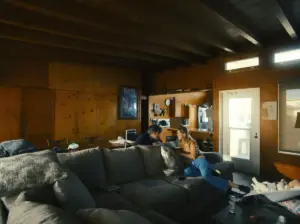
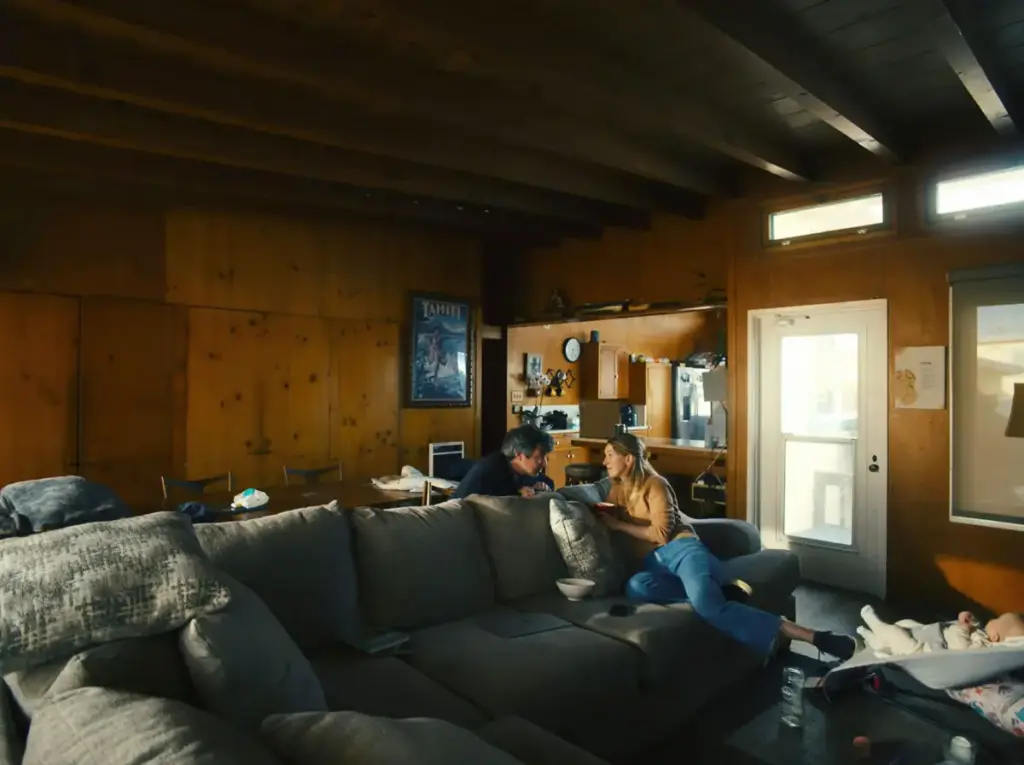
All the while, the small entourage mills about a modestly furnished two-bedroom home in Del Mar, California, while an adjacent two-bedroom guesthouse hosts Fielder. The overall effect makes Holmes surprisingly sympathetic to the viewer, stripping away the monolithic corporate villain and replacing her with a domestic figure caught in the twilight of her freedom.
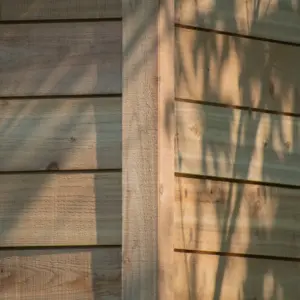
If you look past its direct beach access and affluent zip code—where Zillow estimates the simple house is worth $9 million—the 1940s dwelling is unassuming. Wood-paneled and a bit outdated, it could easily be described as rustic, and its interiors feel widely relatable. However, Holmes and Evans had not been renting the home for long before Fielder and his cameras showed up. Less than five months before filming began, the couple had lived on the grounds of a massive Silicon Valley estate that was then listed for $135 million.
In September 2021, reports revealed that the couple had moved into a house at the historic Green Gables Estate in Woodside, a well-heeled enclave outside of San Francisco. They resided in one of six houses that share the sprawling 74-acre property with the main house: a magnificent English country-style mansion spanning over 10,000 square feet. The estate was originally commissioned by businessman Mortimer Fleishhacker, who hired architect Charles Sumner Greene to design it in 1911. A tennis court, a 300-foot-long Roman-style pool, and three standard swimming pools dot the property.

Holmes and Evans stayed there throughout Holmes’s high-profile federal trial and remained until at least November 2022, according to multiple media reports. On the 18th of that month, she finally received her prison sentence, bringing a temporary close to her Silicon Valley chapter. (The Fleishhacker family ultimately sold Green Gables in 2025 for a discounted yet still record-breaking $85 million.)
By April 26, 2023, production on You Can See Everything had officially begun, capturing Holmes and her family at their rented beach house in Del Mar, a quiet San Diego suburb. Shortly after, on May 7, a New York Times profile revealed to the public that they had relocated to the area, where Evans’s family and their extensive hotel empire are deeply rooted.
“Elizabeth Holmes blends in with the other moms here,” the story observed. “If you are in her presence, it is impossible not to believe her, not to be taken with her and be taken in by her.”

If renting that cozy beach cottage was a calculated choice by Holmes to shape her public image, it would not be the first time she deployed domestic architecture as a narrative tool.
“She pulled this exact same move when Ken Auletta did a piece for The New Yorker on Elizabeth in 2014,” Theranos whistleblower Tyler Shultz recently pointed out.
In that landmark 2014 profile, Auletta wrote, “Her home is a two-bedroom condo in Palo Alto, and she lives an austere life,” adding that Holmes “doesn’t date” and “doesn’t own a television.” In reality, at that very moment, Holmes was living in a sprawling mansion in tony Atherton, California, alongside Theranos executive Sunny Balwani. The pair were secretly dating—a relationship that predated Balwani’s own later conviction for fraud, which landed him a nearly 13-year prison sentence.

Public records show the couple jointly purchased the French provincial-style house in 2013 under an LLC for $9 million. Spanning nearly 9,000 square feet, the Atherton property featured crystal chandeliers, dedicated staff quarters, formal gardens, a guesthouse, a swimming pool, and a sprawling pavilion designed for outdoor entertaining. Balwani eventually bought out Holmes’s ownership stake in the property in 2018 for $7.9 million before selling the estate entirely in 2022 for $15.8 million.
Whatever specific story Holmes hoped would emerge from the collaborative experiment of You Can See Everything, it appears she was determined to rewrite her character for the public stage—a feat she may well have accomplished, in part, by once again carefully engineering her physical setting.