Fans of Truman Capote’s celebrated literary legacy will soon have a rare opportunity to acquire personal effects directly from the iconic author’s estate. Nearly 400 lots of Capote’s personal objects are heading to the auction block, offering a tangible connection to the writer behind American classics such as In Cold Blood and Breakfast at Tiffany’s.
Capote, whose colorful and complex life has been continually revisited in popular culture—most notably dramatized in the 2005 biographical film Capote and the 2024 television miniseries Feud: Capote vs. the Swans—died in 1984 at the age of 59. Following his passing, many of his belongings were entrusted to journalist and close friend Gerald Clarke, who authored the definitive 1988 biography of the writer. Now 89 years old, Clarke is currently in the process of downsizing his estate, prompting the decision to bring this extraordinary trove of literary history to the public.
The official sale is scheduled to take place on November 21 through Cornell Auction, with an online preview and bidding slated to open on October 26. Based in Bellport, New York, the auction house has not yet released the full catalogue to the public. However, a preview shared via an Instagram video revealed an exciting provenance for prospective buyers: "most of the items that we have in the Truman Capote auction were photographed almost exactly 50 years ago in 1976 in an Architectural Digest spread about Truman’s house here in Sagaponack on Long Island."
The New York Times has confirmed that among the items up for grabs is Capote’s extensive collection of paperweights, which were prominently featured in the original Architectural Digest feature. Clarke revealed to the Times that the author "became addicted to paperweights and collected so many of them." Some of these unique decorative objects consist of flowers delicately preserved in resin, handcrafted by Capote himself. Perhaps most notably for true-crime enthusiasts and literary scholars alike, the auction includes a paperweight crafted from rocks sourced directly from the Kansas farm that served as the haunting backdrop for his masterwork, In Cold Blood.

Additional highlights from the upcoming auction lots include a signed copy of To Kill a Mockingbird given to Capote by his lifelong friend and fellow literary icon Harper Lee, a bronze frog inkwell, and even Capote’s personal house keys.
To fully understand the historical significance of these items, one must look back at the sanctuary where many of them lived out their days: Capote’s custom-built retreat in the Hamptons. Finding the Long Island home is virtually impossible for the uninitiated, which suited the author perfectly. Hidden safely behind thick walls of scrub pine, towering privet hedges, and dense rows of hydrangea bushes stood Truman Capote’s two-story, weathered-gray beach house, situated near Sagaponack on the South Fork of Long Island.
Residing in the heart of the Hamptons—a picturesque landscape where rolling potato fields and lush farmlands meet the crashing waves of the Atlantic Ocean—Capote occupied a unique space. The region served as a dual-identity locale: a year-round farming community that seamlessly doubled as a seasonal haven for city dwellers, where historic antique farmhouses competed for ocean views with modern glass structures nestled among the dunes and fields. Capote famously and affectionately once described Sagaponack as "Kansas with a sea breeze."
Over time, the area evolved into a rural Montparnasse, attracting an elite circle of artists and writers including James Jones, Willem de Kooning, Marya Mannes, Jean Stafford, and Joseph Heller. It was a sleepy, sentimental town where local establishments embraced their literary residents. Capote could often be found having lunch or sharing a drink with fellow writers like John Knowles or Willie Morris at a local bar that regularly ran advertisements in the biweekly newspaper wishing him a happy birthday, allowing the famous author to come and go entirely as he pleased.
The most reliable way to locate Capote’s secluded property was behind the wheel of his deep-green Buick. A visitor would embark on a short, bumpy ride down a rustic dirt lane originally established in 1670, make a sharp turn into a gravel driveway past a natural bird sanctuary and a friend’s cottage constructed on his property, and finally arrive in front of his box-shaped, flat-roofed wooden home. Wildflowers bloomed in the surrounding landscape, carrying the pungent, salty scent of the Atlantic Ocean mixed with potatoes nearly ready for harvest.

"I own these fields," Capote would say proudly, sweeping his hand across the six acres he had owned since 1962, the year he had the house built precisely to his specifications. "By a local carpenter who’s dead now. He did it to my directions. It’s exactly the way I wanted it. I work at this untended look. It’s intentional. You can see how quiet it is here because you can barely see the top of another house. This is a place to be alone."
Only a select few trusted friends ever ventured up the overgrown path to the house hidden deeply within the dune grass, and all of them arrived strictly by invitation.
"I’m here to work. I come here a lot in the autumn and winter, and I see almost no one. I don’t care for the Hamptons in the summer—it’s gotten too crowded. I don’t understand the way some people come out here and run themselves ragged every night. I just don’t think some of these writers are working," Capote reflected. Such a statement seemed ironic coming from a man who famously bridged two worlds: maintaining a reputation as one of America’s greatest prose stylists while simultaneously reigning as an ultimate social butterfly, acquainted with everyone from prisoners and sailors to princesses and high-society socialites.
"I spend most of my time out here reading, writing, going for walks with my dog and talking on the telephone. I see people in New York; I don’t see New York people out here. I hardly see anyone when I’m here. In the past 14 years, since I’ve had this house, I’ve gone out six times for dinner. Now that’s quite a record for someone known for being so social, isn’t it? Besides, whom would I entertain? I only know about four people I’d really have over!"
Entering his residence through the back kitchen door, Capote would remove his loafers in the traditional Japanese style before stepping into the living room. Barefoot, he would pick up a rag mop as delicately as Fred Astaire handled a dancing cane, gently dusting the marine-blue floor while the surface was still drying from a fresh coat of boat deck paint.

"I’ve just had it repainted, and this humidity doesn’t help it dry. You should see this room at night. The floor floats like a big blue-green lake," he noted.
Capote often described his home as a "raincoat," a metaphor for its architectural construction. Built with exterior walls exposing vertical studs and horizontal bracings, the building’s outer skin effectively sheltered the interior elements, much like a protective garment.
"I wanted a rustic house. I really think of it as one big room. Completely winterized, it’s been designed to look unfinished. I call it ‘run-down comfort.’ I like the effect of texture in rooms—the rawness of the wood plus the mirrors that line one end."
Floor-to-ceiling windows with divided panes welcomed the morning sun and offered sweeping views of the sea and sand located roughly 200 yards away. A spiraling steel staircase led upward to a balconied second-floor study furnished with red sofas, wicker chairs, hassocks, and a celebrated sketch of Capote created by artist René Bouché, providing an elevated space for reading and writing.
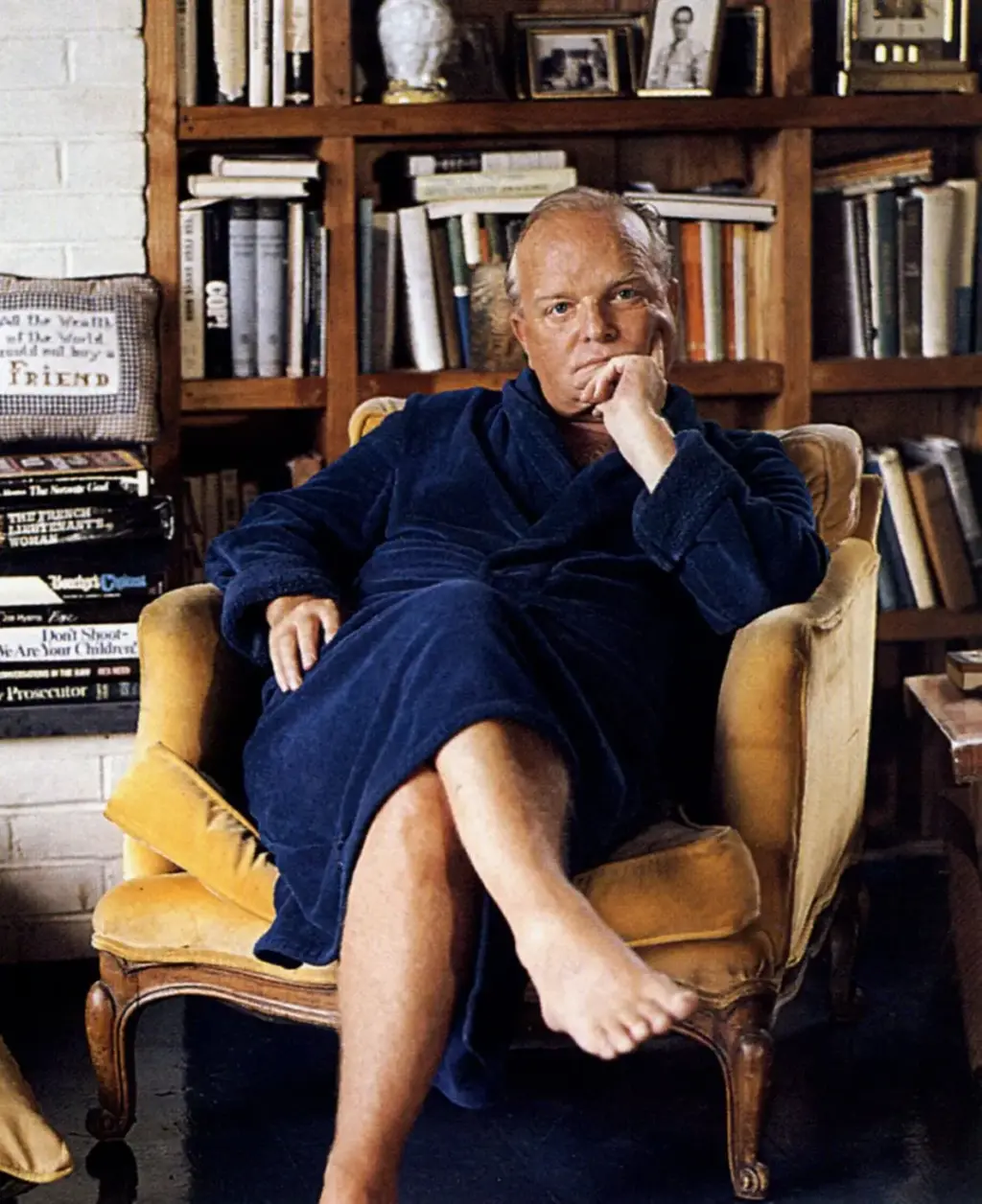
The interior design consciously rejected the "Don’t Touch" mentality. Furnishings were comfortable, attractive, and clearly meant to be lived in rather than merely observed. A priceless Tiffany lamp stood watch over a worn yellow velvet easy chair. While the upholstery displayed a few sun-faded patches, the carefully curated clusters of paperweights remained polished and brilliant. Wicker tables and chairs originated from inexpensive import shops or stood alongside rare antiques, such as the round, claw-footed downstairs table where Capote did his writing. Needlepoint pillows crafted by friends were scattered casually throughout the space alongside silver-framed photographs of prominent figures like Lee Radziwill.

Though her pale blond hairs frequently littered the space, Capote’s celebrated English bulldog, Maggie, was often found visiting neighbors. The author frequently delighted in sharing anecdotes about his pet, whom he described as "sweet, quirky and huggy," and who occasionally developed a habit of raiding picnic baskets along Gibson Beach or consuming unexpected items like Joanne Carson’s pink satin slippers and Charlotte Curtis’s poinsettias.
"Oh, she’s very munchy all right," Capote would concede, adjusting his Windex-blue-tinted prescription glasses on his nose with a characteristic shrug and a high-pitched giggle.
Adjacent to the expansive living room was a small, screened-in porch reminiscent of traditional southern architecture, packed with his cherished wicker furniture and utilized during mild coastal breezes. In contrast, his bedroom near the kitchen was exceptionally stark and sparsely furnished, bearing a close resemblance to a simple summer camper’s tent. Situated near his cot-sized bed were stacks of detective magazines, a physical fitness reducing machine, and a rotating pile of favorite reading materials.
"I like to have my own things around me. Even when I travel to my other houses in Switzerland and in California, I take things of my other houses with me," Capote explained, maintaining a sleek permanent base at the United Nations Plaza in Manhattan. "I’m a great houseguest. I only appear at mealtimes. However, I really don’t like people staying with me. It’s interrupting."
His daily routine in Sagaponack followed a strict, uncomplicated schedule. Rising around 7:00 a.m., he would write until 11:00 a.m., pausing briefly to review the morning newspapers. Writing would resume until 1:00 p.m., followed by lunch, a trip to the local post office, running errands, and taking a walk. Evenings were reserved for relaxation, reading, and walking Maggie, with dinner concluded by 7:00 p.m. and bedtime usually arriving by 9:30 p.m., accompanied by a book.

During the period of the original 1976 profile, Capote was deeply immersed in writing his long-awaited, controversial novel, Answered Prayers, while also wrapping up his first major cinematic role in Neil Simon’s comedy-mystery film, Murder by Death. Playing the eccentric millionaire Lionel Twain—a leading authority on detective fiction living in a gloomy New England mansion—Capote felt the casting was an ideal fit given his lifelong fascination with crime and his groundbreaking work on In Cold Blood. The film featured an all-star ensemble cast including Peter Sellers, Orson Welles, Myrna Loy, Eileen Brennan, Peter Falk, David Niven, Madeline Kahn, James Coco, and Nancy Walker.
As an avid collector throughout his life, Capote was fully aware of his accumulation habits, immortalized in a portrait by society photographer Slim Aarons showing a youthful Capote seated on a Victorian sofa amid his favorite treasures. "I like to collect things, Victorian things, and mix everything together. I enjoy looking for and at all of them. I’m not sure I need them. I’ve got too much, and I haven’t edited myself lately!"
Rejecting the assistance of professional interior designers, Capote firmly believed in curating his own spaces. "For me, it’s a bore to use a decorator. I know exactly what I want. I just don’t care to have someone come in and tell me what I need to live with. I know." His fundamental philosophy of good interior design remained simple: "Something that’s not immediately offensive when you walk into a room. Of course it may be, eventually."
Born in New Orleans and raised across the American South, Capote famously opened his classic novella Breakfast at Tiffany’s with the observation: "I am always drawn back to places where I have lived, the houses and the neighborhoods." For Capote, Sagaponack ultimately recreated the lost sense of place from his youth. "I moved around so much as a child, I never had a sense of home. Maybe I did when I was 11 and I lived in a rural town in Alabama."
Glancing up at a hat rack positioned above his brick fireplace adorned with an assortment of rumpled Panama hats, the writer would offer a characteristic laugh. "Home is where I hang my hats. However, I keep leaving them when I go visit people. I don’t have as many as I used to because I don’t recover them all. People always promise to send them back, but they don’t."