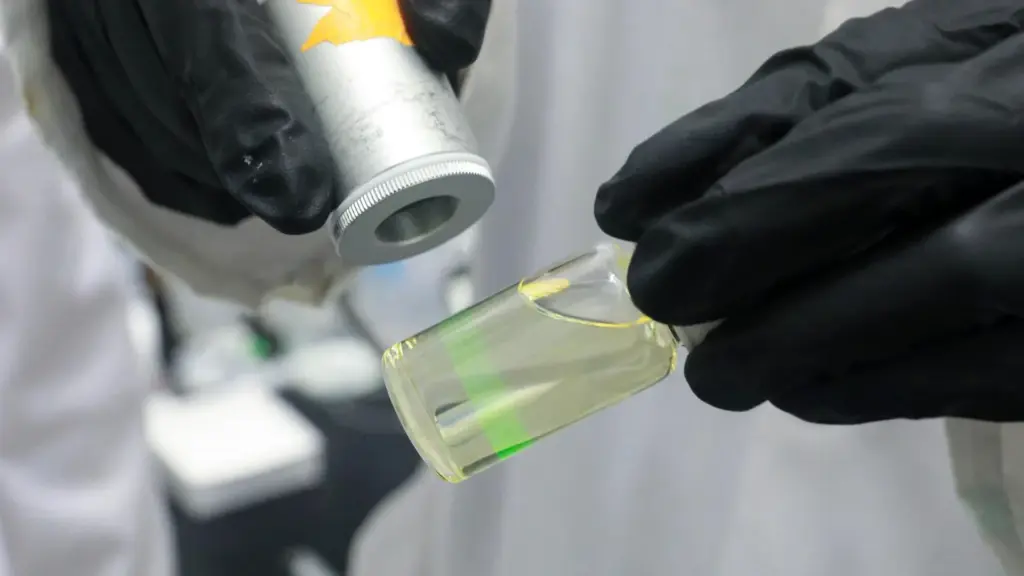
Engineers at the University of Toronto have developed a breakthrough class of dye-sensitized nanoparticles capable of detecting chemical substances at exceptionally low concentrations. Beyond their remarkable sensitivity, these newly engineered microscopic particles possess a sophisticated molecular discernment, allowing them to accurately differentiate between chemical compounds that share nearly identical shapes. This dual capability marks a significant leap forward in nanoscale engineering and could soon transform how industries monitor environmental safety and ensure pharmaceutical quality.
The microscopic particles operate by emitting a distinct optical light signal upon successfully attaching to the specific target chemical they are engineered to locate. Rather than relying on standard light-absorption methods, these particles absorb low-energy photons and fundamentally transform that energy into higher-energy photons, generating a bright, highly measurable optical signal. This unusual conversion process addresses longstanding limitations in optical detection technology and opens up practical applications across multiple scientific and industrial sectors. Pharmaceutical manufacturers, for instance, could leverage the technology to isolate and identify unwanted impurities within drug batches, while environmental scientists might deploy them to trace microscopic quantities of dangerous pollutants hidden within groundwater reserves.
Turning Infrared Light Into a Bright Green Signal
To understand the novelty of this breakthrough, researchers point to the limitations of traditional organic compounds. For decades, organic molecules known as fluorophores have been utilized to absorb light and convert it into colorful emissions. However, this natural mechanism has historically operated in only one direction. Professor Kai Huang, the senior author of a newly published research paper describing the particles in the Journal of the American Chemical Society, explains the mechanical constraints of conventional methods.
"Organic molecules called fluorophores have been used for decades to absorb light and convert it into colorful emissions, but the process only works in one direction," Professor Huang says. "With fluorophores, the excitation frequency has to be higher than the emission frequency, which means that they convert high-energy photons into low-energy photons. What makes our dye-sensitized nanoparticles special is that they are capable of upconversion, meaning that they can absorb light in the form of low-energy photons and emit higher-energy ones. For example, you could excite them with near-infrared light, which can easily be produced with low-cost lasers, and they would glow bright green in response."
This upconversion process grants the nanoparticles a crucial operational advantage. Because the specific wavelength of light used to activate the particles differs entirely from the light frequency they emit, researchers can effortlessly separate the desired optical signal from the disruptive background light generated by the sample matrix itself.
Professor Huang illustrates the clarity this provides by drawing an analogy to the night sky.
"It’s like the difference between stargazing at night versus the daytime," he explains. "The stars shine the same brightness all the time, but during the day the sun is so powerful that it overwhelms them. Shifting the excitation frequency lower produces zero-autofluorescence background in the samples you are analyzing, while the luminescent nanoprobes keep shining; it is like turning off the sun, so you can see the stars better."
The Challenge of Making Nanoparticles Brighter
At the structural level, the nanoparticles rely heavily on specialized ions of ytterbium and erbium—elements belonging to the lanthanide chemical family—to execute the delicate upconversion process. In earlier generations of sensing nanoparticles, engineers typically constructed flat, hexagonal configurations. Within these structures, ytterbium and erbium ions were randomly dispersed throughout a host material composed of sodium, yttrium, and fluorine. The research team compares this architectural layout to chocolate chips distributed evenly throughout a cookie, with organic dye molecules coating the exterior much like icing.
When near-infrared light strikes these particles, the outer dyes initially capture the incoming energy. That harvested energy transfers swiftly to the ytterbium ions, which act as an internal relay system, before passing the energy along to the erbium ions. The erbium ions finally perform the upconversion step, allowing the stored energy to escape as a vibrant green luminescence.
Historically, however, attempts to amplify this system’s overall brightness triggered a counterproductive mechanical failure. Packing the energy-relaying ytterbium atoms too densely inside the particle caused them to interfere with their own operations.
"There’s a problem: if you pack the ytterbium atoms in too densely, they start to absorb not only the energy coming in, but also the energy coming out," explains Jiaze Wu, a PhD student in Professor Huang’s laboratory and the lead author of the newly published paper. "This is called back-energy transfer: it means that the energy that would have been emitted by the erbium ions as green light instead gets bounced back to the ytterbium relay and never reaches the surface."
A Layered Design Creates a One-Way Energy Path
To surmount this fundamental physical limitation, Wu, Huang, and their collaborative team completely overhauled both the chemical composition and the geometric architecture of the nanoparticles. Moving away from the conventional host matrix built from sodium, yttrium, and fluorine, the researchers engineered an entirely new matrix utilizing lithium, lutetium, and fluorine.
Furthermore, they transitioned the particle geometry away from flat hexagons toward more three-dimensional, diamond-shaped structures. Each newly formed particle comprises several distinct architectural regions, featuring a dense core encased consecutively by an inner shell and an outer shell.
"We were able to create a nice gradient: the concentration of embedded ytterbium ions gets denser as you go through each layer, with the core being the most dense," Wu notes. "This arrangement enabled us to pack in much more ytterbium. In our particles, the light energy coming in flows almost entirely in one direction, inward toward the erbium ions."
Rather than relying strictly on empirical trial and error to discover this configuration, the research group utilized advanced computer modeling. The team simulated dozens of distinct chemical formulations and geometric shapes virtually before fabricating the most promising candidates in the laboratory environment.
Weixiang Ben, an undergraduate student who spearheaded the computational components of the study, details the simulation techniques employed. "We used Monte Carlo simulations and density functional theory to simulate how the energy would interact between different parts of the nanoparticle, right down to the atomic or even subatomic level," Ben says. "That’s how we showed that this core-shell-shell structure could actually function as a one-directional energy tunnel for incoming light."
Nanoparticles Up to 150 Times Brighter
The culmination of this modeling and chemical redesign is a nanoparticle that generates a dramatically stronger optical signal than any previous iteration. According to Wu, the light emitted by these newly designed structures is roughly 150 times brighter than standard upconversion nanoparticles lacking dye sensitization. Furthermore, under identical excitation conditions, they exhibit a brightness level approximately 50 times greater than some of the most heavily optimized conventional structures previously documented in scientific literature.
This dramatic surge in brightness translates directly into unprecedented detection sensitivity. Because an individual nanoparticle produces such a robust optical signal, even a minuscule number of particles binding to their intended target molecules can generate enough light for immediate detection.
Crucially, the sensors retain the capacity to discriminate between structural isomers. These are complex molecules that share the exact same types and total quantities of atoms, but whose atomic configurations differ slightly in spatial arrangement. In chemistry, such subtle structural divergences can carry immense consequences, particularly within the pharmaceutical sector.
Spotting the Wrong Molecule in a Drug Batch
The practical implications of molecular selectivity are especially evident in drug manufacturing, where structural purity is paramount. Wu illustrates the hazard posed by undetected structural isomers in commercial pharmaceuticals.
"Let’s say you’re making a drug molecule, and your manufacturing process works fine, except that 10% of the batch is the wrong structural isomer," Wu explains. "That’s a huge problem: it can make the drug less effective, or worse, lead to side effects that you definitely don’t want. The current process for detecting this relies on very expensive analytical tests, but with these nanoparticles, you could do it using low-cost lasers and a very small sample."
The unique intersection of high optical sensitivity and strict molecular selectivity positions the technology as a promising tool for identifying impurities that remain notoriously difficult or cost-prohibitive to isolate through traditional analytical techniques. Beyond pharmaceuticals, the fundamental architecture of the sensor can be adapted for environmental surveillance, where scientists frequently face the challenge of tracking trace amounts of contaminants dispersed across vast volumes of water.
The Next Step Toward Commercial Use
Despite the success of the laboratory demonstrations, the technology currently remains at the proof-of-concept stage. Before these advanced nanoparticles can see widespread commercial adoption or large-scale deployment, researchers must establish a reliable, scalable method for manufacturing them in high volumes.
Professor Huang confirms that work addressing mass production is already actively underway within the university labs. While acknowledging that bringing the technology to market will require a sustained development timeline, the team remains optimistic about its broader potential.
"We’re working on this already, in fact. We think it’s feasible, but it requires a very long roadmap," Huang concludes. "In the meantime, this model serves as proof-of-concept; with this technique, we can produce a very high-performance upconversion nanoparticle that could be customized to any molecule you might want to detect. That’s something entirely new."