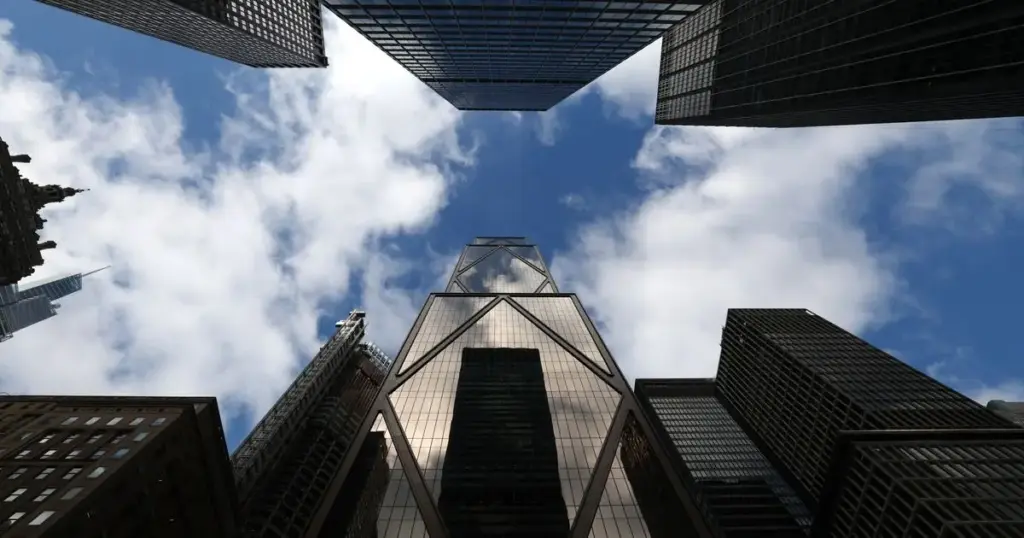
For much of the development process, the bank had maintained a relatively evasive posture regarding the precise financial toll of 270 Park Avenue, frequently tossing around vague baseline estimates of $3 billion or $4 billion. At the same time, however, leadership was rarely shy about showing off the building’s lavish perks and state-of-the-art amenities designed to lure elite talent back to the physical workplace. The 2.5 million-square-foot skyscraper is packed with high-end features that stretch the boundaries of traditional corporate office design. Employees and visitors are greeted by large-scale artworks curated from renowned contemporary artists, including prominent pieces by Gerhard Richter and Maya Lin. The building boasts unique touches such as an indoor flagpole bearing a banner engineered to flutter dynamically in alignment with the wind conditions outside. For moments of leisure, staff can frequent an authentic Irish pub complete with Guinness on tap, while health-conscious workers have access to a sprawling wellness center offering specialized services like physical therapy and allergy shots. The facility’s gym features a dedicated row of Peloton bikes strategically positioned to face the scenic expanses of Central Park.
Beyond its interior luxuries, the building’s exterior serves as a constant visual spectacle for Midtown Manhattan. While historic city landmarks like the Empire State Building traditionally illuminate their spires in shifting colors to mark national holidays and civic celebrations, JPMorgan took a distinct path by hiring celebrated artist Leo Villareal to program an intricate, sweeping light show across half of the building’s massive exterior facade.
The comprehensive construction-cost estimate, compiled directly from the bank’s internal real-estate division, accounts for a vast array of expenses that extend well beyond standard steel and concrete. The total financial figure encompasses everything from expensive air rights—which are routinely factored into Manhattan development budgets—to the bespoke furniture and museum-quality art installations that populate the interior spaces, neither of which are typically included in traditional base construction figures. When calculated on a per-square-foot basis, the total expenditure for the towering 2.5 million-square-foot structure translates to roughly $2,500 per square foot. While that figure is undeniably high, real estate experts note that it is not entirely outside the realm of possibility for a project of this magnitude, particularly given how severely construction costs have spiked in the wake of the COVID-19 pandemic.
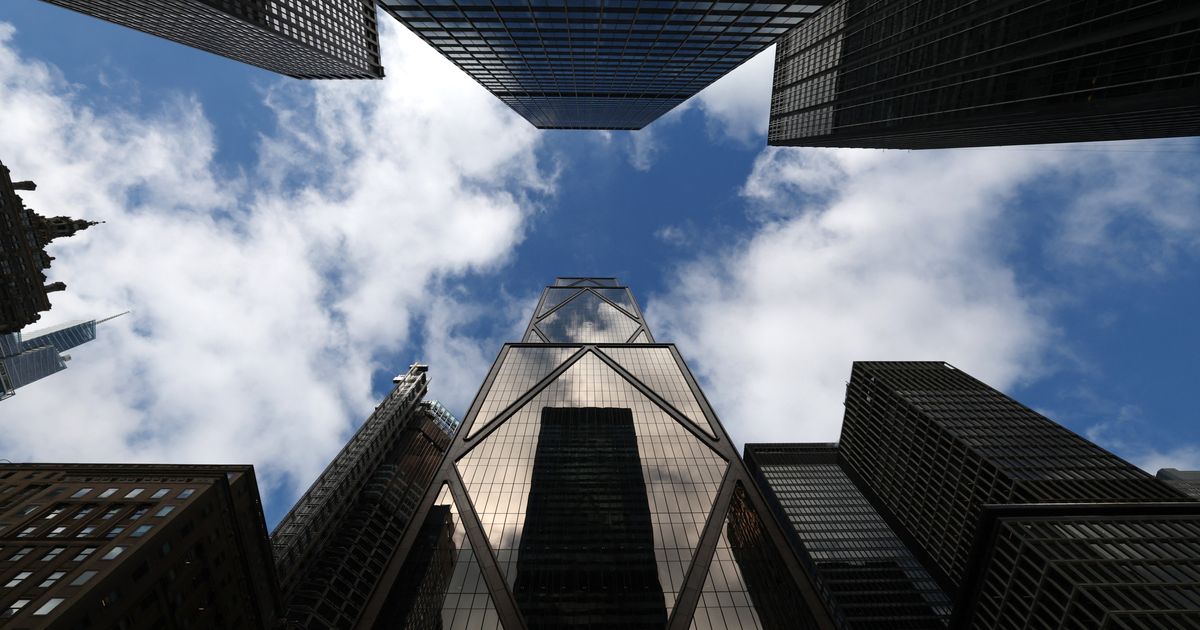
Even so, industry analysts emphasize that 270 Park Avenue stands completely apart from its peers. As The Real Deal pointed out, the JPMorgan skyscraper easily outpaces any other comparable high-end office tower in the city. For comparison, 50 Hudson Yards—the massive 2.9 million-square-foot tower developed by Related Companies that serves as the corporate home to heavyweights like BlackRock and Meta—cost a comparatively modest $4 billion, or roughly $1,400 per square foot. When 50 Hudson Yards was constructed in 2017, it commanded attention as the most expensive office building ever built in New York. Similarly, a decade ago, the $3.14 billion price tag attached to One Vanderbilt was widely viewed by the real estate community as an outrageous and unrepeatable sum.
Yet, 270 Park Avenue represents only the centerpiece of a much broader, highly ambitious real estate strategy orchestrated by CEO Jamie Dimon. The skyscraper anchors a sprawling 6-million-square-foot Midtown Manhattan campus that the bank has systematically assembled over recent years. This aggressive, ultra-luxury expansion marks a striking departure from Dimon’s historically frugal management style. Decades ago, during a markedly different era for the financial institution, Dimon famously closed the corporate gym and shuttered the bank’s former headquarters back in 2004, arguing at the time that employees could easily find and pay for their own workout facilities independently. As recently as 2018, he publicly cautioned investors to short the stocks of any corporations that announced ambitious plans to construct lavish new headquarters.
Those conservative budgeting philosophies, however, have given way to an era of unprecedented corporate prosperity. In 2024, JPMorgan Chase generated a staggering $59 billion in annual profit, marking the highest earnings figure ever recorded by a lender in the history of American finance. Although profits experienced a minor contraction the following year, slipping to $57 billion, the bank’s executive leadership team has expressed robust optimism that forthcoming regulatory relief and the broader benefits of deregulation will help reverse that downward trend and fuel future financial expansion.
The record-breaking investment in 270 Park Avenue may also signal an evolving baseline for elite corporate headquarters in Manhattan rather than a singular anomaly. Signaling that multi-billion-dollar towers are becoming the expected standard for premier financial institutions, Citadel’s planned 2 million-square-foot Midtown tower at 350 Park Avenue is also projected to carry a matching $6 billion price tag as it moves forward through the development pipeline.