The story most frequently told about Fairfield Porter (1907–1975) is one of stubborn, principled isolation. As a mid-century American painter, Porter stood at a curious intersection of history: a man of immense talent who remained doggedly committed to figuration at a time when the art world—led by the gravitational pull of the Abstract Expressionists—insisted that abstraction was the only viable language for modernism. While he counted many of these titans among his personal friends, Porter occupied a position on the periphery, often struggling for the recognition afforded to his contemporaries like Jackson Pollock or Willem de Kooning.
Yet, Porter never wavered. He refused to capitulate to the prevailing trends of his era, maintaining a firm belief that painting was a pursuit unto itself. He famously asserted that "art does not stand for something outside itself," a philosophy that allowed him to focus on the intimate, the local, and the immediate. For the remainder of his life, he committed himself to landscapes, portraits, and quiet interior scenes that echoed the warmth and intimacy of Edouard Vuillard and Pierre Bonnard. While he was not a household name during his prime, the decades since his passing have solidified his place in the pantheon of American painters, and today he is recognized as a vital, singular voice in 20th-century art.
A Painter of Summer: The Pastoral Myth
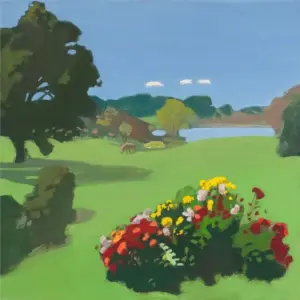
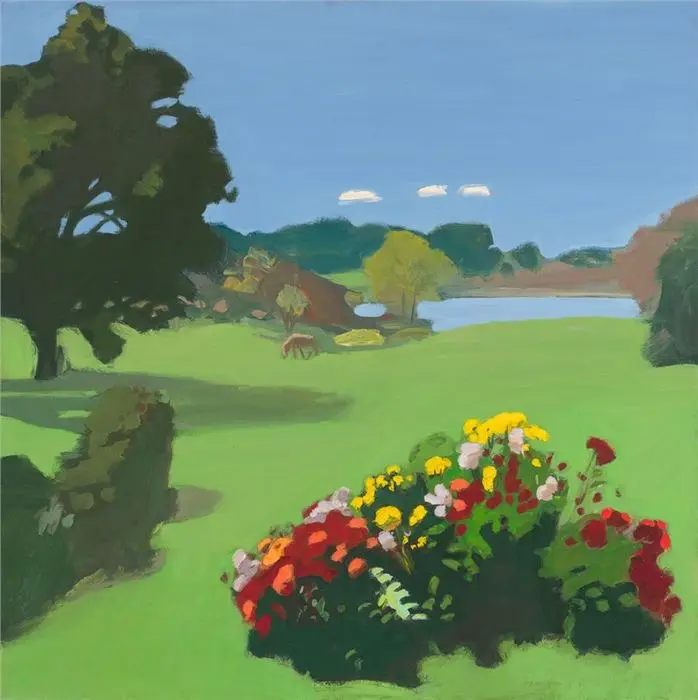
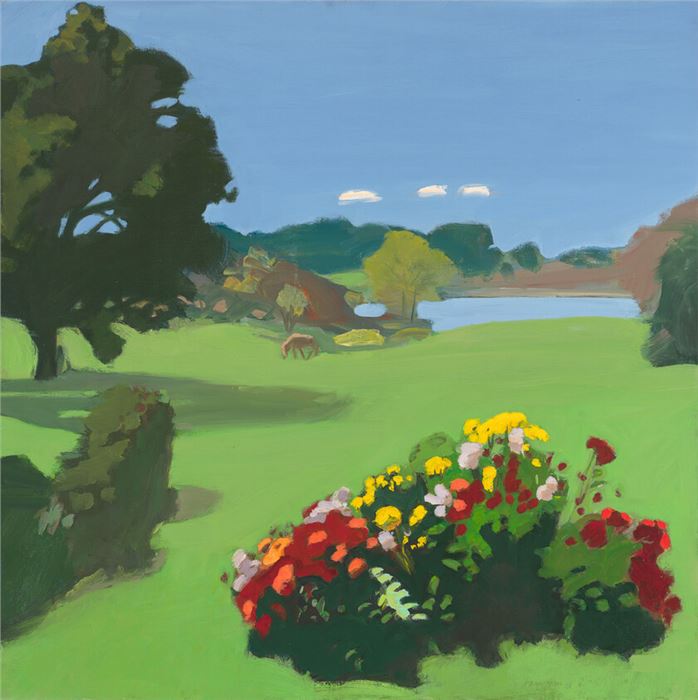
To define Porter solely by his most recognizable works is to see only half the picture. The standard assessment of his career often hinges on works such as Chrysanthemums under a Blue Sky (1961), a quintessential Porter composition featuring a lambent green lawn, a serene, expansive sky, and the quiet stillness of a pond. In these works, the subject matter is deliberate: a cluster of vibrant red, yellow, and orange flowers captures the viewer’s eye, grounding the ethereal light in earthly color.
Similarly, Claire White (1960) showcases his mastery of the interior scene. The subject, a woman in a simple, elegant white dress, sits in repose before a window, the composition radiating a sense of tasteful domesticity. His extensive documentation of his own homes in Southampton and Maine further reinforced this reputation. Paintings like The Harbor (1966), Islands (1968), Trees in Bloom (1968), Oak Tree (1969), and The Dog at the Door (1971) all serve as testament to his deep, abiding love for the familiar home and the idyllic natural world that surrounded it.
It was this body of work that led Artforum in 1985 to offer a critique that was as descriptive as it was dismissive. The publication concluded that "Fairfield Porter floats in memory as a painter of summer, of dappled fields, of porches—a suburban painter, really." While this characterization isn’t necessarily inaccurate, it is incomplete. To label Porter merely as a "painter of summer" ignores the psychological complexity and the surprising, sharp-edged urbanism that permeated his work throughout his career.
The City as a Dreamscape
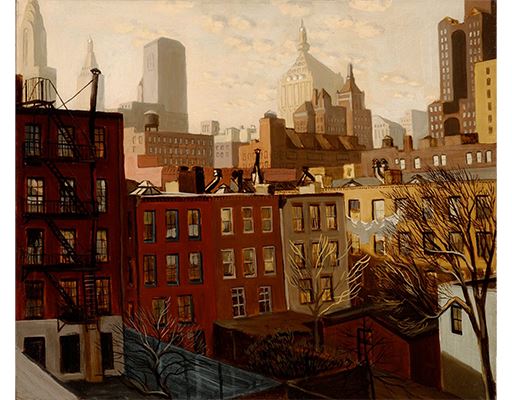
Porter’s affection for the domestic and the arcadian was only one side of his coin. His oeuvre contains a significant, though often overlooked, thread: the cityscapes of New York. These works, some dating back to the 1930s and 1940s and others spanning the 1960s and 1970s, reveal a painter who was just as capable of finding "the extraordinary" in concrete and steel as he was in the flora of his Maine garden.
These urban scenes were not numerous, but they are profoundly evocative and dreamlike. They speak directly to Porter’s own admission regarding his approach to art: "I do not like to be superior to a story or picture. I like to be able to be lost in it. This is not a desire for escape; it is a desire for direct understanding, which is a feeling that gives a sense of psychological power. That is my enjoyment of art."
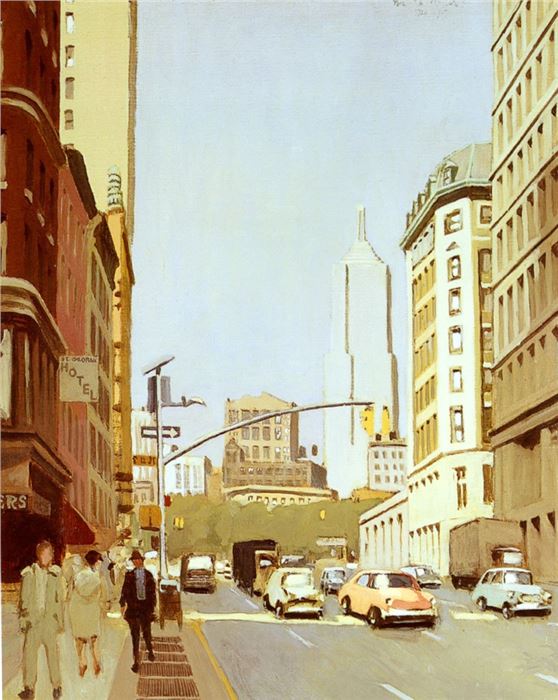
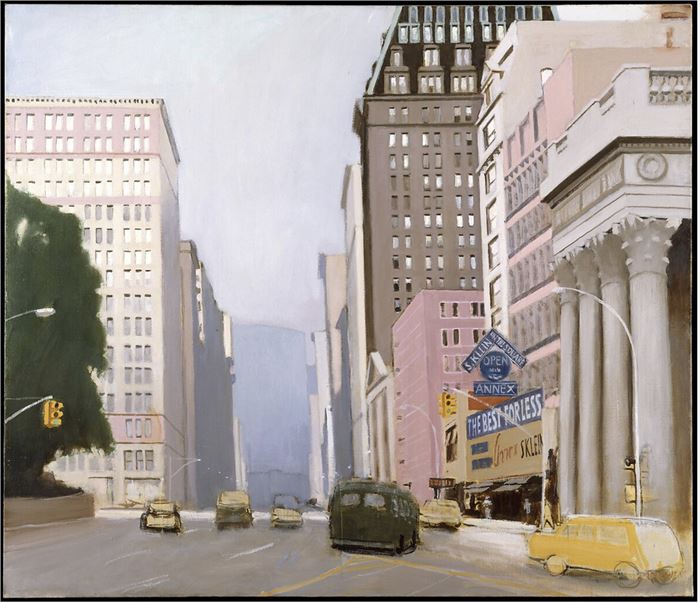
When Porter turned his gaze toward New York, his work seemed to split into two distinct, yet related, strains. The first was characterized by a sense of order and optimism. These paintings captured a version of mid-20th-century New York that felt stable, even elegant, long before the urban decay and fiscal crises of the mid-1970s began to erode the city’s image. Focusing largely on midtown and the environs of Union Square, these works are populated by well-dressed professionals, wide avenues, and building facades touched with the greenery of parks.
Union Square, Looking up Park Avenue (1975) is a primary example of this strain. The canvas depicts cars navigating the streets near the Union Square Savings Bank, rendered in a palette of cool, cozy pewter grays, creamy taupes, and soft cotton-candy pinks. There is a palpable sense of promise and purpose in these streets, a brightness that suggests a city at its functional peak. Porter himself noted in an interview that he found the light in New York to be superior to that of Paris or Rome. In these moments, he was not looking for the grit; he was looking for the inherent, quiet beauty of the ordinary. As he once wrote of his mentor figure, Vuillard, "the extraordinary is everywhere."
Ambiguity and the Uncanny
However, the "patrician" Porter—the man often associated with a refined, middle-class serenity—was capable of creating work that was far more unsettling. There exists a secondary, more ambiguous strain of his cityscapes where his painterly style shifts toward abstraction, resulting in scenes that are mysterious, haunting, and decidedly uncanny.
In Untitled (East 11th Street) (ca. 1961), the canvas is bisected by an empty street that stretches from the foreground into the distance. To the left, the buildings are rendered with recognizable, if simplified, clarity. To the right, however, the structures dissolve into splotchy, unfinished rectangles and squares. These forms lose their architectural definition, appearing more like the color-field geometry of a Hans Hofmann painting than the work of a traditional realist. The effect is disorienting, stripping the urban environment of its logic.
Other works lean further into this sense of unease. City Street (ca. 1970) is entirely devoid of life, a vacancy that creates a strange, quiet tension for the viewer. Street Scene (ca. 1943) includes human figures, but the nervous posture of the woman crossing the street suggests a underlying anxiety. Art critic Lance Esplund has noted that while this anxiety is often tempered by the sheer beauty of Porter’s color palette—the lovely salmons and ochres of the buildings set against a baby-blue sky—there is an undeniable "grimy, gritty, uneasy" quality to the work.
This sense of unease reaches its peak in Cityscape (ca. 1970s). The background, comprised of a bridge and urban infrastructure, is mundane, but the foreground is occupied by three spectral, indistinct figures. A man, a woman, and a small conveyance—perhaps a stroller or a cart—hover on the left side of the composition, their relationship to one another and their purpose left deliberately obscure. A ghostly girl, sketched in light, white lines, emerges from the dirty brown pavement as she crosses the street.
The painter Jane Freilicher, a close friend of Porter, once observed that an "unfinished quality" was an inherent part of his work. In these late cityscapes, that quality serves a specific purpose: it makes the paintings vibrate with a strange, dissonant energy.
To categorize Fairfield Porter simply as a painter of the city, in the vein of the Ashcan School, would be a mistake. He lacked the social-realist agenda of those artists and never sought to document the "grind" for the sake of political commentary. Instead, his New York scenes offer a more nuanced reflection of the era—a window into the Mad Men-era, with its gray flannel suits and polished avenues, while simultaneously capturing the city’s timeless, underlying capacity to both beguile and unnerve. Porter, the supposed "painter of summer," proved that his vision was broad enough to encompass the shadows of the street just as clearly as the light on the lawn.