LOS ANGELES — Imagine sitting next to your favorite uncle, or rather, picture yourself as a child perched on his lap, completely enraptured by the tales he tells of things he has seen and places he has been. He draws you in with his natural eloquence and the vividness with which he can animate and transfer the world he has explored directly into your own imagination. Through his words, you can taste, hear, and feel everything he is sharing with you, right where you are sitting.
Willie Birch: Stories To Tell is an expansive exhibition that places every visitor precisely in that position: safely ensconced in a rich, communal sphere of sharing. Hosted at the California African American Museum in Los Angeles, this milestone event marks the first-ever career retrospective for the artist. Spanning over five decades of creative labor, the exhibition showcases Birch’s dynamic evolution across multiple mediums, geographical shifts, and distinct cultural eras.
Moving chronologically through Birch’s life and art, the exhibition imparts a profound sense of the artist’s enduring fascination with humanity at large, and with Black people in particular. Throughout his career, Birch has maintained a sharp affinity for observing everyday community practices, tracking the unique ways individuals navigate the complexities of the world, and examining how past actions continuously influence and inform present activities.
The exhibition establishes its foundation in the 1970s, a decade when Birch appeared deeply engaged with and amused by recurring patterns of behavior within society. His work from this formative period actively comments on and codifies the ways people move within established Black traditions and histories. Among these early explorations is "Voodoo Series #1" (1978–79), a mixed-media work built on a foundation of Xerox collages. The piece brilliantly marries the ancient, enduring symbols of spiritual and medicinal practices with the burgeoning household technology of the era.
Another pivotal piece from this introductory chapter is "Passages" (1982), which serves as a literal and figurative rumination on movement and migration across oceans. The work features carved, brown wooden bodies set against a painted, water-like surface. These figures are arranged with deliberate care, echoing the formations of a traditional second-line parade from Birch’s hometown of New Orleans. Their facial expressions oscillate between serene composure and an underlying portent of great danger, capturing the dual realities of historical journeys.
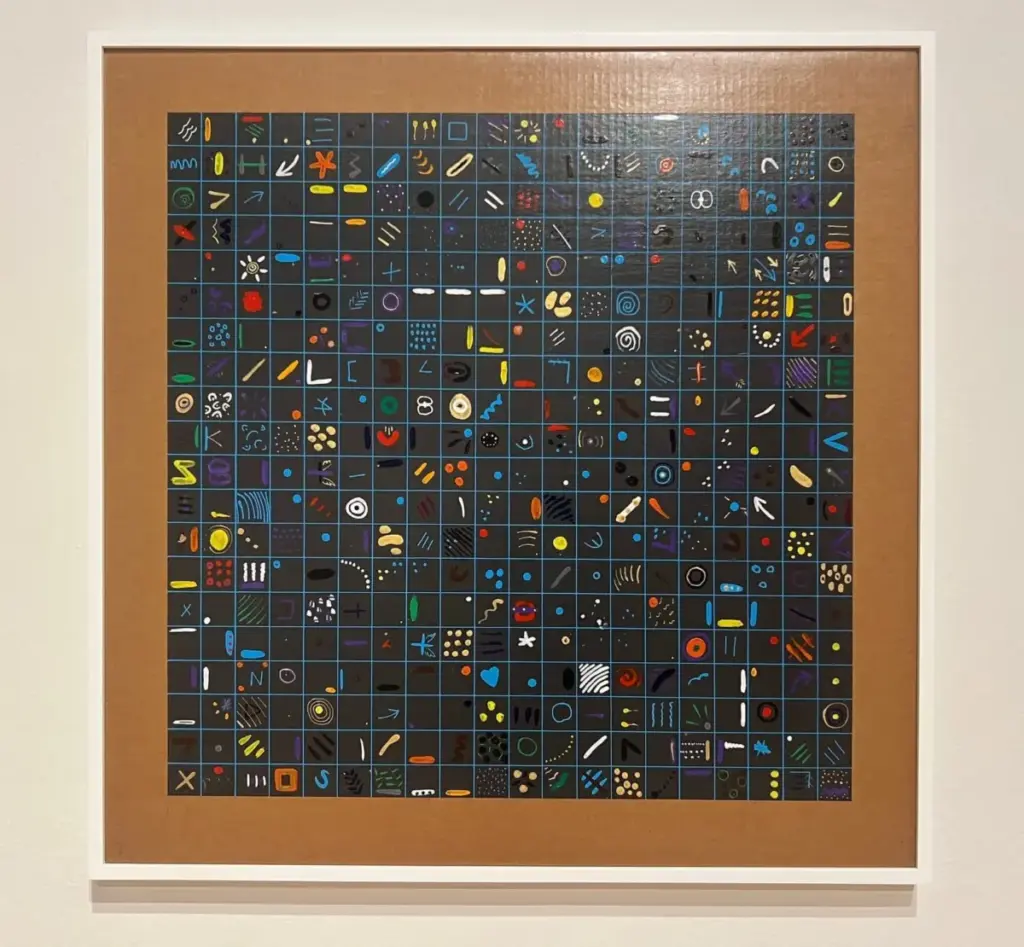
Following his move from New Orleans to New York City in 1975, Birch’s artistic vocabulary shifted to absorb the kinetic energy of his new surroundings. This transition yielded works like the "New York City Jazz Series" (1978), a complex, gridded painting composed of invented symbols, pictograms, and hieroglyphs. Rather than representing literal objects, these visual elements were designed to mimic jazz musical notation, effectively codifying the rhythm, chaos, and goings-on of his new urban environment.
As the exhibition progresses, New York City grows increasingly prominent, ushering visitors into the second major era of Birch’s artistic career. It was during this phase that the artist began introducing painted papier-mâché into his technique, marrying it with graphite, charcoal, and acrylic paint to produce large-scale depictions of New York scenes that read like visual short stories. In these works, the papier-mâché frames function as sculptural extensions of the core ideas embedded within the central drawings. Three-dimensional touches and subtle, debossed words provide crucial context, offering viewers a direct window into Birch’s intellectual and political thinking at the time.

Pieces from this period, such as "Keeping Up with the Iran-Contra Hearings" (1987) and "Birthday Celebration for Nelson Mandela" (1988), vividly reflect the pressing concerns of New York City’s Black community concerning its leading figures and global events. By anchoring these local reactions within the broader national and international political issues that shaped daily life in the city during the late 1980s, Birch highlighted the interconnectedness of localized community awareness and global political struggle.
Eventually, these complex wall-hanging pieces give way to an entirely new era in Birch’s artistic trajectory: the creation of life-size, freestanding figures. Variously hued Black bodies inhabit and animate the exhibition space, posed dynamically as though they are actively telling their own individual and collective stories. Ranging from smaller, sconce-sized sculptures like "For Alex Haley" (1993) to monumental figures capable of filling an entire room, each lifelike presentation represents a layered, multifaceted aspect of Black existence.
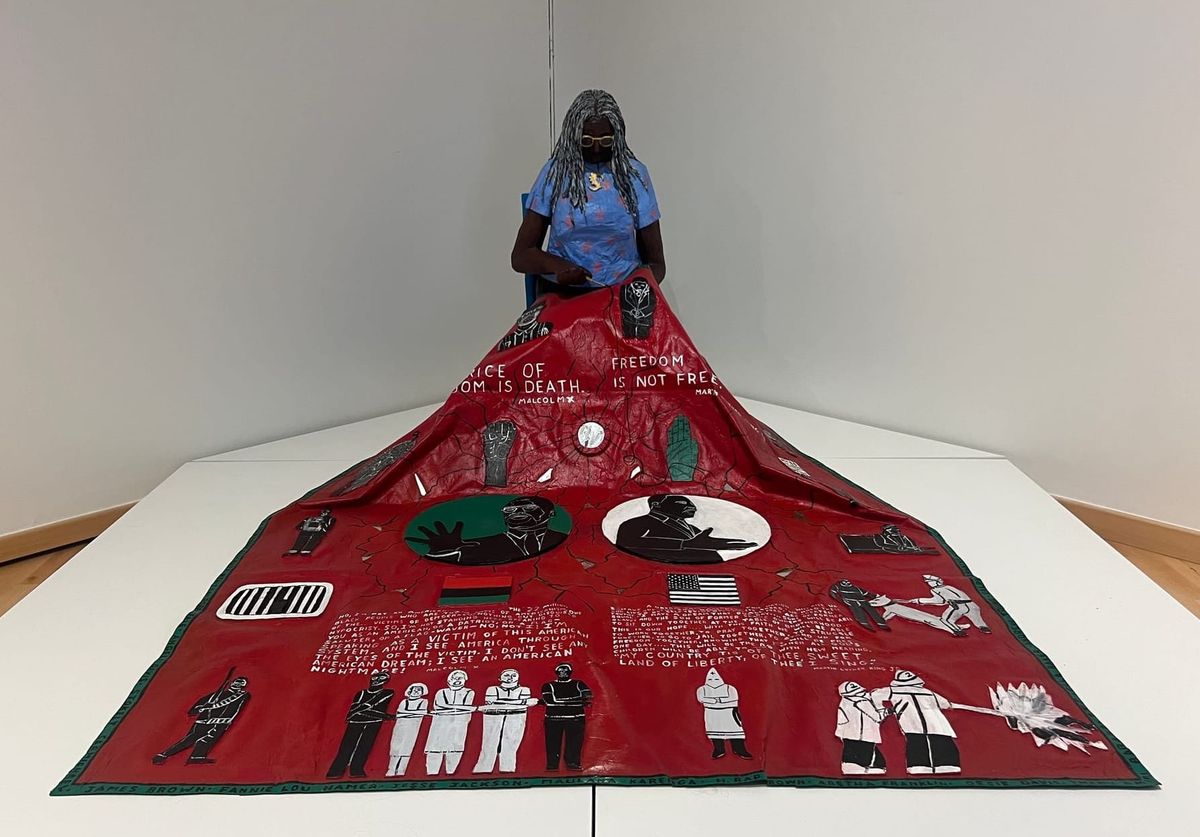
Among these sculptural achievements is "Memories of the ’60s" (1992), a sprawling, intricate quilt composed of important historical moments and visual signifiers from the Civil Rights Movement. Centered on the resonant words and legacies of leaders like Malcolm X and Martin Luther King Jr., the quilt rests across the knees of a contemplative woman with grayed locs who is caught in the act of sewing the final seams. A gold Gye Nyame, a traditional Adinkra symbol that gives praise to God, hangs prominently around her neck.
It is an arresting piece of art, commanding attention not only for its gargantuan physical size but also for the simultaneous serenity and profound gravity it elicits from those who stand before it. Beyond its individual impact, "Memories of the ’60s" acts as a powerful threshold, successfully ushering viewers onward into the broader gallery spaces dedicated to Birch’s more recent and contemporary creations.