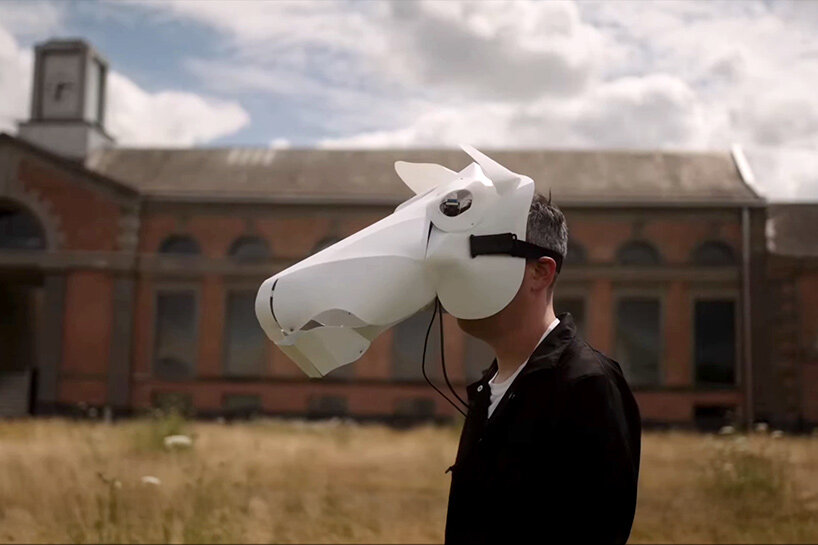
In an era defined by human-centric innovation, the boundaries of how we build, design, and interact with the world are being fundamentally challenged. Alan Hook, a researcher and designer at Ulster University, is at the forefront of this shift through a speculative and playful approach to interspecies design. His flagship creation, Equine Eyes, is a giant, horse-shaped headset that allows human wearers to experience a close approximation of how horses perceive their environment. Part wearable art, part philosophical inquiry, the project asks a radical question: What happens when the animals that share our homes, workspaces, and landscapes are formally considered users too?
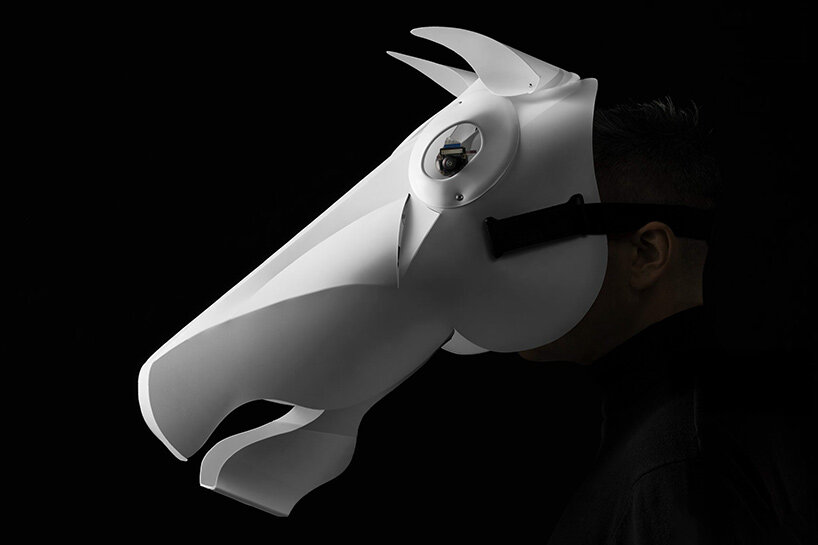
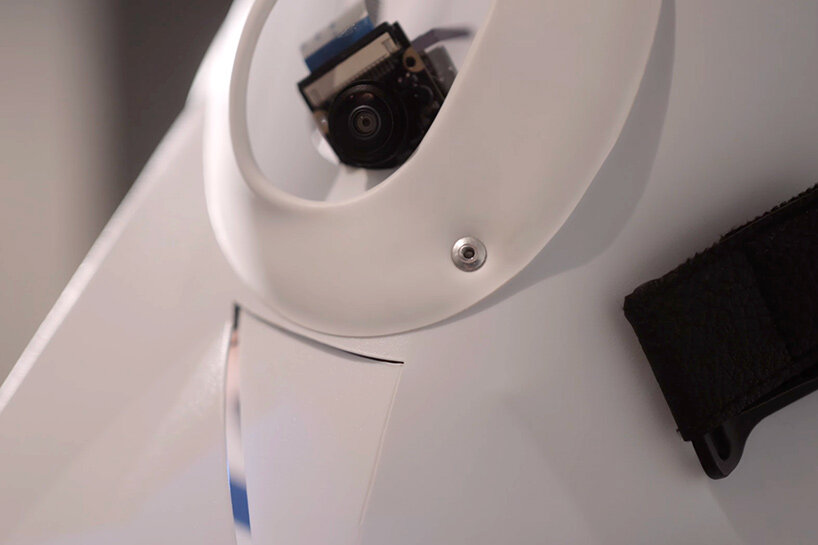
With its elongated white muzzle, sculptural shell, and upright ears, the headset carries a striking, almost cartoonish aesthetic. Beneath its playful exterior, however, lies a sophisticated piece of technology designed to upend human perception. Small, wide-angle cameras are embedded on either side of the head where a horse’s biological eyes would naturally sit. These cameras feed live footage into a virtual reality display worn inside the mask, translating an entirely different visual reality for the human participant. It is an immersive, highly unusual experience designed to pull individuals momentarily out of their deeply ingrained habits of sight.
Recreating a Horse’s Sweeping Field of Vision
To authentically simulate equine sight, Alan Hook had to tackle fundamental biological differences between human and horse vision. While humans possess forward-facing eyes with a relatively narrow field of view, horses have eyes positioned on the sides of their heads. This anatomical arrangement gives them a sweeping, nearly panoramic field of vision spanning approximately 350 degrees.
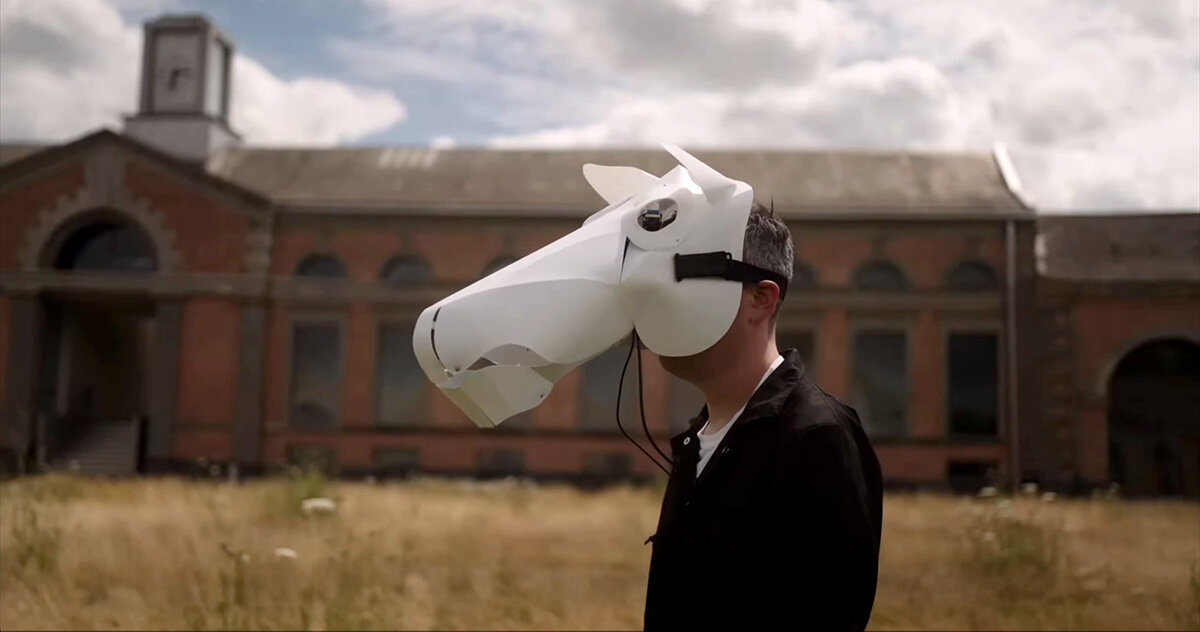
To approximate this perspective, Hook developed a specialized camera system utilizing two 180-degree lenses. Together, they generate a simulated view where the images overlap slightly at the front, while the wearer’s own body becomes visible within the outer limits of their peripheral vision. Furthermore, the live footage is digitally processed to reflect the equine reality of dichromatic color perception. This shifts the visual spectrum distinctly toward blues and yellows, altering how familiar objects and spaces appear.
During testing phases, the psychological and physical impact of the headset proved profoundly disorienting for participants. One tester memorably described the sensation as akin to "taking your eyes out and sticking them on the sides of your head." Familiar surroundings suddenly materialize through an entirely different spatial arrangement, challenging wearers to reconsider how horses navigate architecture, open landscapes, and respond to sudden activity in their periphery.
Hook readily acknowledges the inherent limitations of the technology. A headset can only ever approximate optical perception; it cannot replicate the complex reality of experiencing the world through an entirely different physical body, which extends far beyond the limits of eyesight alone. Nevertheless, the physical simulation serves as a powerful catalyst for empathy and spatial awareness.
The Evolution of the Horse-Shaped Mask
The journey toward Equine Eyes began years prior, in 2017, when Hook started experimenting with early iterations using low-resolution webcams tethered to an Oculus Rift headset. Those initial prototypes produced heavily pixelated images, which inadvertently drew participants’ attention away from the experiment and toward the technological hardware itself.
Determined to ground the simulation in a more visceral experience, the researcher began experimenting with a simple cardboard cutout of a horse’s head placed strategically between the cameras. To his surprise, this low-tech addition drastically shifted how participants responded to the environment. Test subjects reported feeling far more psychologically transformed when the equipment visually resembled the animal they were attempting to understand.
Over successive iterations, the concept evolved into the sleek, sculptural white mask seen today. The lightweight outer shell extends well beyond the wearer’s face, creating a distinct physical presence. Interestingly, during subsequent testing phases, Hook briefly experimented with stripping away the horse-shaped enclosure entirely in an effort to make the transport and setup of the equipment easier.
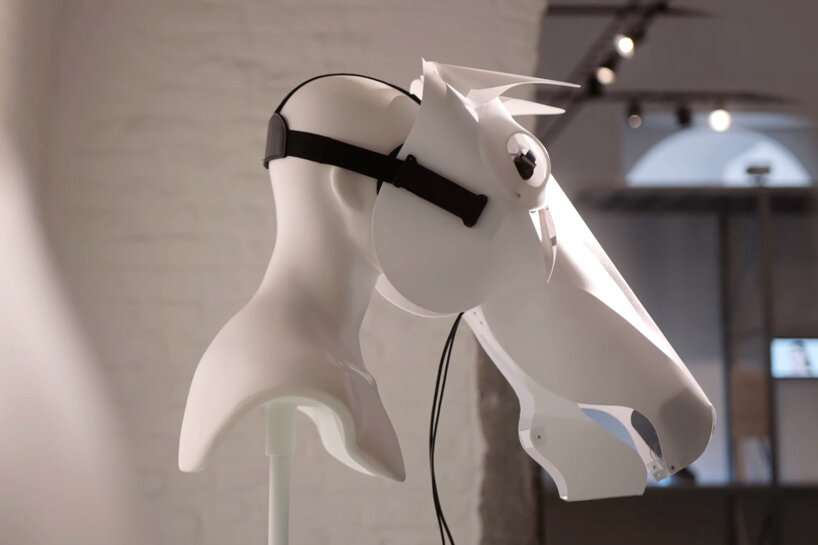
Yet, participants immediately felt that something vital was missing. The physical act of stepping into the animal’s head—of wearing its form—had become a cornerstone of the interaction. The mask encourages participants to fully commit to the simulation through their own bodies, bridging the gap between abstract intellectual empathy and physical embodiment.
An Interspecies Toolkit for Broader Design
The foundational questions raised by Equine Eyes extend far beyond the equestrian world. They form the core of Hook’s broader academic inquiry, including the Interspecies Design Toolkit, a speculative proposal developed through his research collaborations at Imagination Lancaster and Ulster University.
Drawing explicit inspiration from Microsoft’s renowned Inclusive Design Toolkit—which encourages developers and creators to recognize and accommodate exclusion among people with varying physical and cognitive abilities—Hook adapts this framework to account for the diverse sensory realities of nonhuman species.
The downloadable toolkit features a series of guidelines and activity cards intended for use in collaborative design workshops. Participants are guided through exercises that encourage them to carefully observe how various animals interact with their surroundings, identify architectural and environmental barriers created by purely human-centric design, and imagine creative alternatives based on those direct observations. One foundational exercise suggests allowing an animal to initiate play on its own terms, following its natural behavioral cues rather than forcing a human-directed interaction.
Another core principle advises designers to begin by studying an individual animal before attempting to generalize their findings to an entire species. This localized, empathetic approach offers a fresh lens through which to conceptualize everything from domestic household objects to large-scale architecture. In such a framework, even a seemingly ordinary opening, threshold, or interface can be re-evaluated to determine which nonhuman bodies are accommodated within shared spaces.
Moving From Speculative Research to Public Exhibition
What began as an isolated academic experiment has steadily transitioned into public-facing exhibition spaces, allowing a wider audience to engage directly with the philosophy of interspecies design. In 2024, the headset was featured prominently in the Superpower Design exhibition at the Centre for Innovation and Design at Grand-Hornu in Belgium, where Hook led interactive workshops inviting visitors to test the device.
More recently, the project found a permanent institutional home. In July 2026, the National Museum of Racing and Hall of Fame in Saratoga Springs, New York, introduced two Equine Eyes headsets for public use and educational programming. This installation places the wearable apparatus in an ideal setting, engaging visitors, equestrians, and industry professionals who regularly work alongside horses in their daily lives.
Despite its expanding public footprint, Equine Eyes remains fundamentally an exercise in speculative design. Hook is the first to emphasize the insurmountable barriers of fully capturing another animal’s subjective interiority.
Instead, the true value of the project lies in its ability to provoke curiosity. By making the question of animal perception physical and interactive, the headset—alongside the broader Interspecies Design Toolkit—urges creators, architects, and the public to rethink how differently other living beings encounter the spaces we share, ultimately challenging the assumption that humans should remain the sole measure of all things.