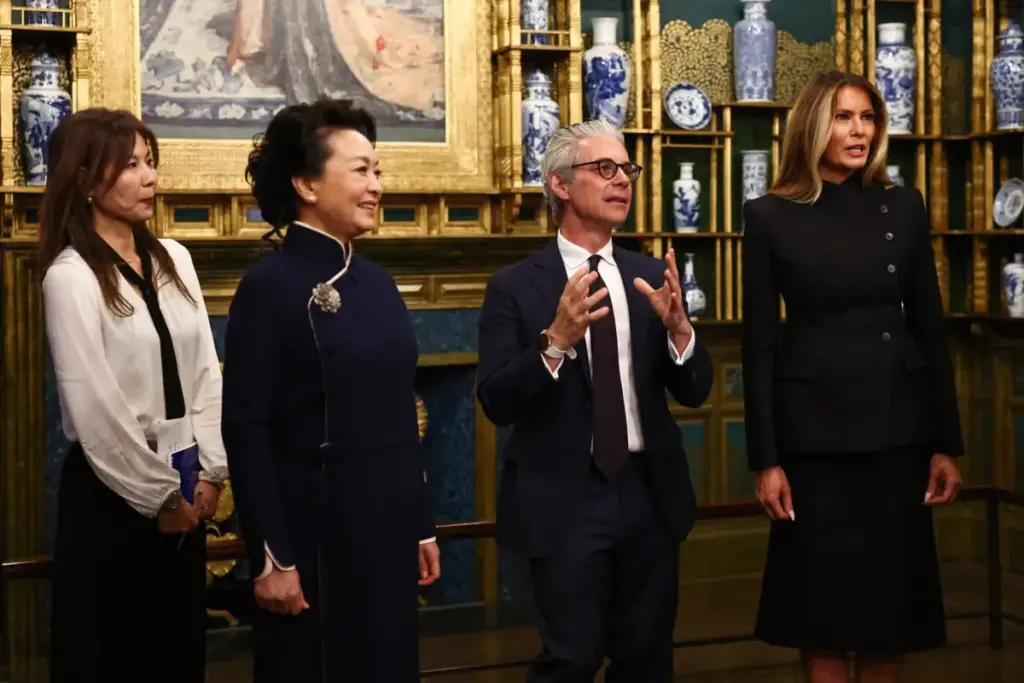
WASHINGTON — Any seasoned host knows that when high-profile international visitors arrive in town, a cultural excursion to a premier museum is a staple of diplomatic protocol. Continuing this time-honored tradition on a busy Thursday in the nation’s capital, the First Lady of the United States welcomed China’s First Lady to the Smithsonian’s National Museum of Asian Art in Washington, D.C., for a private and carefully curated tour highlighting centuries of artistic exchange between the two nations.
Melania Trump guided Peng Liyuan through the prestigious museum galleries during a 45-minute visit that offered both leaders a quiet respite amid intense high-level political discussions taking place across the city. The itinerary featured stops in several iconic exhibition spaces, most notably the legendary Peacock Room, where historic Chinese porcelain takes center stage, alongside other galleries dedicated to exceptional Asian artworks and intricate traditional design.
For museum leadership, the visit provided a unique platform to showcase the enduring power of cultural diplomacy. Speaking about the significance of the afternoon tour, Chase Robinson, the director of the museum, told the South China Morning Post, “What better place to introduce the two first ladies to our museum on the occasion of high-level conversations and discussions between our two countries?”
The Peacock Room, which served as the centerpiece of the visit, holds a fascinating and complex history deeply intertwined with both American art history and Chinese artistic traditions. The legendary interior was originally built between 1876 and 1877 by renowned American painter James McNeill Whistler, whose broader body of work continues to draw international acclaim and is currently being exhibited at the Tate Britain until Sunday.
Decades later, in 1904, the entire extraordinary room was acquired and moved to the United States by American industrialist Charles Lang Freer. Freer’s deep appreciation for the region blossomed during an extensive trip to China between 1910 and 1911, a journey that ultimately laid the foundational collection for the museum that now bears his name within the Smithsonian institution.
Reflecting on the reactions of the two distinguished guests as they examined the historic space, Robinson noted that both leaders appeared deeply engaged with the historical narrative preserved within the walls. “I think they were both intrigued by the scale of 19th-century interaction between China and the United States,” Robinson said, pointing to how the artwork bridges geographic and cultural divides across eras.
Fashion also played a subtle yet communicative role during the high-profile museum outing, with both first ladies making sartorial choices that nodded to cross-cultural appreciation. To visit the museum, Melania Trump wore a sophisticated black Alexander McQueen tweed jacket distinguished by an asymmetrical collar—a subtle and elegant nod to the traditional Chinese dress known as the qipao, which is famously characterized by its distinctive asymmetrical closure. She completed the polished afternoon look with a matching tweed skirt and classic black Christian Louboutin heels. Accompanying her, Peng Liyuan chose a traditional and modest navy qipao, embodying classic grace and honoring her own cultural heritage during the joint public appearance.
The museum visit was just one facet of a packed day of bilateral engagement in Washington. Later on Thursday, as part of the formal state visit activities hosted at the White House, President Donald Trump presented Chinese President Xi Jinping with a carefully chosen diplomatic gift: a detailed sculpture of a bald eagle.
The bald eagle holds deep symbolic weight as the United States’ national bird and a majestic species native exclusively to North America. Presenting the striking piece of art, President Trump remarked that the sculpture represented “the free and soaring spirit of America,” adding a personal touch of symbolism to the diplomatic engagements that defined the state visit.