Renowned contemporary artist and stage designer Es Devlin is opening the doors to her creative universe in an unprecedented way, bringing decades of intimate studio materials, personal archives, and a vast, well-thumbed collection of literature into the public gallery spaces of London. Opening on October 2, 2026, at the prestigious Design Museum, Es Devlin: Other Worlds marks the celebrated creator’s very first major retrospective in Europe. Rather than presenting a conventional, linear retrospective of finished masterpieces, the exhibition offers visitors an immersive journey that traces the evolution of monumental public spectacles back to their most fragile, private origins: the messy desk, the well-worn book, and the small-scale handmade model.
Spanning three decades of groundbreaking work across theater, opera, stadium concert stages, and sprawling architectural installations, the exhibition meticulously contextualizes Devlin’s massive output. By juxtaposing towering spatial sculptures with the quiet, meditative tools of her trade, the show invites audiences to reconsider the intricate relationship between literature, personal memory, and large-scale public art.
Es Devlin’s Library Begins on Her Own Shelves
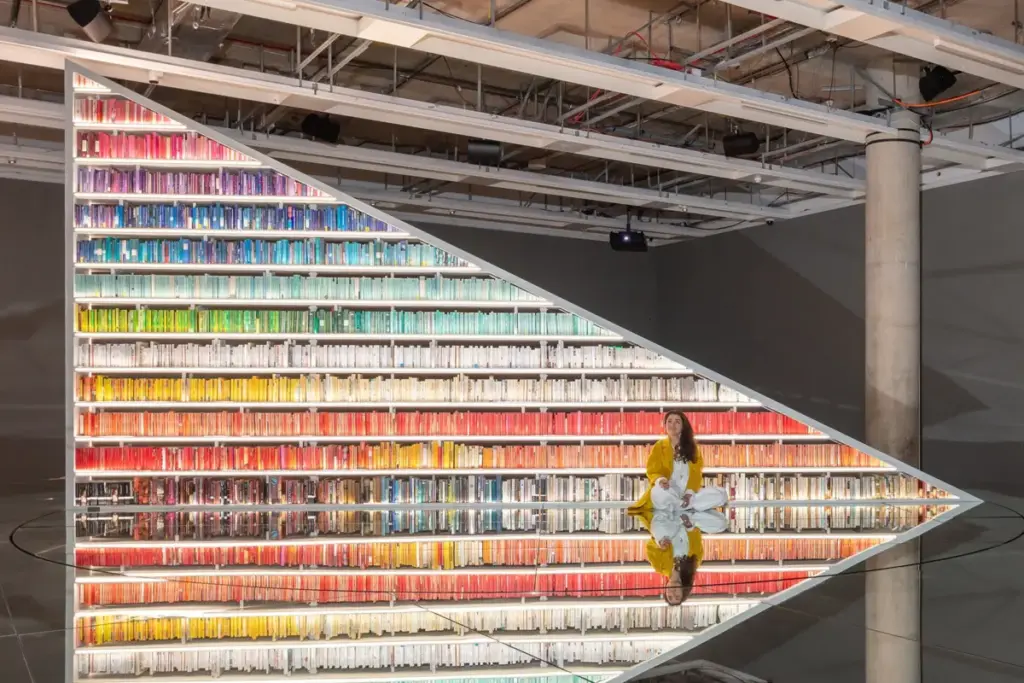
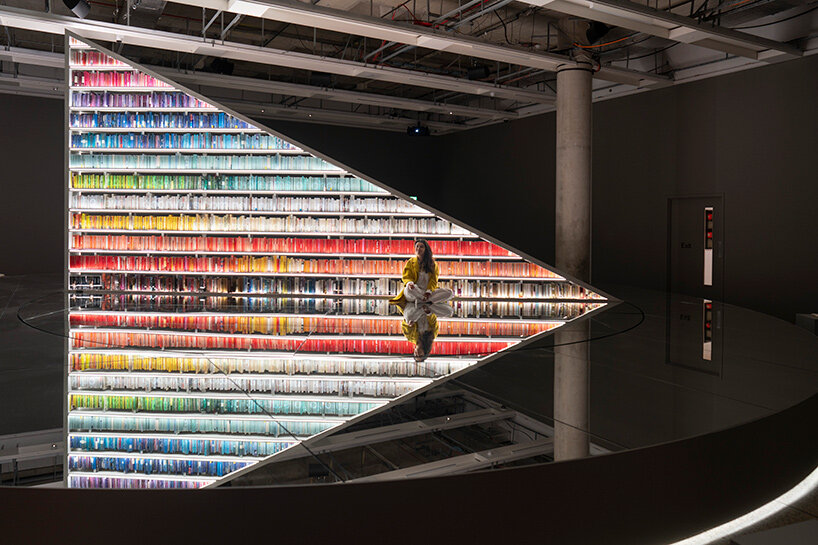
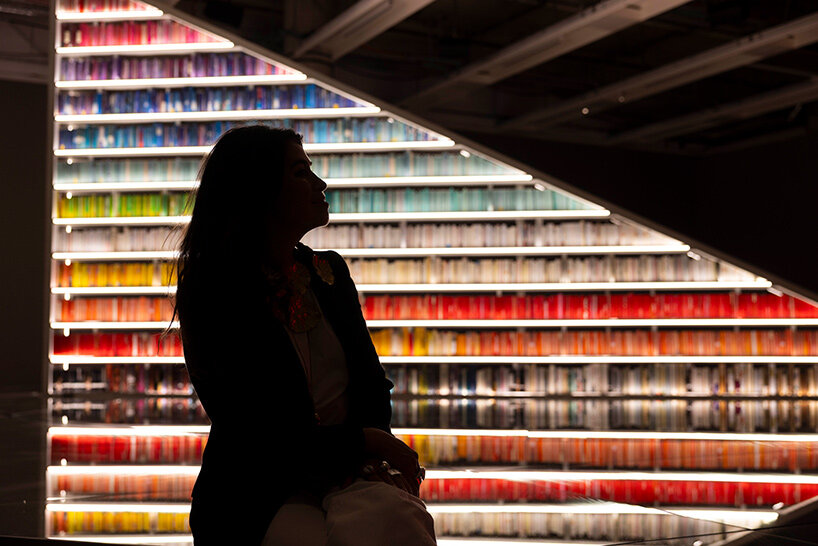
The exhibition culminates in a breathtaking and deeply personal installation titled An Infinite Library, occupying the final room of the retrospective. At the heart of this sculptural work sits an eight-meter-wide triangular shelf system, revolving slowly above a vast circular mirror. Within this rotating architectural structure rest more than 2,000 volumes, many of which bear unmistakable, physical signs of active use, having been physically lifted straight from Devlin’s own studio shelves.
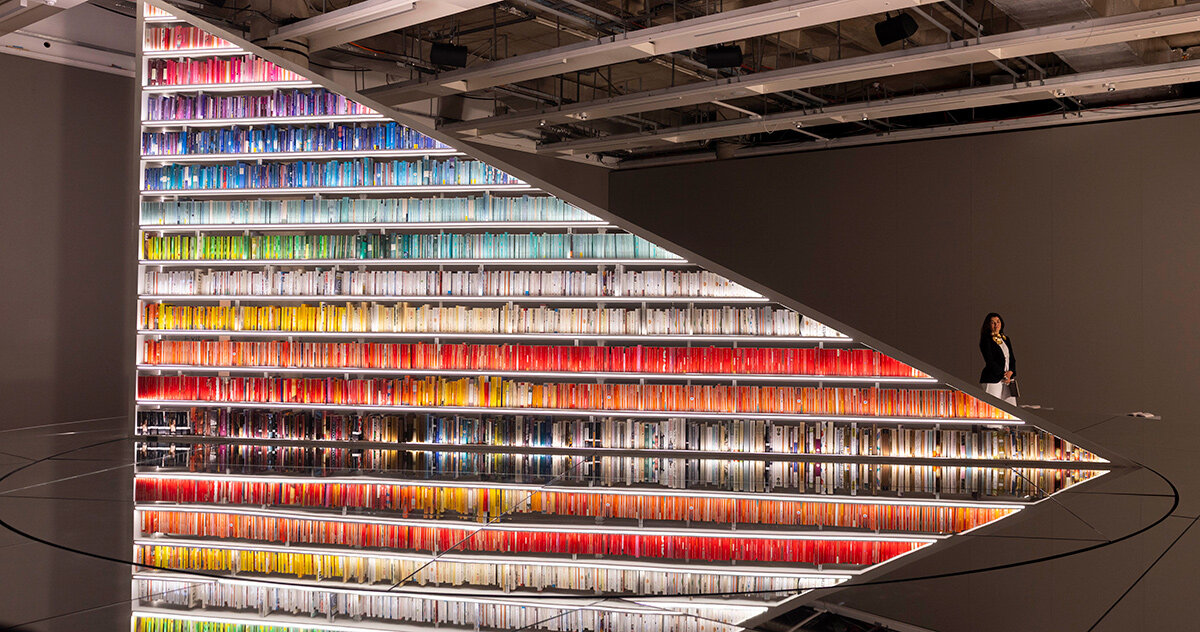
Among the carefully selected titles are foundational works that have shaped the artist’s worldview over years of dedicated reading, including James Gleick’s seminal exploration of complexity theory Chaos, Toni Morrison’s haunting Pulitzer Prize-winning masterpiece Beloved, and Margaret Atwood’s dystopian speculative fiction Oryx and Crake. Rather than being organized by conventional library classification systems like the Dewey Decimal or Library of Congress systems, these volumes are deliberately arranged by color, transforming a lifetime of intellectual curiosity into a striking, living visual tapestry.
As the massive triangular structure turns, dynamic projections gently sweep across the spines of the books, while the soothing, recorded voice of Devlin herself reads aloud selected passages from the texts. This multi-sensory environment creates a profound sense of reflection for the visitor, merging the private intimacy of reading with the grand scale of museum exhibition design.
This installation follows three earlier iterations of sculptural libraries that Devlin previously erected in international cultural hubs such as Milan, Miami, and Yorkshire. However, An Infinite Library marks the very first time one of these monumental book-based sculptures has been permanently housed inside a museum gallery. In a generous philanthropic gesture following the close of the exhibition, the books—generously supplied for the project by Penguin Random House UK—will be formally donated to local schools and community charities, ensuring that the literary collection continues to inspire future generations long after the gallery doors close.
A Studio Opens into a 30-Year Archive
While An Infinite Library provides a meditative, literary conclusion to the exhibition, Es Devlin: Other Worlds begins at the exact opposite end of the creative pipeline: inside a meticulously crafted recreation of the artist’s South London studio. Upon entering this opening gallery, visitors are immediately enveloped in the tangible atmosphere of daily artistic production. Books, reference materials, and physical maquettes line the walls, while the artist’s primary work desk remains visibly cluttered with raw tools, tubes of paint, and half-finished projects.
From this intimate reconstruction of the workspace, the exhibition flows outward into the wider body of work that emerged from these very materials. Visitors are guided through a comprehensive retrospective spanning thirty years of career milestones, encompassing iconic theater sets, experimental museum commissions, and legendary concert stages.
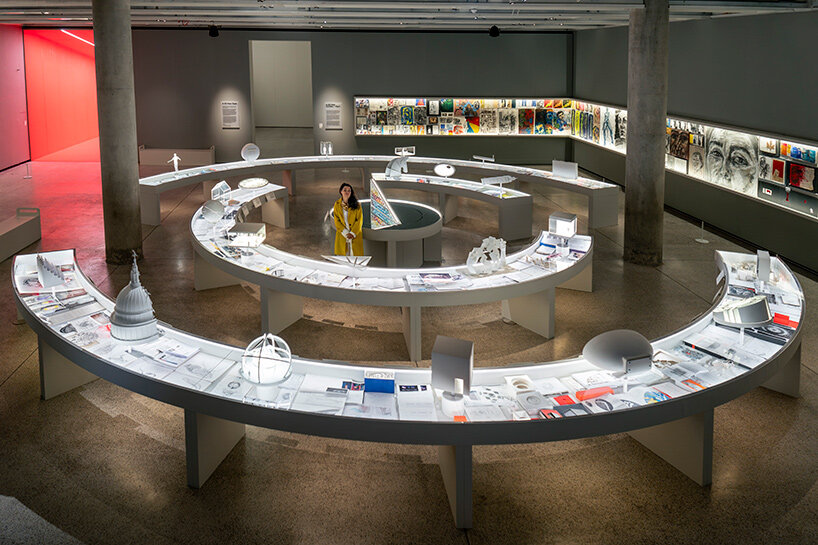
A striking centerpiece of this archival journey is a series of concentric desks that thoughtfully display original drawings, photographic documentation, and more than thirty physical architectural models detailing Devlin’s rigorous design process. This extensive display sheds light on some of the most celebrated cultural projects of the twenty-first century, including the critically acclaimed theatrical production The Lehman Trilogy, the globally watched London 2012 Olympics closing ceremony, and the thought-provoking environmental installation Forest of Us in Miami.
Peppered along the surrounding gallery walls are early sketches, rough notes, and delicate paper collages that stretch even further back into Devlin’s formative school years. The stark contrast in scale is striking; many of these preliminary drawings are remarkably small and unassuming, belying the enormous physical footprints of the colossal arenas and public plazas their realized counterparts would eventually inhabit.
Older Works Find a New Setting
The retrospective also grants new life to several monumental pieces from Devlin’s recent past, recontextualizing them within the architectural boundaries of the Design Museum. Among them is Come Home Again, a haunting and deeply moving installation that returns to London four years after its initial, widely praised debut outside the Tate Modern.
Originally conceived as a towering structure modeled after a cross-section of the dome of St Paul’s Cathedral, the installation’s intricate framework was illuminated by thousands of detailed cut-out drawings depicting various endangered species. In its new iteration at the Design Museum, Come Home Again is positioned directly beneath a sweeping mirrored ceiling. This careful curatorial choice dramatically alters the viewer’s spatial perception, reflecting the dense, glowing architecture upwards and infiniteizing the sprawling collection of moths, birds, and botanical illustrations that populate the structure.
By placing these familiar works into dialogue with the newly commissioned installations, the exhibition underscores a central theme of Devlin’s career: the porous boundary between private reflection and public communion. Through Es Devlin: Other Worlds, the Design Museum does not merely showcase the glittering end products of a world-famous designer, but rather honors the winding, intellectually rich path of reading, sketching, and experimenting that brought them into existence.