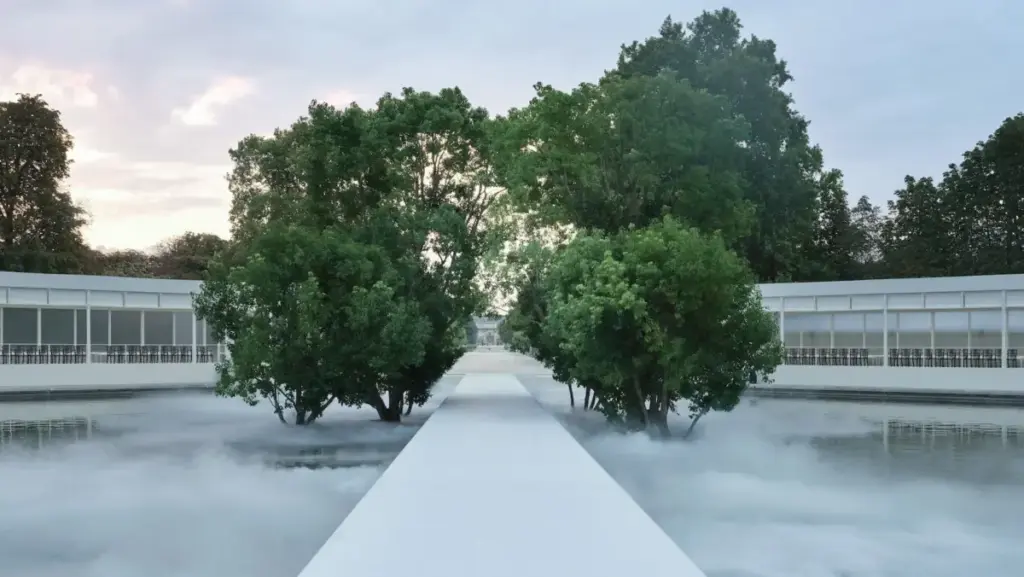
At the historic Jardin des Tuileries in Paris, the Dior Summer 2027 women’s show successfully immersed its distinguished guests in an idyllic, dreamlike environment of rippling water, drifting mist, and living camphor trees. Designed by the renowned production agency Bureau Betak, the temporary landscape radically reimagined Le Bassin Octogonal, turning a familiar Parisian landmark into a striking architectural theater. Rather than relying on traditional, enclosed indoor venues, the presentation brought the raw elements of nature directly into dialogue with high fashion, creating a sensory experience that unfolded across water and stone during Paris Fashion Week.
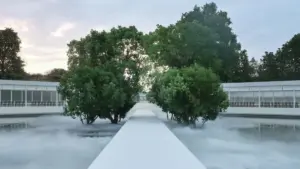
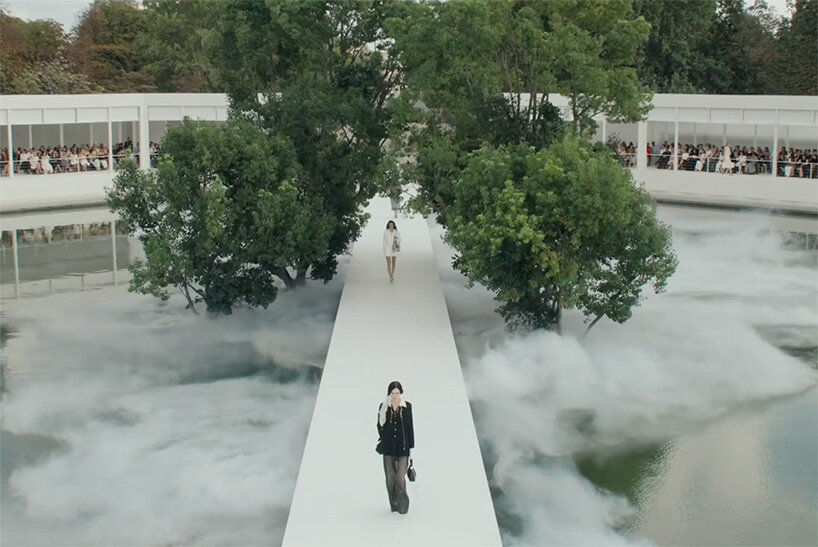
For this ambitious presentation, Bureau Betak placed a long, solid white runway that cut dramatically across the center of the octagonal basin. Surrounded entirely by water and enveloped in continuous clouds of mist, the catwalk behaved almost like a minimalist bridge. Models traversed the space as the shifting atmospheric conditions alternately obscured and revealed the surrounding landscape. Rising directly from the water around the pathway were living camphor trees, introducing an irregular, organic presence into an otherwise strictly controlled architectural composition.
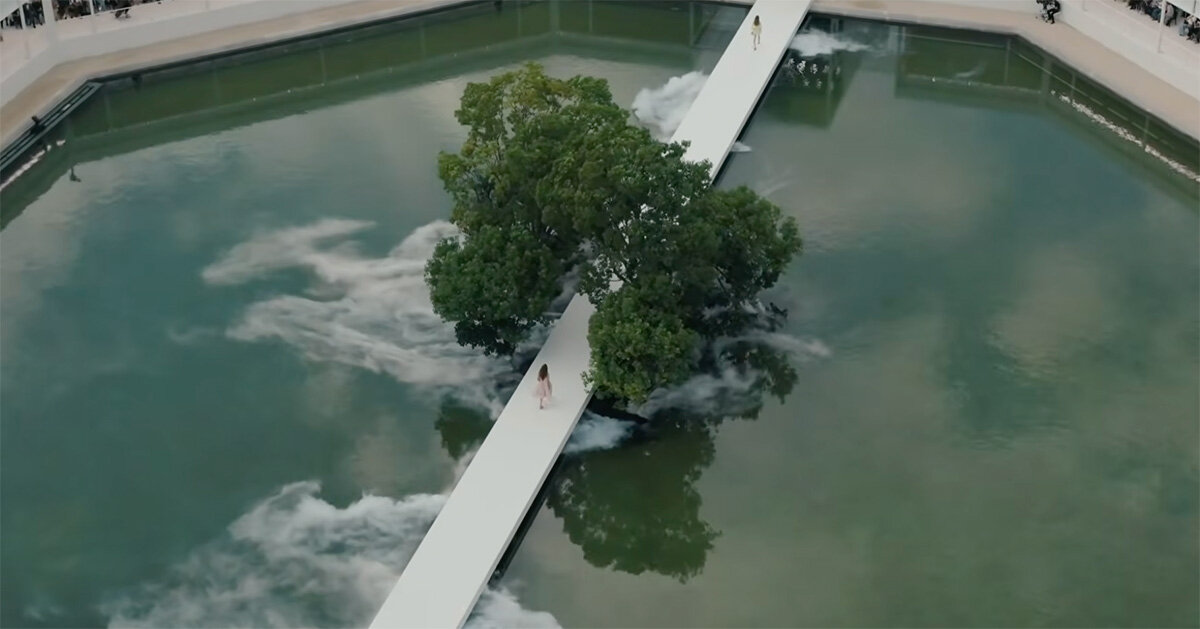
The interplay between the clean, geometric lines of the runway and the unpredictable forms of the natural world formed the emotional and visual core of the event. Guests seated around the perimeter of the basin looked across the reflective surface of the water toward the models, experiencing a spatial composition where architecture, nature, and human movement continuously interacted. Beyond the ephemeral nature of the fashion show itself, Dior confirmed an important ecological commitment: the living camphor trees brought in for the presentation will not be discarded, but will instead be permanently replanted within the public gardens of the Tuileries. Consequently, the temporary scenography contained an element of lasting value—living botanical material destined to grow and thrive long after the runway, the mist, and the temporary event architecture have disappeared.
A Precise Runway Against Organic Forms
The dynamic tension between man-made precision and natural irregularity defined the spatial layout crafted by Bureau Betak. The stark white catwalk established an exact, unwavering architectural axis across the historic basin, while the camphor trees deliberately interrupted that strict geometry with their uneven trunks, sprawling branches, and natural canopies. Drifting patches of mist rolled continuously between the two, softening the harsh edges of the built environment and constantly altering the visual perception of the landscape throughout the presentation.
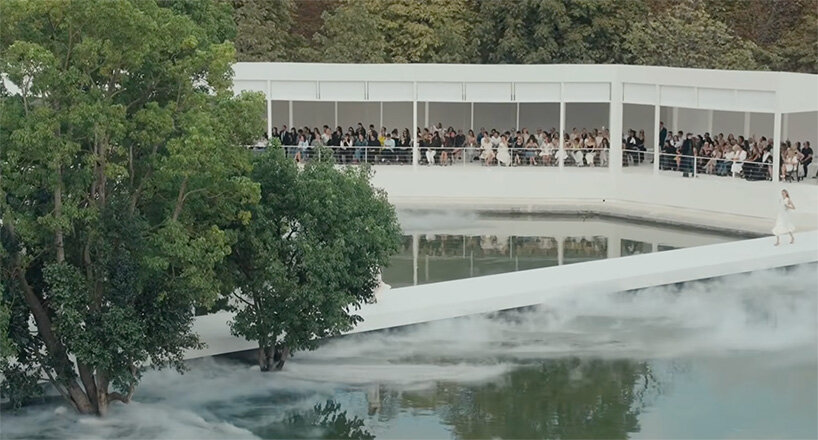
As the audience watched from the perimeter, the water acted as a reflective mirror, doubling the scenography beneath and around the runway. This careful orchestration of elements—water, vegetation, architecture, and spectators—transformed the presentation into a holistic spatial experience. The movement of the models activated the landscape, turning the historical basin into a living stage where the boundaries between urban public space and exclusive fashion presentation momentarily blurred. Dior’s choice to integrate living trees that would later return to the soil emphasized a growing consciousness within major fashion houses regarding the lifecycle of temporary runway installations, merging temporary spectacle with permanent civic contribution.
Wénwán Walnuts Bring Time and Touch into Focus
This overarching design philosophy—balancing controlled structure with natural variation and the passage of time—was mirrored in the tangible details of the show’s invitation. Invited guests received a pair of wénwán walnuts housed inside a precisely fitted box. The object draws inspiration from a longstanding Chinese cultural tradition in which individuals hold and rotate natural walnuts against one another in the palm of the hand. Through months and years of repeated handling, the rough surfaces of the nuts gradually develop a deep, smooth patina, becoming uniquely polished by human touch. Furthermore, finding two natural walnuts that match so closely in shape, size, and texture represents a rare and deliberate challenge.
Reflecting on this thoughtful gesture, Jonathan Anderson noted the profound connection to the natural world embedded in the tradition. When discussing the inspiration behind the choice, Anderson explained that encountering wénwán walnuts served as a direct reminder of how deep knowledge, patience, and true preciousness can be found within nature rather than synthetic creation.
The walnuts introduced a much slower, contemplative understanding of time into the fast-paced context of Paris Fashion Week. While their value relies on the organic difficulty of finding harmonious pairs, their transformation depends entirely on physical interaction and the passage of time. This exact philosophy resonated throughout the physical scenography of the show. Just as the walnuts require human touch to evolve, the Dior runway brought together elements that relied on contrast: the manufactured exactness of the white catwalk versus the unpredictable growth of the camphor trees, and the fixed geometry of the basin versus the ever-changing movement of the mist.
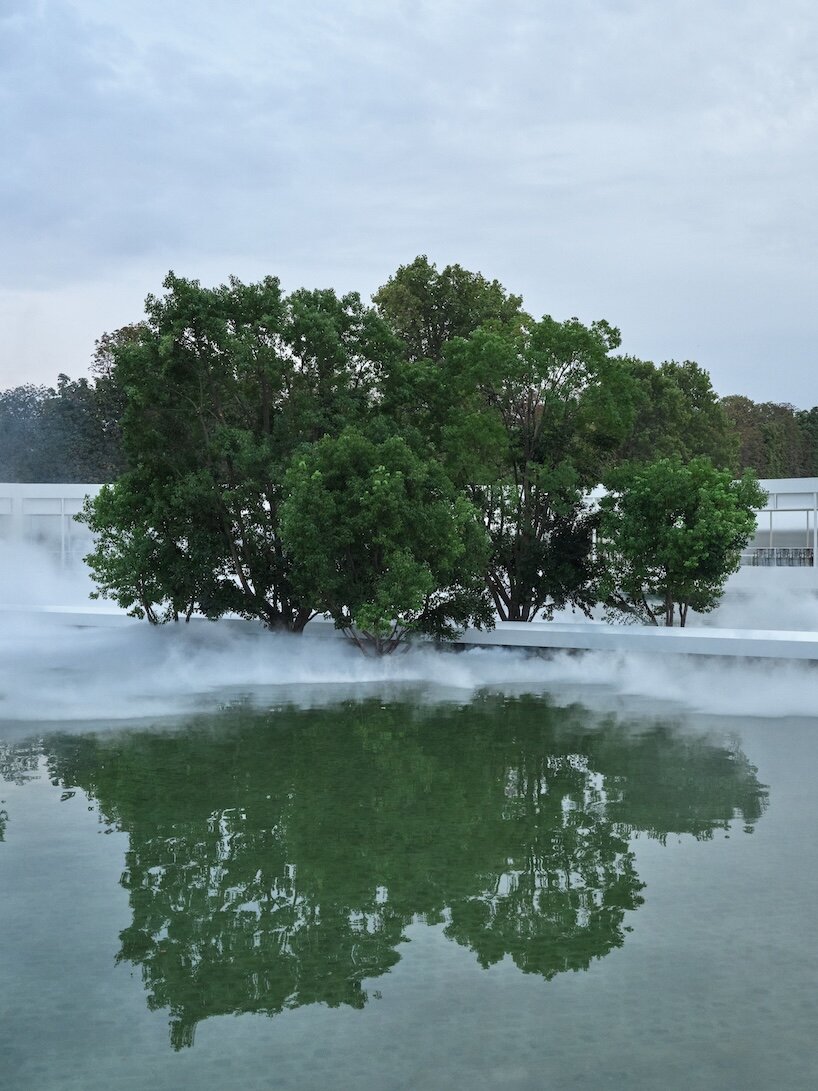
Through Bureau Betak’s careful direction, the set established a framework where natural elements remained visibly independent of the built architecture. The water captured reflections of the passing models and surrounding foliage, the artificial mist made the air itself perceptible, and the living trees stood resilient against the rigid geometry of the runway. The resulting scenography stood as a testament to balance—a careful negotiation between what can be meticulously designed by humans and what must simply be allowed to grow, shift, and change on its own terms.