Twenty years after it first opened its gates to the public, the Instituto Inhotim is navigating one of the most transformative and decisive chapters in its illustrious history. Conceived on an unprecedented scale by mining magnate-turned-collector Bernardo Paz within the rolling, mineral-rich hills of the Brazilian mining town of Brumadinho, the sprawling hybrid of contemporary art museum and botanical garden has evolved into a global cultural destination. Spanning 346 acres of lush, meticulously landscaped terrain, the institution recently recorded the highest annual attendance in its history, welcoming an impressive 365,000 visitors in 2025. Yet, even as Inhotim celebrates this milestone from a position of institutional strength, its founding visionary is no longer at the helm of its daily operations. Having donated the land, gallery spaces, and 326 foundational works to the institution in 2022, Paz has officially stepped away from Inhotim’s management and is currently constructing an entirely separate museum directly adjacent to its borders—on land originally earmarked for Inhotim’s future expansion.
This unfolding dynamic has created a complex landscape for the internationally acclaimed art sanctuary. Adviser Allan Schwartzman, a cofounder of Inhotim who now serves as the chief curatorial adviser to the forthcoming Museu Bernardo Paz, characterizes the two neighboring projects as "two halves of a body." Sharing a founder, a geographical border, and an uncompromising ambition, both institutions are dedicated to creating immersive, site-specific experiences around artworks that could never be suitably housed or presented within the confines of a conventional, white-cube urban museum.
Reflecting on the institution’s humble and uncertain origins, Schwartzman recalled a time before the public opening in 2006 when even the founders doubted whether art enthusiasts would make the arduous 37-mile journey southeast from Belo Horizonte. "We thought maybe if a couple hundred people came a week, we would be successful," Schwartzman said in a Zoom interview. "Well, now you get up to 10,000 people on a nice weekend day."
For more than a decade, Paz personally financed the acquisition of world-class artworks, the commission of monumental, large-scale projects, and the construction of individual architectural pavilions dedicated to single artists. However, as the institution expanded in physical footprint and operational complexity, the mounting challenges of long-term sustainability necessitated a structural evolution. According to Schwartzman, a governing board was established in 2012 to take over institutional decision-making, artwork donations, and fundraising responsibilities.

This administrative separation unfolded gradually and was not entirely free of controversy. Paz stepped down as the chair of Inhotim’s board in 2017—the same year a lower court convicted him of money laundering, a conviction that was subsequently overturned when an appeals court acquitted him in 2020. Five years after leaving his formal leadership post, Paz formalized the transfer of ownership by donating Inhotim to Inhotim, placing all the artwork and the sprawling 140-hectare botanical garden under the stewardship of the nonprofit organization.
A Maturing Institution and Expanding Horizons
As Paz embarks on his next construction venture, Inhotim is marking its two-decade milestone with a mature and solidified infrastructure. The museum now encompasses 19 dedicated galleries displaying more than 900 works of art. Of these spaces, 12 are permanently dedicated to showcasing the immersive visions of individual artists, while the remaining seven host dynamic, rotating temporary exhibitions. Beyond its cultural significance, Inhotim serves as an economic anchor for the region. Alongside local mining companies, the institution stands as one of Brumadinho’s principal employers, with nearly 70 percent of its staff residing directly within the municipality. Since flinging open its doors two decades ago, Inhotim has welcomed nearly 5 million visitors from across the globe.
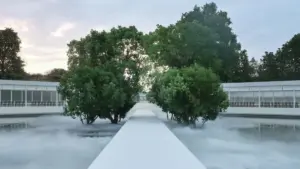
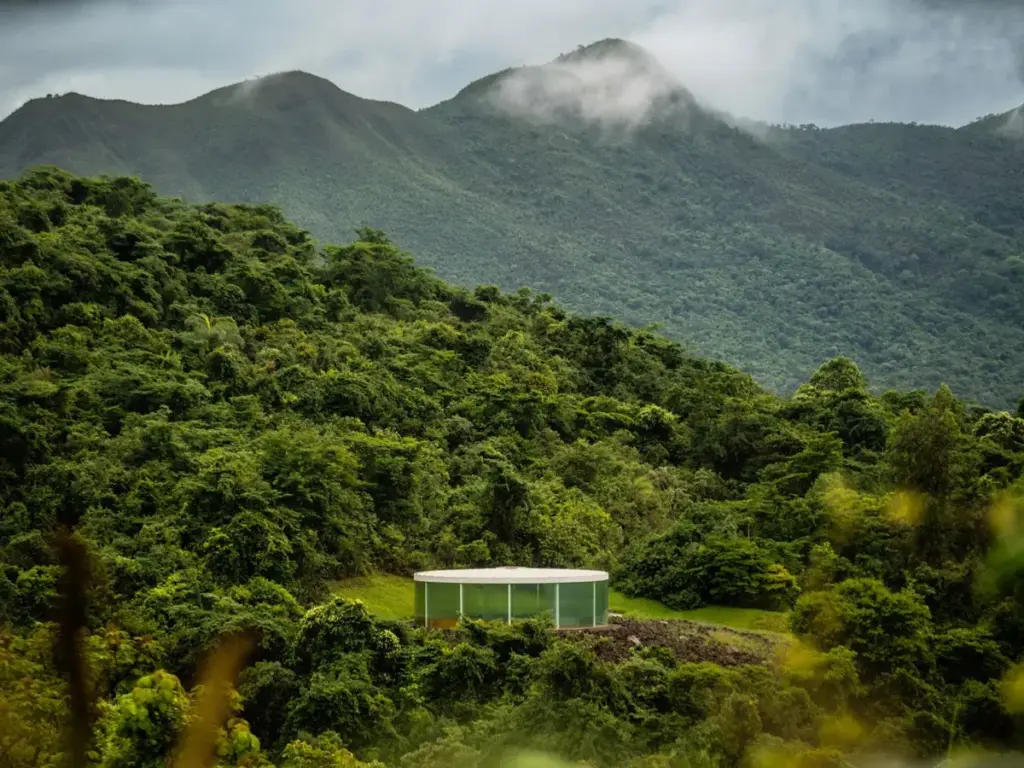
Among the museum’s most celebrated attractions are its iconic artist-specific pavilions, which showcase site-specific installations by luminaries such as Yayoi Kusama, Adriana Varejão, Hélio Oiticica, Doug Aitken, and Tunga. These structures underscore Inhotim’s core philosophy: art conceived in profound, inseparable dialogue with radical architecture and the surrounding tropical landscape.
Looking toward the future, Inhotim’s curatorial team is eager to expand the institution’s geographical and cultural perspectives while honoring its foundational ethos. Deri Andrade, a curator at Inhotim, noted that Brazilian art will forever remain a cornerstone of the museum’s identity, but the institution is simultaneously broadening its lens. "Brazilian artists will always be part of our curatorial program, but we are also turning our attention to Latin America," Andrade said. "I would say we are looking at the world as a whole, with a very diverse program."

This evolving vision is vividly reflected in the institution’s 20th-anniversary programming, which kicked off with a series of high-profile exhibitions opening in April. Foremost among them is a major career survey of artist Dalton Paula. Curated by Beatriz Lemos and titled "Dupla Cura," the comprehensive exhibition spans works from 1999 to the present across painting, installation, photography, and video. The show deeply explores themes of Black historical memory, Afro-Brazilian spirituality, childhood, and healing.
Outdoors, the landscape itself continues to serve as an active canvas. Laís Myrrha’s newly unveiled Contraplano introduces a striking concrete structure directly inspired by an iconic Oscar Niemeyer building in Belo Horizonte. Positioned deliberately within a region deeply scarred and shaped by industrial mining, the installation bridges Brazilian modernism and historical architectures of power with the distinct topography of Minas Gerais.
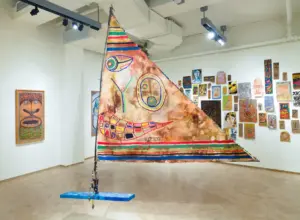
Inside the galleries, davi de jesus do nascimento has transformed a newly renovated space for his exhibition "Tororoma"—a Tupi term evoking a rushing river in full flow. The immersive installation draws inspiration from the São Francisco River, located north of Inhotim, and blends paintings, video, traditional carved riverboat figureheads known as carrancas, and a vast, sprawling network of roots cast from molds taken directly from trees in the artist’s hometown of Pirapora in northern Minas Gerais.
The anniversary celebrations will continue on November 14 with the opening of "À Céu Aberto," an exhibition rooted in extensive archival research and selections from Inhotim’s permanent collection, alongside the much-anticipated reopening of Janet Cardiff’s haunting audio installation, The Murder of Crows.

Financial Resilience and a Complex Neighbor
For Andrade, the path forward relies as much on re-engaging with the museum’s existing holdings as it does on commissioning new works. "The next step will be to revisit our own collection," Andrade explained. "If you compare Inhotim with other museums, you will find that our collection is small. We have fewer than 1,000 works." By pivoting back to intensive commissions and deeper scholarly re-examinations of its permanent galleries, Inhotim aims to stay true to its original mandate of inviting artists to create work explicitly tailored for its unique ecosystem.
When asked whether Paz’s departure had destabilized the museum’s financial foundation or caused corporate sponsors to withdraw, Andrade was definitive. "On the contrary, with his departure, we began to raise money through cultural incentive laws to maintain the museum, at the municipal, state, and federal levels," he noted. Today, Inhotim operates as a private nonprofit entity that successfully leverages Brazil’s federal Rouanet Law, Minas Gerais’s state cultural incentive legislation, and vital contributions from private donors and philanthropic foundations.
Yet, the developments unfolding just beyond Inhotim’s perimeter fence cannot be entirely separated from the institution’s trajectory. According to Schwartzman, once Paz completed the monumental task of donating Inhotim, his creative drive remained unabated. "And once he did that, Bernardo said, ‘I’m ready for another project,’" Schwartzman recalled.
As one of the region’s largest private landowners, Paz turned to an adjacent parcel of land within his portfolio that happened to border Inhotim directly. Significantly, two of the flagship projects originally intended for Inhotim—a major commission by Michael Heizer and a permanent home for a monumental sculpture by Anish Kapoor—will now find their home in the forthcoming Museu Bernardo Paz, scheduled to open next September.

"I think it becomes a kind of part two in [his] thinking," Schwartzman reflected. "Institutionally, how these two entities end up functioning, of course, needs to necessarily remain different."
While Schwartzman noted that formal conversations between Paz and Inhotim’s current administration have not yet taken place, he expressed openness to the possibility that the two neighboring cultural destinations might find ways to collaborate in the future. Representatives for Inhotim declined to comment on any prospective future partnerships with the Museu Bernardo Paz.
As the institution steps into its third decade, the focus remains firmly on institutional longevity and creative vitality. Summing up the overarching challenge for the years ahead, Júlia Rebouças, Inhotim’s artistic director, wrote in an email, "The challenge from 2026 onward is to build a lasting Inhotim that continues to be innovative and relevant."