The estate of legendary Pop art giant Tom Wesselmann has teamed up with Japanese American artist Tomokazu Matsuyama for a first-of-its-kind exhibition. Staged inside the East Village studio that Wesselmann occupied during the final decade of his life, the show offers a rare, intimate look at the confluence of two distinct artistic visions separated by generations yet unified by an intense fascination with consumer culture, art history, and appropriation.
Open to the public by appointment through September 27, the exhibition arrives serendipitously just in time for Armory Week, a bustling period when thousands of international art dealers, collectors, and enthusiasts converge on New York City. Exhibiting inside another artist’s personal workspace is an unusual and deeply intimate endeavor. Touring the space during a recent visit, Matsuyama described the sensation with characteristic candor: “It’s like wearing someone else’s underwear and saying it’s mine!”
All around the expansive 4,000-square-foot studio are physical traces of Wesselmann’s daily life and creative process. The room is filled with objects the Pop artist touched—not only his finished artworks, but his paintbrushes, used paint tubes, and even a pair of work gloves that remain handily labeled “TR” and “TL” for Tom’s right hand and Tom’s left hand.
The seeds for this unique collaboration were planted when Wesselmann’s estate invited Matsuyama to create new works for the major 2024 exhibition titled “Pop Forever, Tom Wesselmann &…” at the Fondation Louis Vuitton in Paris. That grand showcase also featured prominent contemporary stars such as Derrick Adams, Jeff Koons, and Mickalene Thomas. Writing for ARTnews at the time, critic Sarah Douglas observed that the Paris exhibition took a clever approach, noting that it was “bookended by Wesselmann’s Pop peers and red-hot contemporary artists, giving him a strong association with both.” Wesselmann’s presence was felt everywhere in Paris during that season, with major galleries also offering his works concurrently at Art Basel.

Both artists command a powerful and established presence in the global art market. Matsuyama’s current auction high stands at $647,125, a figure achieved at Sotheby’s Hong Kong in 2023, with dozens of his works having successfully sold in the lucrative six-figure range. Meanwhile, Wesselmann’s market history includes roughly 65 works that have achieved prices north of $1 million. However, compared to some of his fellow Pop art icons, Wesselmann’s $10.7 million auction peak, set at Sotheby’s New York in 2008, remains relatively modest, leaving substantial room for critical and commercial reappraisal.
The East Village studio exhibition features a carefully curated selection of twelve works: seven by Wesselmann, dating from the 1960s through the year prior to his death in 2004, and five by Matsuyama, all produced within the last two years. Among them, Matsuyama created three brand-new pieces specifically for this studio presentation. Jeffrey Sturges of the Wesselmann estate noted the generous scale of the workspace, which provides an ideal environment for viewing these large-scale conversations between the two creators.
Each of Matsuyama’s new works closely riffs on Wesselmann’s signature iconography and spatial arrangements, utilizing shaped canvases—a distinctive format that Wesselmann frequently employed throughout his career. Yet, while Wesselmann’s original compositions were famously chock-full of clever consumer and art historical references, Matsuyama pushes that methodology to an exponential degree. A single work by Matsuyama might contain layered visual references to historical figures as varied as Henri Matisse, Yves Klein, James McNeill Whistler, Raphael, and Pieter Claesz, alongside traditional patterns like Japanese textile designs.
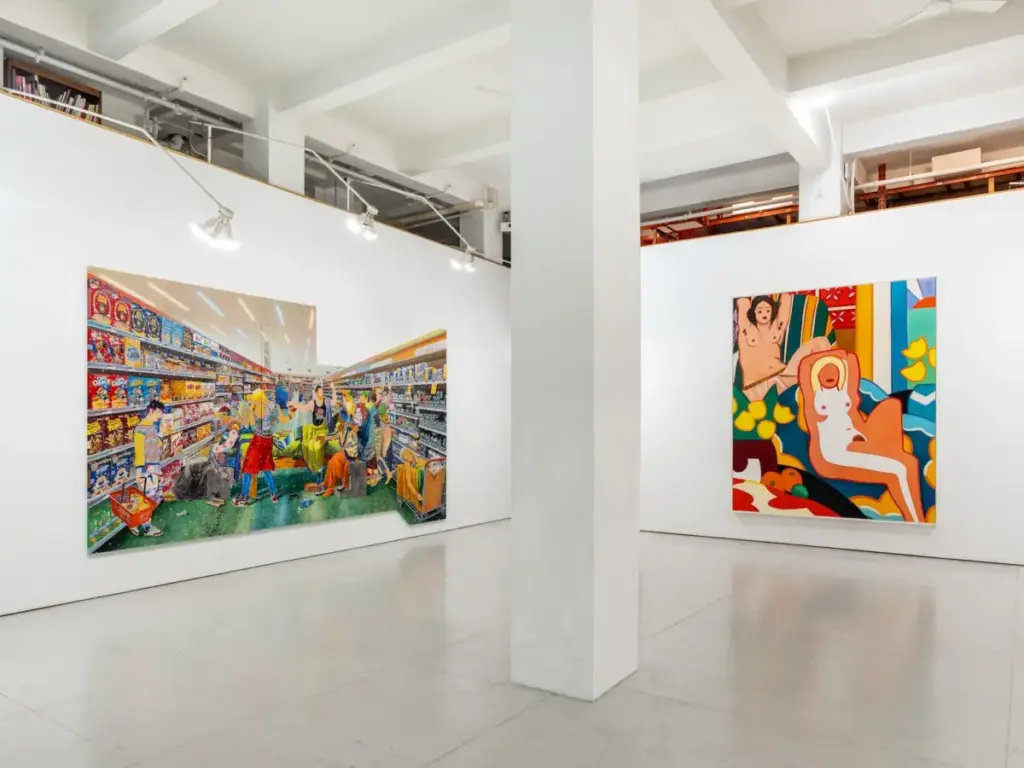
A central juxtaposition of the exhibition involves Wesselmann’s massive, 16-foot-wide Still Life #35 (1963), an iconic composition featuring a loaf of supermarket bread, a pack of cigarettes, and a six-pack of Royal Crown cola. Positioned across the studio on a neighboring wall is Matsuyama’s grand ode to modern consumer goods, the slightly larger We the People (2025). This ambitious painting directly quotes Jacques-Louis David’s neoclassical masterpiece The Death of Socrates (1787) from the collection of New York’s Metropolitan Museum of Art, but radically transplants the philosophical drama into the wide, fluorescent-lit aisles of a modern discount warehouse store.
In Matsuyama’s reimagining, the groceries and medicines are painted with loving, obsessive detail. It presents Greek moral philosophy expounded at Costco, where Socrates is depicted drinking a bowl of Froot Loops as a colorful, toxic stand-in for the fatal hemlock, while shelves of diabetes medications loom in the background.

“The way Wesselmann appropriated historical art and consumer culture already had a big influence on me,” Matsuyama reflected before he was ever invited to participate in the Paris exhibition. Following that institutional showcase, however, he dove even deeper into his predecessor’s oeuvre. Reflecting on the intensity of the project, Sturges told Matsuyama, “I was surprised at the depth at which you went into it.” Matsuyama replied, “The research took longer than creating the paintings.” That is a remarkable admission, given that Matsuyama’s complex, labor-intensive works require large teams of studio assistants to execute.
Among the Wesselmann pieces on display are two paintings from his celebrated “Bedroom Paintings” series, a fitting inclusion for the intensely personal setting of the artist’s former living and working quarters. Wesselmann initiated this provocative series in 1967, characterized by intimate, close-up views of women’s body parts combined with everyday domestic objects typically found on a night table.
These works do not shy away from explicit anatomy. For instance, Bedroom Painting #19 (1969) verges on the pornographic, prominently featuring the image of the artist’s own erect penis. The exhibition is supported by gallery Almine Rech. Incidentally, before joining the editorial staff at ARTnews, the author of this report wrote a press release for dealer Almine Rech when she mounted a 2025 Wesselmann exhibition that similarly included several of the artist’s paintings depicting his own anatomy.
The Bedroom Paintings are not only fitting for the domestic environment of the studio, but they also serve as a deeply relevant touchstone for Matsuyama. When Matsuyama first arrived in New York and eagerly perused magazine stores selling American interior design publications, he was struck by how willing Americans were to publicly expose their private domestic spaces to strangers—a sharp contrast to his native Japan, where homes are traditionally treated with a much higher degree of privacy.
Regarding whether this unique exhibition might travel to other venues in the future, both Matsuyama and Sturges remained circumspect. Much of the magic and conceptual weight of the presentation derives specifically from its realization inside Wesselmann’s authentic studio, surrounded by the tools and personal effects he left behind. Furthermore, as Sturges pointed out, “You see a lot of shows pairing artists, but it’s not always clear what they bring beyond what two solo exhibitions might.”

Even so, Sturges did not close the door entirely on future iterations, remarking slyly about the current presentation, “It’s a proposal. I think it’s an exciting way to see art.”
Wesselmann X Matsuyama is on view by appointment through September 27. Members of the public can email [email protected] to request an appointment.