CAIRO — Recent archaeological excavations at the ancient site of Tell Al-Abqain in Egypt’s Beheira Governorate are shedding profound new light on the daily existence, social structures, and military operations within a vital New Kingdom frontier post. Announced on Wednesday by the Egyptian Ministry of Tourism and Antiquities, the latest finds significantly enhance our understanding of the fortification’s strategic role during a turbulent era in Egyptian history.
Established during the New Kingdom period, which spans from 1570 to 1069 BCE, Tell Al-Abqain served as a critical military stronghold designed to guard Egypt’s western borders against incursions and migrations by neighboring Libyan tribes. While previous excavations confirmed the site’s defensive purpose, the latest discoveries made by an active Egyptian archaeological mission delve deeper into the human element of the fortress, painting a vivid picture of how soldiers, civilians, administrators, and craftsmen lived, worked, and worshipped within its fortified mud-brick walls.
In an official statement released by the ministry, Egypt’s Minister of Tourism and Antiquities, Sherif Fathy, emphasized the profound historical value of the new findings. According to Fathy, the discoveries not only shed essential light on the overarching military function of the ancient fortress but also provide intimate glimpses into the daily routines, social interactions, and domestic lives of the diverse community of inhabitants who called the stronghold home centuries ago.
At the heart of the recent excavations is a remarkably well-preserved large mud-brick housing complex that connects directly to the southern entrance of the fortress. Urban planning and architectural organization were clearly prioritized by the ancient builders. In the northern section of this expansive complex, excavators uncovered a main street running clearly from east to west. This thoroughfare is intersected at right angles by a secondary road running south to north, demonstrating an advanced level of urban layout and spatial organization within the fortification that facilitated troop movements, supply distribution, and everyday civilian traffic.
The newly explored residential and administrative complex reveals a high degree of organized resource management and self-sufficiency. Within its boundaries, archaeologists identified extensive grain storage silos designed to safeguard vital food reserves during potential sieges or lean agricultural seasons. Alongside these silos, excavators found cylindrical pottery ovens clearly utilized for baking bread, a dietary staple of ancient Egyptian society. Furthermore, several residential chambers were uncovered immediately adjacent to previously discovered water wells located in the southeastern corner of the fortress. This proximity underscores a carefully planned infrastructure that ensured a reliable, secure water supply for the stronghold’s human and animal populations.
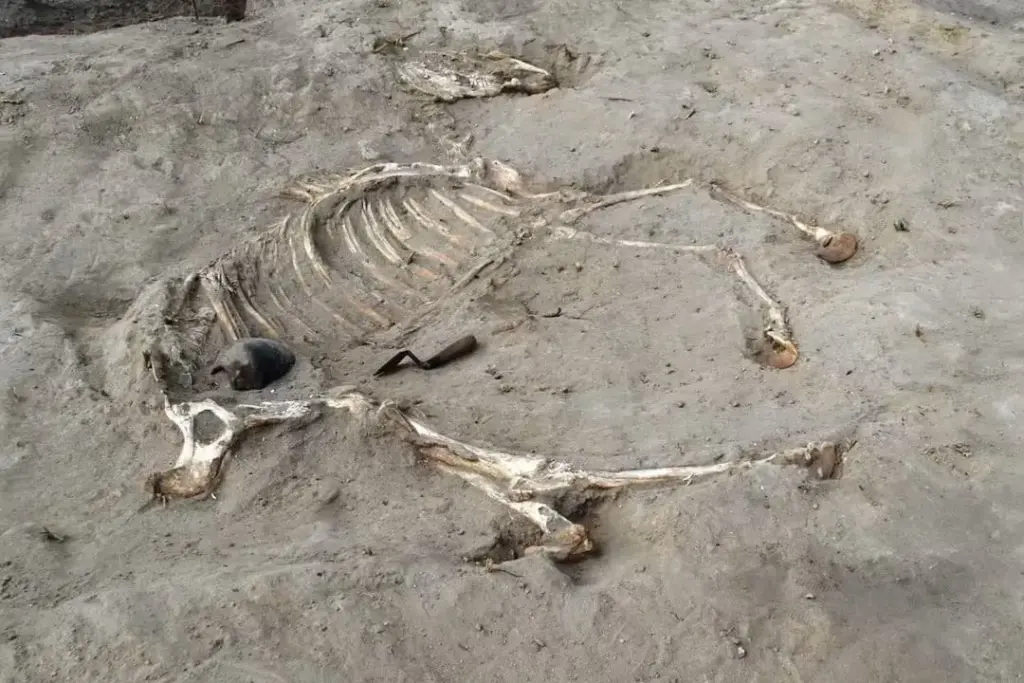
Perhaps the most unusual and intriguing discovery made during this excavation phase is the ceremonial burial of a young male horse. Horses were of immense strategic and symbolic value in ancient Egypt, particularly during the New Kingdom when chariot warfare revolutionized the battlefield. Preliminary osteological and archaeological studies indicate that the animal belonged to a specialized breed known for its exceptional speed and agility. Such equine assets were indispensable for high-mobility military operations, scouting missions, and the deployment of elite chariot units.
The horse’s body was found entirely intact, accompanied by the pieces of an intricate decorative harness. The careful placement of the animal, combined with the presence of the harness, suggests a deliberate and deeply respectful interment. Whether the horse was buried to honor a beloved animal companion of a high-ranking military officer, sacrificed during a ritual, or commemorated for its service on the frontier, the burial offers a rare window into the bond between ancient Egyptians and their military animals.
In addition to architectural and zoological finds, the excavation work uncovered a rich trove of epigraphic and written evidence that anchors the fortress firmly within the historical chronology of the Nineteenth Dynasty. Chief among these textual discoveries is a fragment of a limestone stela directly linked to the reign of Pharaoh Merneptah, the powerful son and successor of Ramesses II. The inscription on the stela, written in traditional hieratic script, extols the might and martial prowess of the king, comparing his devastating effectiveness in battle to that of Seth, the turbulent and formidable god of chaos, storms, and deserts.
Further reinforcing the site’s historical timeline, another stela fragment bears the official royal titulary—including the birth name, throne name, and Horus name—of Ramesses II, widely celebrated in history and popular culture as Ramesses the Great. These royal monuments served not only as reminders of central authority to the soldiers stationed on the distant frontier but also as ideological anchors, linking the remote desert outpost directly to the divine kingship seated along the Nile.
A third stela fragment discovered at the site provides a stark visual and textual reminder of the geopolitical conflicts that necessitated the fortress’s construction. This artifact depicts a bound prisoner captured in a classic posture of submission. The detailed rendering of the captive’s clothing and physical markers explicitly identifies him as an individual of Libyan origin, specifically belonging to the Meshwesh tribe. The Meshwesh were among the primary tribal groups that frequently clashed with New Kingdom pharaohs along Egypt’s western frontier, making the presence of this imagery at Tell Al-Abqain entirely fitting for a stronghold dedicated to repelling such threats.
The archaeological team also recovered a wide array of smaller artifacts that illuminate the religious beliefs, personal tastes, and everyday domestic concerns of the fortress inhabitants. Among these are numerous scarab beetles inscribed with the names of revered kings and powerful deities, functioning both as seals of authority and protective talismans. Alongside the scarabs, excavators found a variety of amulets designed to invoke divine protection, promote fertility, and grant physical strength.
These spiritual artifacts are complemented by everyday objects that flesh out the material culture of the site. A rich assortment of pottery vessels, used for cooking, storage, and consumption, reveals details of local culinary practices. Loom weights discovered in the residential sectors indicate that textile production was actively carried out within the fortification, likely by women managing household chores or producing garments for the community. Pieces of personal jewelry recovered from the site demonstrate that despite the austere and demanding nature of military life on a remote frontier, inhabitants still valued personal adornment and aesthetic expression.
Taken as a whole, the diverse artifacts and architectural features uncovered at Tell Al-Abqain weave a remarkably comprehensive and nuanced narrative. They move beyond the traditional framing of a military outpost as a sterile, purely defensive installation, revealing instead a thriving, multifaceted community. The civilian and military members who lived, worked, and died within the fortress possessed complex social lives, distinct daily routines, varied tastes, and deep-seated religious beliefs that sustained them at the very edge of the ancient Egyptian world.