On Park Avenue in midtown Manhattan, an office worker commuting home might pause to take in the Lever House lobby, which currently glows with more than a dozen hanging paper lanterns. These are Akari lamps, the name Isamu Noguchi famously gave to his delicate sculptures crafted from traditional washi paper and bamboo. That high-profile installation, alongside a number of other Noguchi sculptures and models thoughtfully placed throughout the building, serves as far more than standard office decor. It stands as a striking physical reminder of the historical connection between Gordon Bunshaft, the visionary architect of the glassy modernist office tower, and Noguchi, whom he originally commissioned in the early 1950s to design monumental sculptures for the building’s open courtyard.
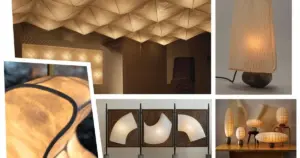
Noguchi would ultimately never fulfill that specific architectural commission, but he would, around this exact period, develop the revolutionary lights that would go on to become nearly ubiquitous in modern interior design. In 1951, the mayor of Gifu, Japan, tapped the celebrated artist to help revive the region’s centuries-old paper-lantern industry, which was struggling in the post-war era. Noguchi immersed himself in the traditional techniques, collaborating closely with Ozeki & Co., Ltd., a family-owned company in Japan that still produces his authentic designs to this day. His resultant Akari series—which would eventually total more than 200 unique models in all—stripped the traditional lanterns of any decorative writing and most of their color, stood them up on thin, minimal metal stands, and replaced the traditional oil lamps and candles that historically illuminated them with modern electric bulbs.
The resulting aesthetic was spare, geometric, and seemingly weightless. To honor the milestone of 75 years since their inception, the Noguchi Museum recently unveiled a major exhibition titled "No Ordinary Light: Akari at 75," which is scheduled to run through September 5, 2027.
It would be easy for casual observers to dismiss the Akari lamps as a purely commercial consumer product when weighed against the breadth of Noguchi’s broader artistic output. The artist, who heavily preferred not to be pigeonholed as a mere designer, had by the late 1940s established a remarkably prolific practice spanning sculpture, furniture design, theatrical set design, and massive public works. Yet, the Akari would endure as one of his most accessible and lasting legacies, a body of work he insisted on presenting even on the most prestigious and rigorous artistic stages of the international art world. In 1986, only two years before his death, Noguchi achieved the historic distinction of becoming the first American artist with a solo presentation at the Venice Biennale.
To the considerable pushback of traditional curators and critics at the time, he chose to display Akari lamps in two of the pavilion’s formal rooms—a bold curatorial move that many art historians believe ultimately cost him the festival’s coveted Golden Lion prize.
The title of that landmark exhibition, "What Is Sculpture?", served as yet another defiant demonstration of his refusal to artificially separate fine art from industrial design. The mammoth Akari structure he created specifically for Venice, which remains his largest ever produced, stands as one of the undeniable highlights of the current museum show, presented inside its own custom pine structure originally designed for the Biennale. Revisiting Noguchi’s enduring Akari series also presents an ideal opportunity to examine how a vibrant new generation of contemporary designers are working with paper and light today, exploring their own complex relationships to the master artist. Across the design world, several distinct studios are currently rethinking the paper lantern for the modern era.
Now based in Los Angeles, designer Andrea Claire first established her independent design practice in Brooklyn back in 2011. During those formative early days, Claire recalls that the Noguchi Museum served as her ultimate "happy place." On one particular exploratory visit to the museum 15 years ago, she went seeking inspiration and technical ideas for her very first chandelier design. "I knew what I wanted to do but didn’t yet understand how to do it," she recalls. During that visit, Claire happened to see a documentary video detailing precisely how the Akari lights were made, and instantly, "it clicked," she says.
That exact manufacturing process remains essential viewing in her studio today: "To this day, when someone starts working for me, I have them sit down and watch the same video as an introduction to my initial inspiration."
Claire transitioned to working directly with paper—specifically hanji, a revered traditional Korean paper—in 2020, following years of experimenting with pieces made from bamboo, glass, and porcelain. "The fact that it was used for over a thousand years in bookmaking spoke to its longevity, which is important in my work," she explains. This year, Claire looked directly to the organic works of Andy Goldsworthy and Constantin Brancusi for her latest collection, titled Totemic. The series features striking vertical pendants that mark a clear departure from her earlier, Calder-like mobile chandeliers.
Three distinct handcrafted shapes, named Moon, Sage, and August, are interspersed carefully along a brass stem between shiny, diamond-like beads. As a trained painter, Claire actively aims to show the raw imperfections of the heavily textured, layered, marble-like paper that gets wrapped entirely by hand around brass armatures, successfully concealing the lightbulb from view. "The ability to see things in 3-D through computer programs is invaluable to my work," she notes. "But if the work weren’t made by hand in the end, it would lose its depth and the human touch."
A similar dedication to materiality drives Aaron and Irisa Chan-Kawabi, the husband-and-wife duo behind the New York–based studio Kawabi. The two met while studying product design at the Parsons School of Design, a choice they describe retrospectively "as a compromise"—a practical way to keep working creatively while satisfying heavy familial pressure to pursue a conventional, practical career path.
Paper lanterns, however, always held a profound psychological and aesthetic pull for them. "Like us, they were migrants from another place, another origin," Irisa reflects. And Noguchi stood out as a particular source of artistic inspiration for the deliberate way he went about "finding ways to belong in his split identity between Japan and America."
Their practice officially began when they began experimenting with making objects for their own home, eventually arriving at paper-structure techniques that closely mirrored traditional methods. Since then, they have traveled extensively to study directly with master papermakers and wood craftsmen in Japan to thoroughly hone their craft. Their practice has steadily evolved into a deep focus on creating functional furniture-object hybrids they term "archival forms"—representing a complex interplay between traditional architecture, contemporary lighting, and historic archetypes. Despite these modern frameworks, they continue to employ the traditional Japanese method utilized by Noguchi, which involves coiling reed tightly over a collapsible wooden mold before layering the delicate paper sheets on top.
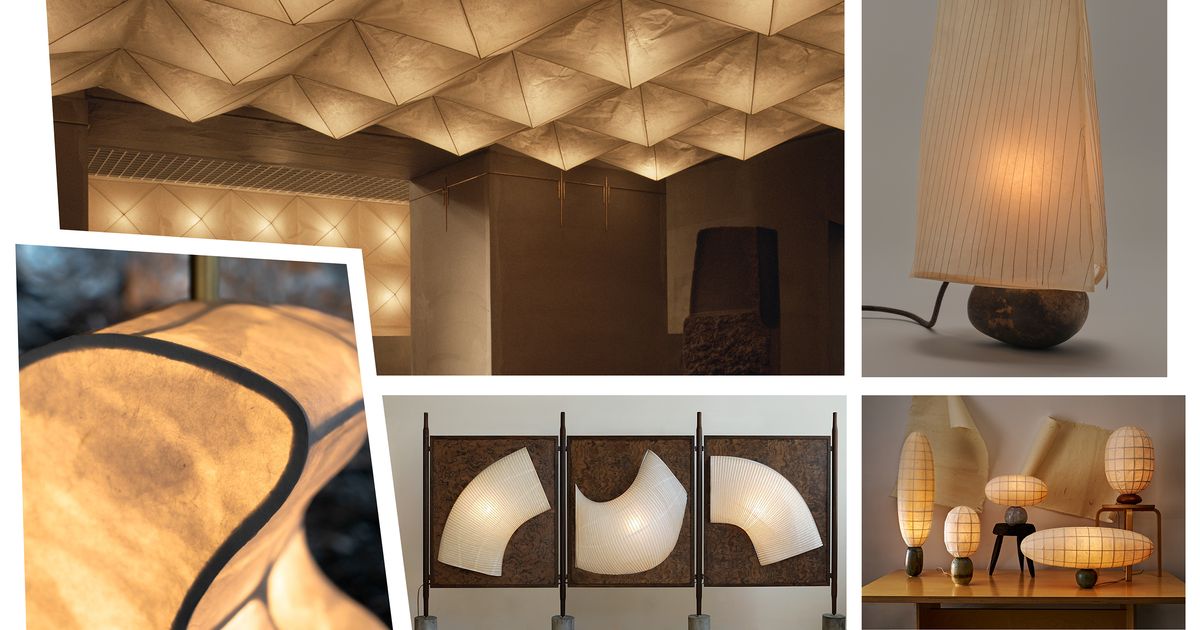
In 2025, the Tea Screen Lamp from their Confluence collection debuted as a triptych screen functioning as a hybrid between architectural lighting and a traditional room divider, featuring mulberry-bark paper lamps seamlessly encased within rich walnut-burl panels. The Relic I Lamp, originating from the same cohesive collection, brilliantly juxtaposes the extreme lightness of a pleated paper fan with the stark sturdiness of the solid concrete block that anchors it firmly in place.
At design showcase Assembly Line earlier this year, Kawabi launched its broader Amica collection, which gets its name from a close creative collaboration with ceramics artist Christopher Merchant. The resulting sconces, pendants, and table lamps cleverly blend two distinct crafting techniques: hand-built ceramics and mulberry-paper shades held open by precision-cut white-oak rims. "Looking back, I think we weren’t designing with each other but for each other," Aaron says of collaborating with Merchant. Merchant’s sculptural bases closely emulate the wooden molds that Aaron and Irisa rely on to hold the paper steady as they construct the shades. In the Amica collection, the overarching geometry of the shades embraces a much more symmetrical and traditionally Western approach.
"I’ve had designers say my work is art because I am making it myself, while I’ve had artists say my work is clearly design because it is somewhat repeatable," observes Steffany Trán, who releases her body of work under the moniker Vy Voi, the name of her dedicated design and craft practice. The New York–based designer, who originally hails from the Bay Area, began incorporating delicate paper volumes into her existing ceramic works in 2024. She utilizes traditional dó paper sourced directly from family-run workshops in Northern Vietnam, where the labor-intensive material has been produced continuously for over 800 years.
A master craftsman located in Hoi An taught her how to build traditional Vietnamese lanterns featuring silk panels and flexible bamboo frames over a video call; she then boldly proposed creating unique elliptical shades utilizing those exact same foundational techniques. "He told me it couldn’t be done. So I did my own trial and error with dó paper, testing dozens of glue combinations, hand pressure, and frame builds, learning how the paper behaves with every prototype made."
Her deeply rooted belief in honest, unadorned materials, she feels, strongly resonates with Noguchi’s overarching philosophy. "There’s a clear respect in the natural state of what [Noguchi] chose to use, and I aim to echo that in my own work too."
Her designs frequently draw inspiration from familiar, everyday items, such as common root vegetables. In her Rấu Cây collection, ovoid paper lampshades inspired by the unique shapes of different fruits and vegetables appear to "sprout" organically from sturdy porcelain bases. Other pieces borrow from very specific cultural references tied to her heritage: Kite In-Flight makes direct reference to a traditional whistling paper kite unique to Vietnam. Most recently, she has developed an intricate series of wall sconces that take their structural form from the specific folding method used to wrap bánh giò, a traditional pyramid-shaped rice dumpling wrapped tightly in banana leaves.
Trán considers modern industrial design to be the absolute "polar opposite" of what she strives to accomplish, and she firmly plans to continue crafting all of her lighting designs entirely by hand. As she explains, "Whether it is bending lampshade frames with wood or brushing on lacquer, there are telltale signs that a human made it that is incredibly grounding during an age of extreme waste and mass production."
Similarly, designer Thomas Yang rejects the philosophy of "treating material as a means to an end," a pragmatic mentality he strongly associates with mainstream industrial design. He far prefers embracing the slow, deliberate rituals associated with traditional craft, even when that physical labor involves unearthing heavy stones directly from riverbeds upstate. Since completing his prestigious residency at Colony in 2024—where he debuted a comprehensive home collection including paper lanterns deeply rooted in his Taiwanese heritage—Yang has continued exploring novel structural applications for raw materials like stone, wood, and paper.
"It was Noguchi who led me to paper," Yang shares. "In university, I studied the Akari manufacturing method through video archives and books." His initial exploratory prototypes were likewise constructed using Mino washi, the exact same variety of Japanese paper utilized in Noguchi’s Akari lamps.
Yang’s 2024 Tian Den series is constructed from two delicate sheets of Yame Kozo Hadaura paper—a regional variation of mulberry-bark paper produced locally in Yame, Fukuoka Prefecture—seamed carefully together with thin bamboo ribbing. Suspended delicately from a minimal wooden frame, the resulting shade appears to gently dance with the slightest indoor breeze. In a more recent creative iteration, Yang designed a similar paper shade finished completely in beeswax to be placed atop a solid wooden wall sconce. "Laminating it with beeswax binds the paper fibers and makes it naturally hydrophobic, adding both robustness and longevity, as wax acts as an effective preservative," Yang notes.
For his Stone series, Yang incorporates a traditional architectural construction method known as ishibadate, in which heavy wooden columns stand directly atop foundation stones without the use of mechanical anchors or hardware. The lamp’s base features a carved wood stem dovetailed directly into the face of a raw river stone using a combination of machine precision and hand work. Three distinct layers of paper featuring varying finishes sit atop the structure to softly diffuse the warm light, while the internal wiring and structural frame are left intentionally exposed, "hinting at the intentions beneath," as Yang explains. Furthermore, the wooden stem is entirely removable to allow for easy portability, bearing a conceptual resemblance to the flat-packed capabilities of the historic Akari lamps.
"The more I developed the practice, the more I hoped for the work to be completely ordinary, like a seasoned cooking spoon passed down through generations," Yang concludes. "I hope that an object can speak beyond its form to what has come before, and to how it may shape the conversation going forward."