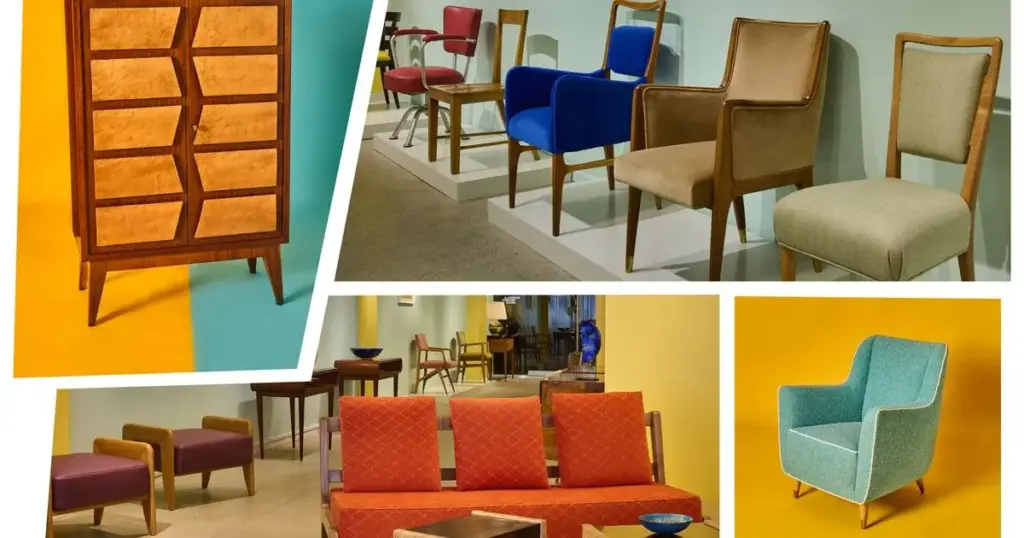
While his 20th-century contemporaries routinely wrestled with the strict dogmas of the Bauhaus—the dominant design ideology that swept across Europe from the 1920s through the end of the Second World War—Gio Ponti remained remarkably agnostic to any single, utopian vision of modern living. Over an extraordinarily prolific career spanning six decades, the seminal architect, industrial designer, and founding editor mined the rich historical layers of Mediterranean history to conjure up wildly futuristic concepts. For Ponti, looking backward was simply a prerequisite for looking forward.
This philosophy rarely yielded a uniform, predictable look. He was just as comfortable developing a pragmatic, utilitarian shelf to serve the austere, belt-tightening years immediately following World War II as he was, decades later, designing a pair of sumptuously ornate lounge chairs for an exclusive luxury hotel. Despite—or perhaps precisely because of—his stubborn refusal to adhere to any single prevailing style, trend, or school of thought, an astonishing number of his furnishings successfully made it into commercial production, cementing his legacy in both elite design circles and everyday domestic spaces.
That spirit of relentless, tireless experimentation is the unmistakable driving theme of "Designing Optimism," a sweeping retrospective currently on view at New York’s Donzella Project Space. The exhibition is the result of years of meticulous, boots-on-the-ground sourcing by gallerist Paul Donzella and design historian Brian Kish. Kish has spent three decades living and breathing Ponti artifacts, original drawings, and archival papers, even co-authoring a massive, definitive Taschen monograph along the way. Together, the pair have captured six remarkably fertile decades of Ponti’s furniture design, tracing his evolution from the late 1920s onward.
Assembling the exhibition was no small feat. Over the three years it took to develop the show, Donzella leaned heavily on high-end auctions and a dedicated buying partner who could secure access to tightly held private collections. Meanwhile, Kish tapped into much more offbeat, unconventional channels, including an elderly French nobleman who maintained deep connections to Vatican-adjacent charities. The resulting collection is remarkable not just for its scope, but for its exclusivity: many of the works featured in the gallery have not been seen publicly in decades.
Even with nearly 80 pieces on display, the selection is far from exhaustive. Donzella readily acknowledges the sheer volume of the designer’s output, noting that no matter how large a collection they managed to gather, inevitable omissions remained simply because Ponti produced so much. Regardless, he points out, the exhibition features a carefully curated mix between Ponti’s more minimal creations and those that showcase his deeply decorative leanings. The newest piece in the exhibition debuted over half a century ago, and the last comprehensive retrospective dedicated to Ponti took place back in 2001. For both Donzella and Kish, this current show represents a vital opportunity to bring the influential 20th-century polymath into sharp focus for an entirely new generation of admirers, collectors, and designers.
Born into a prominent Milanese family, Ponti was initially nudged toward a conventional career in engineering, though he was ultimately permitted to pursue his true passion for architecture. Even so, his artistic roots always ran deep. Kish observes that Ponti always wanted to be a painter, and that fine-art sensibility never truly left him. Operating with an astonishing, almost breathless velocity—fueled notoriously by a mere five hours of sleep a night, much to the lament of his wife, who frequently had to banish his late-night sketching sessions to a desk down the hall—his mind churned out ideas across every conceivable scale of object. He designed everything from diamond-faceted cutlery to grand architectural monoliths, including Milan’s emblematic Torre Branca, as well as towering street lamps that were eventually re-engineered and scaled down for domestic interiors.
Across a shifting cultural landscape where tastes continuously evolved, the importance of decoration remained a completely nonnegotiable element in all of Ponti’s creative output. While his prominent peers—such as Adolf Loos, author of the famous polemic Ornament and Crime, and high modernist pioneer Le Corbusier—firmly looked down upon nonfunctional flourishes and ornamentation, Ponti viewed decoration as an absolute necessity for genuine emotional engagement. This perspective aligned seamlessly with the enduring Italian belief that physical objects should actively delight their users, particularly during difficult periods of collective hardship.
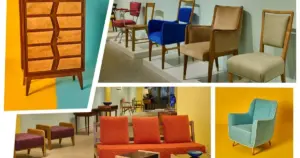
Even amid the severe belt-tightening of the post-World War II era, a seemingly simple two-door cabinet created in 1946 could be trimmed into a dynamic zigzag pattern, perhaps signaling an underlying hope for a more prosperous future. Similarly, for a 1954 telephone side table prototype, he incorporated his quintessential curved edge while simultaneously harnessing the advanced manufacturing capabilities of the burgeoning industrial boom that would soon become standard practice across Europe.
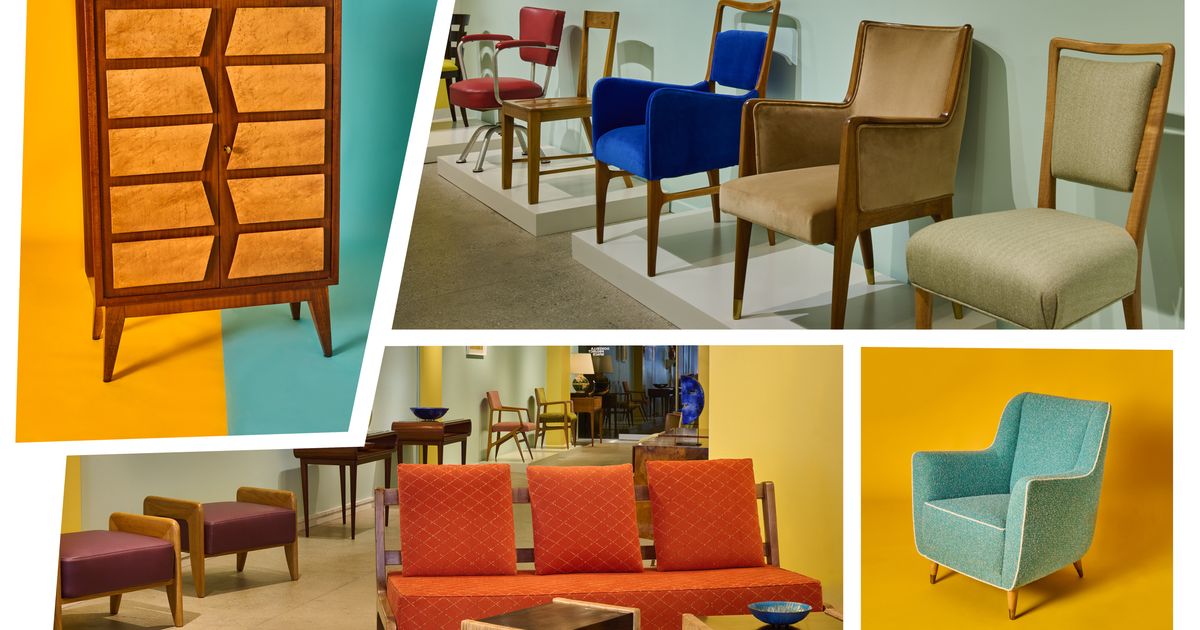
The exhibition loosely groups Ponti’s furniture according to broad time periods, though, as with most complex trajectories in design history, his career resists being neatly packaged into rigid boxes. He effortlessly pulled from both Art Deco motifs and International Style modernism while carving out a distinct path entirely his own. The roughly chronological organization of the show reveals formal and aesthetic through lines that emerged, matured, and were continually refined over decades.
During the 1920s and 1930s, he engaged deeply with neoclassical motifs while playfully experimenting with unlikely material pairings, gradually perfecting his paradigmatic curved edge. What began as sharply defined, Deco-esque geometry slowly evolved into something much more organic over time. By the 1940s and 1950s, he enthusiastically embraced Italy’s postwar economic miracle, resulting in work that was increasingly viable for industrial mass production. Later, in the 1960s and 1970s, a series of unique, one-off commissions allowed him to craft highly artistic pieces that fully demonstrated the sheer breadth of his accumulated experience. These later works stand among his most innovative, proving to be hyperfunctional yet retaining a striking, ornate visual presence.
Ponti consistently rejected the rigid cultural hierarchies that separated high art from low design. He famously integrated humble Formica with luxurious burled walnut, a technique visible at Donzella in a rare 1950 display cabinet featuring lithograph-transferred Fornasetti prints of Venice. He paired bamboo caning, which was widely perceived at the time as cheap and pedestrian, with rare African padauk wood in his 1940 Diavolo tables. He moved fluidly between fulfilling multimillion-dollar commercial commissions and developing accessible, everyday furnishings for returning World War II veterans, all while editing influential design magazines—platforms he frequently used, perhaps, to covertly inform his own private research and aesthetic crusades.
Along the way, Kish notes, Ponti’s design philosophy noticeably gravitated toward weightlessness. The insectlike lounge chairs he designed in 1964 for the Parco dei Principi Hotels in Rome and Sorrento feature ultrathin, tapering legs that make their heavily curved seat shells appear as though they are effortlessly floating in space. Donzella admits that there is an avant-garde tension to them that might make them somewhat difficult to live with in a traditional domestic setting, but they nonetheless reveal that Ponti was still actively pushing formal boundaries well into his 70s.
Although the curators initially worried it might be too obvious an inclusion, they ultimately decided to display a rare 1950 prototype of Ponti’s iconic, featherlight 699 Superleggera chair. Created using an intricate combination of delicately carved wood and specialized brass hardware, the early version proved far too complex to manufacture successfully on a mass scale. It serves as a tangible reminder that Ponti’s restless, constant exploration of novel techniques, unfamiliar forms, and untested materials did occasionally hit real limits. For Kish, however, Ponti’s willingness to make mistakes, learn from them, try again, and ultimately push the entire design field forward demonstrates a rare generosity of spirit. It is an ethos that feels increasingly difficult to find in today’s highly risk-averse design landscape, where even the smallest stylistic divergence is frequently scrutinized as a major professional misstep. After being endlessly reworked for cost-effectiveness, the Superleggera became so phenomenally popular that its producer, Cassina, was eventually forced to take out an advertisement in Domus—the very magazine Ponti had established three decades prior—warning competitors about the legal ramifications of copyright infringement.
The New York exhibition arrives as the first in a series of major retrospectives slated to open over the next few years, coinciding with plans for a permanent home dedicated to Ponti’s extensive archives in Milan. While there may not be as many direct Ponti imitators working today, "Designing Optimism" makes a compelling, timely case for borrowing something essential from the designer’s enduring ethos: a steadfast refusal to conform.
"Designing Optimism" remains on view through December 22 at Donzella.