LOS ANGELES — When filmmaker George Lucas and his wife, Mellody Hobson, first set out to build a monumental home for narrative art in the heart of Los Angeles, the guiding vision was one of absolute openness. The institution, officially opened to the public this past weekend, was conceived not merely as a gallery space, but as a generous civic gift to the city—a cultural hub where comics, illustrations, and cinematic imagery could be celebrated as the "people’s art."
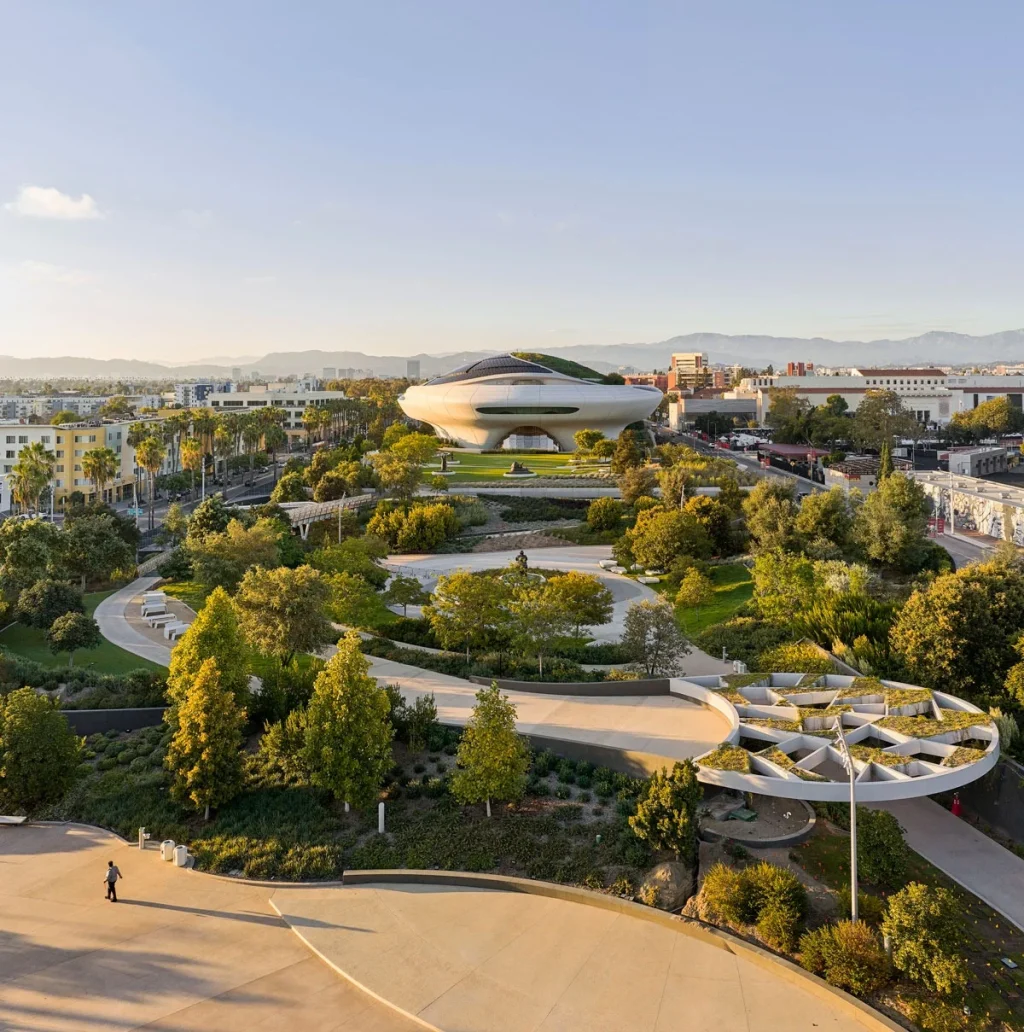
Yet, visitors arriving for the inaugural public opening days were met with an unexpected and jarring architectural reality. Rather than the sweeping, frictionless public thoroughfare envisioned by its designers, the expansive plaza surrounding the billion-dollar institution has been permanently fenced off. According to reports from the Los Angeles Times, temporary barriers lined with artificial plastic greenery blocked entryways to the plaza from both sides during the museum’s opening weekend.
Described by critics as a shockingly makeshift solution for an enterprise that cost over $1 billion to construct, these initial temporary barriers are slated to be replaced by permanent stainless steel gates. Representatives for both the museum and its design team have confirmed that the plaza’s main entryways will remain permanently gated off, transforming what was once hailed as an inviting civic gateway into a heavily controlled compound.
The decision has sparked immediate questions regarding the balance between modern urban security demands and the utopian promises of civic accessibility that typically accompany high-profile cultural developments.
A Shift From Civic Gateway to Gated Compound
When celebrated architect Ma Yansong, principal of MAD Architects, first presented the design for the Lucas Museum of Narrative Art, he described the sweeping outdoor plaza as a crucial "gateway" bridging the physical distance between the museum building and the surrounding urban fabric. It was meant to function as a seamless extension of the public parkland, inviting passersby to wander freely, gather, and engage with the environment without the formalities of museum admission.
However, as the project evolved through its final development phases, the practical realities of site management began to shift. Museum spokesperson Seth Fowler explained to the Los Angeles Times that the decision to enclose the plaza stems from a dual necessity: protecting pedestrians from fast-moving car traffic bordering the property on multiple sides, and managing visitor flow around the busy campus.
While unticketed visitors will still be permitted to enter the gated plaza, the museum’s on-site café, and the gift shop, the architectural barrier fundamentally alters the psychological relationship between the institution and the public.
Dixon Junliang Lu, a principal at MAD Architects, noted that the fence design naturally evolved over the course of the project as operational and security requirements became more rigorously defined. Despite these functional justifications, the transition has not gone unnoticed by architectural and cultural critics who argue that the physical interventions undermine the museum’s foundational ethos.
"What could have been a grand welcome has become a gated off, highly controlled space that now feels separate from the park and the neighborhood," the Los Angeles Times critiqued in its coverage of the opening. "Sure, anyone can come, but they are no longer invited."
Contradictions in a Public-Leased Space
The implementation of permanent fencing carries an added layer of irony given the favorable terms under which the museum occupies its land. The site for the institution is being leased from the state at a symbolic rate of just $30 a year. This heavily subsidized public arrangement was granted with the understanding that the museum would serve a broad, democratic mission: bringing popular visual storytelling, such as comic book illustrations, concept art, and iconic movie imagery, to the widest possible audience.
For a project explicitly founded to celebrate art derived from popular culture and everyday life, the presence of security gates creates a peculiar contradiction. Critics and urban observers point out that an institution dedicated to the "people’s art" should naturally embody a people-first spatial philosophy, rather than retreating behind defensive architecture.
This tension stands in stark contrast to the explicit promises made by museum leadership during the years leading up to the opening. In a 2020 interview with ARTnews, former museum director Sandra Jackson-Dumont emphasized the institution’s commitment to radical accessibility and community integration.
"We want to be a people-first organization," Jackson-Dumont said at the time, outlining a philosophy focused on meeting visitors wherever they are—physically, intellectually, and emotionally. "We want to be inclusive in a way that connects with who people are in their daily lives and what matters to them."
Those leadership ideals have faced several turbulence points in recent years. Jackson-Dumont ultimately departed from her role in 2025, leaving the institution to navigate its final operational transition under shifting administrative direction.
Broader Shifts in Mission and Public Engagement
The enclosure of the outdoor plaza is not the only way the Lucas Museum has recalibrated its approach to public engagement and education as it transitions from a construction project into a functioning civic institution. Over the past year, the museum’s internal operations have undergone substantial transformations that have drawn scrutiny from the cultural press.
In 2025, the institution implemented significant structural changes, including deep layoffs that cut roughly 14 percent of its full-time staff, with educational and public programming departments bearing a substantial portion of the reductions. These staffing shifts raised early concerns among arts advocates regarding the institution’s long-term capacity to execute robust community outreach programs.
Furthermore, visitors stepping inside the galleries have encountered a distinct curatorial philosophy that further distances the museum from traditional educational models. As noted in a critical review published by ARTnews, the museum has deliberately chosen to eschew didactic wall texts and explanatory labels throughout its exhibition spaces.
The institutional argument behind the design choice, confirmed by museum representatives, is that pure visual observation should be privileged above all else. While proponents argue that prioritizing direct looking allows viewers to forge unmediated connections with the artwork on display, critics have argued that this approach sidesteps another vital function of a modern museum: the production of shared knowledge and public education.
Art historians and cultural critics have long argued that a museum’s primary role extends beyond simply displaying objects; it involves providing the historical, cultural, and technical context necessary to help the broader public understand and interpret the works on view. By stripping away explanatory texts alongside the physical closure of its grand public plaza, the Lucas Museum of Narrative Art presents a complex portrait of a billion-dollar institution grappling with the delicate line between high-security operations and the promise of open, democratic cultural access.