By Pansy Schulman
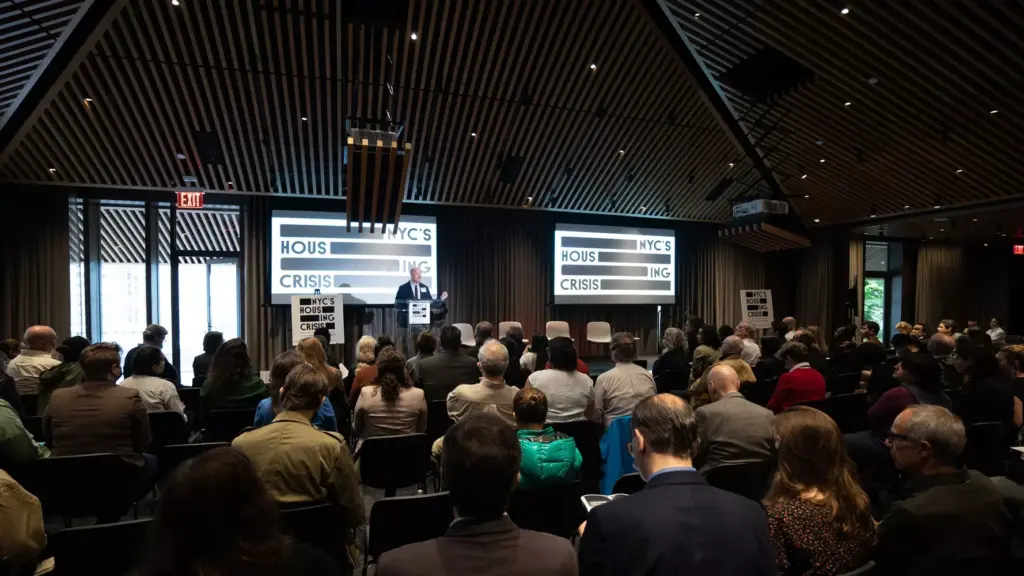
“In a way, architects know everything about affordable housing, and very little,” said Benjamin Prosky, executive director of AIA New York, as he kicked off a half-day conference titled “NYC’s Housing Crisis” held last week at the city’s newly opened Stavros Niarchos Foundation Library.
As a group, Prosky explained, architects naturally want to start where their expertise lies—designing their way out of a difficult situation. However, the conference, organized jointly by AIA New York and the Center for Architecture, functioned deliberately as a pre-design call to action. Rather than focusing solely on drafting tables and blueprints, the event brought architects together face-to-face with the policymakers, grassroots activists, and academic researchers who have spent years grappling with the crisis on the front lines.
The city’s housing emergency, evidenced by record-breaking rates of homelessness, a surge in evictions, and an ever-widening affordability gap, has been festering for years, if not decades. By the conclusion of Michael Bloomberg’s twelve-year mayoral administration in 2013, the economic disparity in New York City had reached stark proportions: the top one percent of wealthiest New Yorkers were estimated to be earning an average of 45 times more than the bottom 99 percent.

When Bill de Blasio assumed office, he did so carrying an ambitious promise to amend this deep-seated “tale of two cities.” Over the course of his two terms, the city recorded the creation or preservation of more than 465,000 affordable housing units. Yet, despite these substantial numbers, structural pressures persisted. More than half of all New Yorkers remain rent-burdened today, meaning they spend upwards of 50 percent of their total household income exclusively on housing. Meanwhile, rates of homelessness have climbed to historic highs. Now, at the dawn of a new mayoral administration led by Eric Adams—who has pledged $22 billion toward affordable housing over the next decade—housing advocates continue to warn that even these substantial financial commitments fall short of what is truly required to stabilize the market.
Opening the conference with an eloquent keynote address, New York Times architecture critic Michael Kimmelman offered a guiding perspective for the morning’s discussions, noting that “crisis is an opportunity for change.” It was a sentiment that would be echoed by numerous speakers throughout the event. Heavily centered on policy, economics, and systemic reform, the program was divided into three distinct panels. The first looked back at the historical origins and steady escalation of the crisis; the second examined current approaches and evaluated their effectiveness; and the third explored forward-looking models of urban development and design.
The Past: Defining the Roots of the Crisis
During the first panel, titled “The Past: Defining the Crisis,” three distinct speakers traced the historical roots of today’s urban emergency back to the 1970s. During that era, a severe municipal fiscal crisis forged a new, complex type of public-private partnership that permanently altered how New York City built and managed its real estate.
Ingrid Gould Ellen, faculty director of New York University’s Furman Center for Real Estate and Urban Policy, provided stark economic context. She noted that housing prices across the city have skyrocketed 20-fold since 1974, while median incomes over the same period have grown only 6.5 times. Ellen pointed to a compounding set of pressures, including shrinking amounts of developable land, decades of federal divestment from public housing programs, and rapidly accelerating wealth inequality. In her assessment, high-earning newcomers continue to drive up rents and purchase prices across neighborhoods, squeezing out long-term residents.

Moses Gates, vice president for housing and neighborhood planning at the Regional Plan Association, expanded the conversation to the physical utilization of the city’s built environment. “How we use space is part of the housing crisis,” Gates argued. He highlighted a troubling trend dating back to the 1980s: an increase in vacant residential units across the city, many of which serve merely as pieds-à-terre for wealthy individuals who reside elsewhere. Simultaneously, he noted, the city has experienced a steady erosion of robust rent-regulation protections.
The Present: Assessing What’s Working and What’s Failing
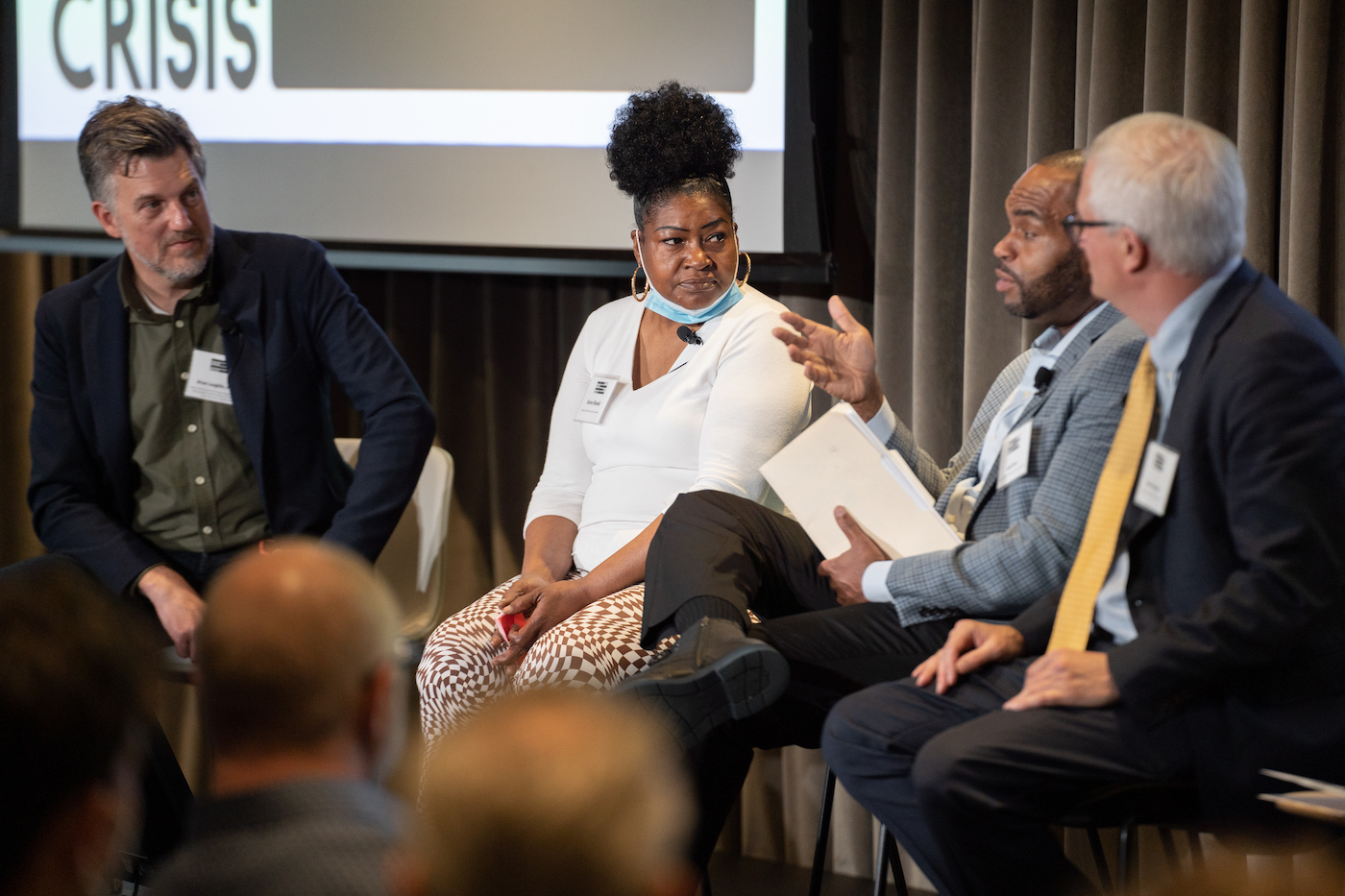
The second panel, moderated by Brian Loughlin, a principal at Magnusson Architects, was titled “The Present: What’s Working? What’s Not?” Loughlin opened the discussion by arguing that the true interests of everyday residents are frequently left unrepresented within the public-private partnerships that have come to dominate modern urban development.
Providing a legislative counter-perspective, State Senator Brian Kavanagh pointed to recent positive developments in state policy. Most notably, he cited the tenant protection laws passed in Albany in 2019, which represent the strongest legislative safeguards for renters in decades, alongside a renewed state government commitment to funding affordable housing initiatives. Joining the conversation, Jamie Smarr, president of the nonprofit developer National Housing Partnership, suggested that everyday New Yorkers possess a strong, practical understanding of why inclusionary zoning laws are necessary, pointing to the tangible triumphs of mandatory inclusionary zoning policies implemented across the city.
However, the most compelling and grounded voice on the panel belonged to Karen Blondel, founder of the Public Housing Civic Association. Blondel brought an essential frontline perspective to the proceedings, stressing that city policymakers must genuinely listen to public housing residents and bring them directly to the decision-making table. Drawing from her own lived experience, she spoke candidly about the severe physical decay, infrastructural neglect, and unsafe living conditions that she and her neighbors at the public Red Hook Houses in Brooklyn have been forced to endure over the past four decades. Blondel’s powerful presence ensured the panel remained firmly rooted in reality, countering the tendency of academic and policy conferences to drift into abstraction and hypothetical models.
The Future: New Models of Development and New Approaches
The final panel of the conference, “The Future: New Models of Development/New Approaches,” opened with remarks from Antonio Reynoso, who was elected Brooklyn borough president in 2021. Presenting himself as part of a rising generation of municipal officials who refuse campaign contributions from real estate developers, Reynoso launched a critique against what he termed the “YIMBY/NIMBY deaf loop”—a polarizing political dynamic that he argued continually stifles development and blocks the production of much-needed housing units.
Calling boldly for increased urban density, Reynoso urged the audience to embrace vertical growth. “We need height, we need a lot of it,” he stated plainly. “Height is the way out.”
Muzzy Rosenblatt, president and CEO of the Bowery Residents’ Committee (BRC), shared a successful, real-world case study during the discussion. Rosenblatt described an initiative in which he successfully convinced municipal leaders to subsidize the development and mortgage of a combined shelter and low-income housing project in the Bronx. By securing strategic municipal aid, BRC was able to generate enough revenue from the project to directly subsidize rent for formerly homeless individuals transitioning out of the shelter system and into permanent, stable homes within the 130-unit development. “We can design and build with dignity,” Rosenblatt argued, “and recapture profit to subsidize more units of housing.”
In his closing remarks, Benjamin Prosky emphasized that the conference, “NYC’s Housing Crisis,” serves merely as the launchpad for a much broader, long-term initiative spearheaded by the Center for Architecture and AIA New York. He announced that the NYU Schack Institute of Real Estate will publish a comprehensive report later this year to accompany and expand upon the findings of the event.
Ultimately, finding viable pathways toward affordable, equitable, and sustainable housing for all New Yorkers will require an unprecedented confluence of targeted public policy, grassroots activism, rigorous civic debate, and the dedicated technical support of the city’s design and architectural communities.
Architectural Record served as the official media sponsor for the conference. A full video recording of the event is available online.