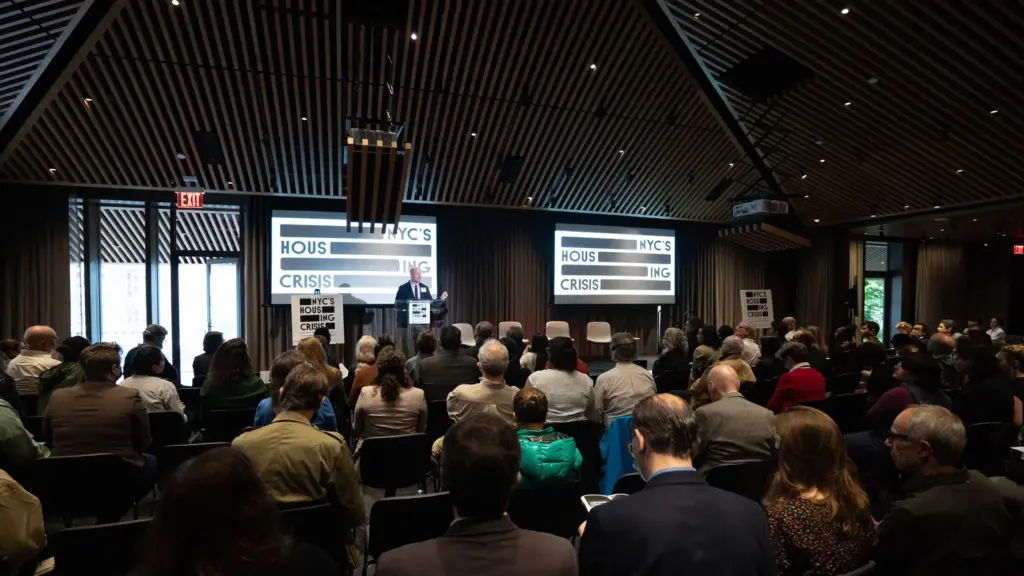
In a stark assessment of the metropolis’s enduring structural struggles, Benjamin Prosky, executive director of AIA New York, took the stage at the city’s newly opened Stavros Niarchos Foundation Library to issue a sobering pre-design call to action. Addressing a packed room of industry professionals, municipal leaders, and community advocates, Prosky captured the complex paradox facing the architecture profession as it attempts to address urban affordability.
"In a way, architects know everything about affordable housing, and very little," Prosky told the audience while kicking off the half-day conference titled "NYC’s Housing Crisis." He elaborated on the sentiment by noting that while design professionals naturally lean toward solving urban challenges through physical interventions and spatial creation, the current crisis requires an immediate and collaborative step backward to reevaluate the underlying economic, political, and historical drivers of the shortage. Rather than functioning as a standard showcase of architectural renderings and blueprints, the event—organized jointly by AIA New York and the Center for Architecture—was purposefully designed to bridge the gap between drafting tables and the front lines of policy, grassroots activism, and academic research.
New York City’s housing emergency is far from a recent phenomenon. It is an entrenched challenge characterized by record rates of homelessness, escalating eviction filings, and a widening economic chasm between the city’s highest and lowest earners. The roots of this crisis have been festering for decades across successive mayoral administrations. By the end of former Mayor Michael Bloomberg’s 12-year tenure in 2014, economic disparity had widened significantly, with estimates indicating that the top one percent of earners in New York City brought in an average of 45 times more than the bottom 99 percent.

When Bill de Blasio assumed office promising to bridge this wide-spanning "tale of two cities," his administration prioritized housing production, resulting in the creation or preservation of more than 465,000 affordable housing units across the five boroughs. Yet, despite these substantial output figures, the affordability metric remained persistently out of reach for a majority of residents. More than half of all New York City households continue to be classified as rent-burdened, meaning they spend upwards of 50 percent of their total household income exclusively on housing costs. Simultaneously, city shelter populations have soared to all-time highs. Now, at the dawn of the mayoral administration under Eric Adams—who has pledged an unprecedented $22 billion toward affordable housing initiatives over the coming decade—housing advocates and urban analysts warn that even this substantial financial commitment may fall short of meeting the staggering magnitude of the need.
Opening the conference with an eloquent keynote address, New York Times architecture critic Michael Kimmelman offered a vital perspective for the assembled professionals, asserting that a "crisis is an opportunity for change." Kimmelman’s observation set a constructive tone for the morning’s proceedings, which were heavily centered on the intricate intersections of public policy, real estate economics, and social equity. The conference was structured around three distinct panel discussions, methodistically exploring the historical origins of the crisis, the mixed effectiveness of current policy approaches, and innovative future models for urban development.
The first panel, aptly titled "The Past: Defining the Crisis," featured speakers who collectively traced the systemic architecture of today’s affordability emergency back to the turbulent fiscal crisis of the 1970s. During that era of municipal bankruptcy, the city forged a new, heavily privatized model of urban development and public-private partnership that permanently altered the housing landscape. Ingrid Gould Ellen of New York University’s Furman Center for Real Estate and Urban Policy presented alarming economic data during the session. Ellen noted that housing prices across New York City have skyrocketed by a staggering 20-fold since 1974, while median incomes over the same fifty-year span have increased by a mere 6.5 times. She attributed this dramatic imbalance to a combination of shrinking available land, retreating federal investment in public housing, and rapidly accelerating wealth inequality that allows high-earning households to continually bid up rents and purchase prices across competitive neighborhoods.
Adding historical and spatial context to the discussion, Moses Gates of the Regional Plan Association argued that the physical management and allocation of urban space are foundational components of the housing crisis. Gates highlighted a troubling trend dating back to the 1980s: a steady increase in the number of chronically vacant residential units throughout the city, many of which serve merely as part-time pied-à-terre investments for non-residents, paired with a simultaneous erosion of meaningful rent regulation protections.
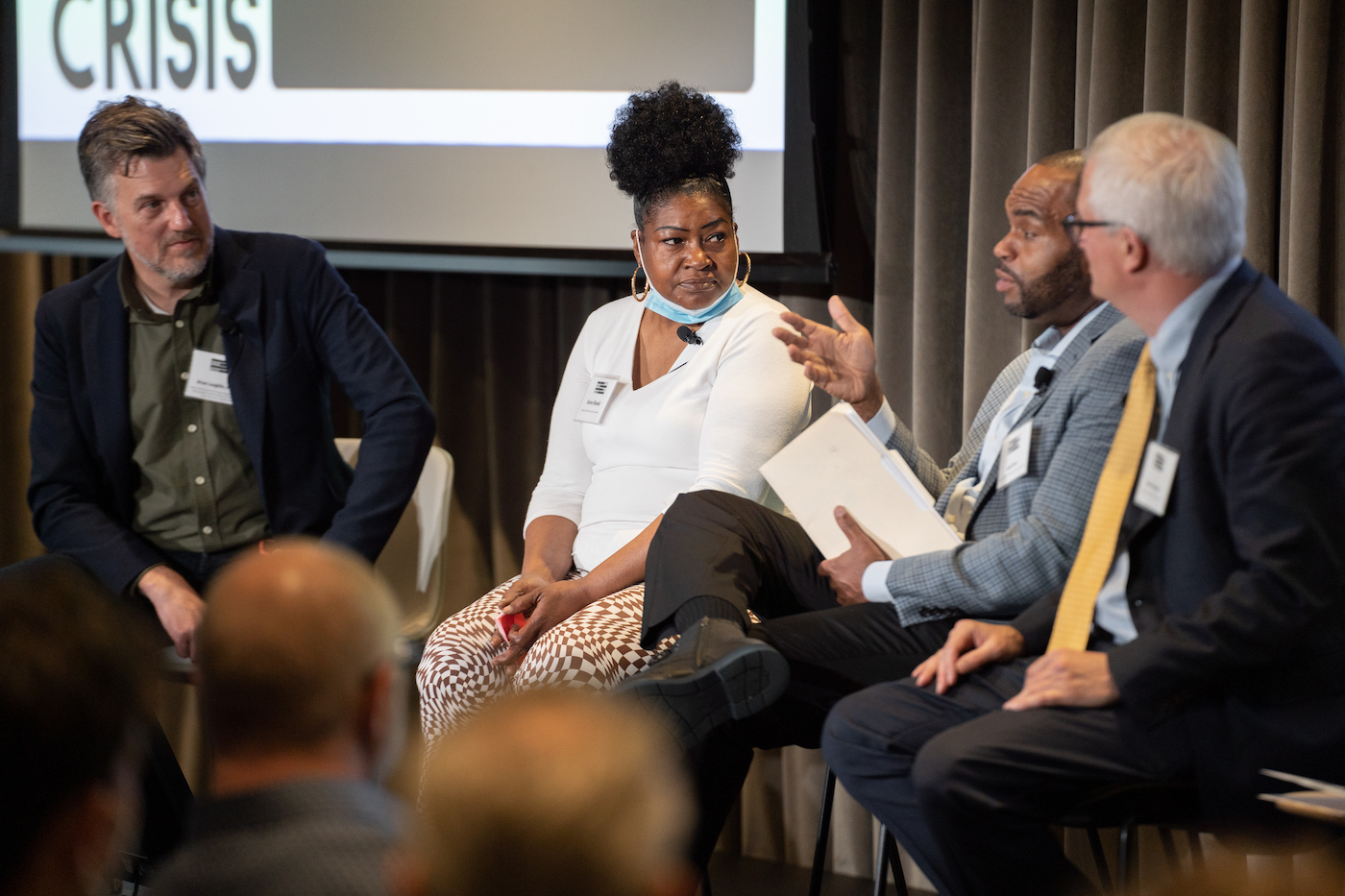
Moving from historical analysis to contemporary policy, the second panel—titled "The Present: What’s Working? What’s Not?"—was moderated by Brian Loughlin, a principal at Magnusson Architects. Loughlin launched the discussion by critiquing recent urban development paradigms, asserting that the true interests and daily needs of existing neighborhood residents have frequently been sidelined within the public-private partnerships that have dominated city planning for years.
Countering these concerns, State Senator Brian Kavanagh pointed to significant legislative victories that signal a shifting political tide at the state level. He highlighted the landmark tenant protection laws passed in 2019, widely regarded as the strongest tenant safeguards enacted in the state in decades, alongside the state government’s renewed fiscal and political commitment to financing affordable housing stock. Joining the conversation, Jamie Smarr of the nonprofit developer National Housing Partnership suggested that ordinary New Yorkers possess a remarkably high level of civic literacy regarding the necessity of affordable housing legislation, pointing to the broad public acceptance and ultimate triumph of mandatory inclusionary zoning laws across the municipality.
Perhaps the most resonant and grounding voice of the panel came from Karen Blondel, founder of the Public Housing Civic Association. Blondel brought an essential grassroots perspective to the proceedings, cutting through abstract policy debates by emphasizing that municipal policymakers must genuinely listen to public housing residents and secure them a permanent seat at the planning table. Drawing from her own lived experience, Blondel spoke candidly about the severe physical decay, infrastructural neglect, and unsafe living conditions that she and her neighbors at the Red Hook Houses in Brooklyn have endured over the past four decades. Her powerful intervention served as a crucial reminder of the human stakes involved when conferences drift into purely theoretical or academic realms.
The third and final panel, "The Future: New Models of Development/New Approaches," shifted the gaze forward, opening with remarks from Antonio Reynoso, the newly elected Brooklyn borough president. Presenting himself as part of a rising generation of municipal officials who refuse campaign contributions from the real estate industry, Reynoso delivered a direct critique of the traditional local zoning battles. He argued against what he termed the "YIMBY/NIMBY deaf loop," a polarized cycle of community opposition and defensive development that frequently stifles comprehensive planning and blocks the construction of vital new housing units. Challenging the low-density status quo in many neighborhoods, Reynoso made a passionate plea for vertical growth. "We need height, we need a lot of it," he declared to the audience. "Height is the way out."
Continuing the exploration of innovative development frameworks, Muzzy Rosenblatt, chief executive officer of the nonprofit Bowery Residents’ Committee (BRC), shared a successful case study demonstrating how creative financing can alter the trajectory of supportive housing. Rosenblatt detailed an initiative wherein his organization successfully convinced city agencies to subsidize both the development and the mortgage structure for a combined shelter and low-income housing project located in the Bronx. By leveraging municipal aid, BRC was able to generate sustainable revenue streams that directly subsidized permanent rent for individuals transitioning out of the shelter system into the 130-unit residential development. "We can design and build with dignity," Rosenblatt argued, "and recapture profit to subsidize more units of housing."
In his closing remarks, Benjamin Prosky underscored that the "NYC’s Housing Crisis" conference was intended merely as the opening salvo in a much broader, sustained initiative spearheaded by the Center for Architecture and AIA New York. He announced that a comprehensive research report produced in collaboration with the NYU Schack Center will be published later in the year to accompany the ongoing advocacy effort. As municipal leaders grapple with zoning reforms, tenant protections, and record-high housing costs, the morning’s discussions made it abundantly clear that charting viable pathways toward affordable, sustainable, and equitable housing for all New Yorkers will demand an unprecedented confluence of rigorous public policy, active community activism, and cross-disciplinary debate, supported steadfastly by the design and architecture community.